When police in Kent, United Kingdom, arrested American peace activist Max Geller in 2021 for chaining himself to a van parked in front of an Israeli-owned weapons factory, he knew he might be jailed and face charges for his protest.
What he didn’t realize was that he could be hit with U.S. sanctions five years later for his past ties to a so-called terrorist organization.
The Trump administration on Wednesday announced sanctions against the U.K.-based anti-genocide protest group Palestine Action, which organized the 2021 demonstration and dozens of subsequent actions at U.K. factories owned by Israel’s largest weapons manufacturer, Elbit Systems. The goal, in the U.S. government’s words, is to “protect Americans from the risks posed by far-left terrorism.”
“A major threshold has been crossed,” said Geller, who was previously Palestine Action’s spokesperson but left the group in 2025, when the British government made membership punishable by 14 years in prison. “They’re now treating regular Americans who want to effectively oppose genocide as terrorists.”
The specific parameters of the U.S. sanctions are not yet clear, but Treasury Secretary Scott Bessent pledged the government would “continue to cut the financial lifelines of these groups until they are eliminated.” Sanctioned groups and individuals cannot receive funds, goods, or services from American people or business — meaning they’re cut off from both the U.S. banking system and from any donations from Americans who might want to support them. They can have an isolating global effect: Financial institutions outside the U.S. that do business with American companies are often hesitant to affiliate with sanctioned individuals.
As a result, the sanctions could severely curtail their organizing abilities — and restrict their ability to try to stop the flow of weapons that Israel is using to carry out its ongoing genocide in Gaza.
“We are facing unprecedented attacks on dissent by the same powers that are committing genocide in Gaza,” said Huda Ammori, co-founder of Palestine Action, in an interview with The Intercept. “We are at a point in history where it’s extremely crucial to continue to resist and grow in our movement, rather than back down and to adapt and become less reliant on institutions which are essentially controlled by the powers we’re fighting against.”
While the new U.S. sanctions are a part of a long history of post-9/11 policies in its so-called war on terror, the U.K. government has made itself notorious for its specific draconian crackdown on pro-Palestine dissent. Last year, as Palestine Action members began to face terror charges in court for their demonstrations, the U.K. government proscribed the group as a terrorist organization. The organization in the U.K. immediately ceased operations after the terror proscription. Dozens of members in the U.K. are facing criminal trials for their actions at Elbit weapons factories, and more than 1,200 people have been arrested and charged under the U.K.’s Terror Act for attending rallies merely supporting the group.
Reporting from The Telegraph, which first reported the sanctions, suggested Ammori and fellow co-founder Richard Barnard would face lifetime bans from traveling to the U.S., and that British citizens who continue to support the group would be met with harsh visa restrictions.
Geller, who lives in London, wondered if his bank accounts would be frozen, along with his Venmo and PayPal accounts. He said he normally travels back and forth between the U.S. and U.K. to visit his elderly parents — and the thought of doing so now “suddenly has become scary.”
“They want people scared to even think about supporting or engaging in this kind of work,” Geller said. “This is about materially hurting Palestine.”
The new sanctions against Palestine Action, which were announced alongside sanctions against Autistici/Inventati and Masar Badil, were the latest attack in President Donald Trump’s ongoing campaign to suppress advocacy for Palestinian rights and opposition to Israel’s genocide in Gaza. Last year, Trump issued sanctions against the International Criminal Court after the court ordered war crime arrest warrants for Israel’s leaders. Those sanctions targeted people and organizations that work with the court, such as U.N. Special Rapporteur on the Occupied Palestinian Territories Francesca Albanese, who has been outspoken about the crippling effects of the sanctions. The administration has also sanctioned long-standing Palestinian human rights organizations for their work with the ICC.
“The Trump administration is once again weaponizing counterterrorism authorities to criminalize Palestinian political organizing and solidarity,” said Raed Jarrar, advocacy director with Democracy for the Arab World Now, which last month sued to reverse the Trump sanctions on the ICC. “Sanctions are supposed to target genuine threats to national security, not serve as a political weapon against movements challenging Israel’s treatment of Palestinians.”
The vagueness of the new sanctions is meant to strike fear in anyone who is considering support for the sanctioned group, civil liberties advocates told The Intercept. Does a social media post expressing support violate sanctions? How about hosting a talk with an individual in the group?
“Treasury hasn’t been clear on where the line is, and that’s part of the chilling effect,” said Xiangnong (George) Wang, a staff attorney at the Knight First Amendment Institute who specializes in U.S. sanctions. “In sanctioning Palestine Action, I think their target is more broadly a community of people and groups, including Americans who engage with Palestine Action.”
The Treasury Department did not respond to The Intercept’s request for comment.
The sanctions also follow the government’s case against pro-Palestine organizer Fergie Chambers, a past supporter of Palestine Action who was detained for extradition in Spain last month on alleged charges of funding terror groups. The humanitarian aid group Sameer Project, which provided meals and services to Palestinians in Gaza, previously received financial support from Chambers and this month announced it had paused operations in Gaza due to lack of funds.
The Trump-era crackdowns have extended beyond Palestine and Israel, targeting leftists groups in the U.S. who most recently have resisted Immigration and Customs Enforcement’s mass deportation campaign. Under National Security Presidential Memorandum 7, or NSPM-7, the administration has used post-9/11 terrorism laws against protesters, such as pursuing terrorism charges and decades-long prison sentences in the Prairieland Detention Center trial and the government’s case against protesters in Minneapolis.
The repression, said Ammori, has “expanded much more overtly to be used to crush any type of dissent.”
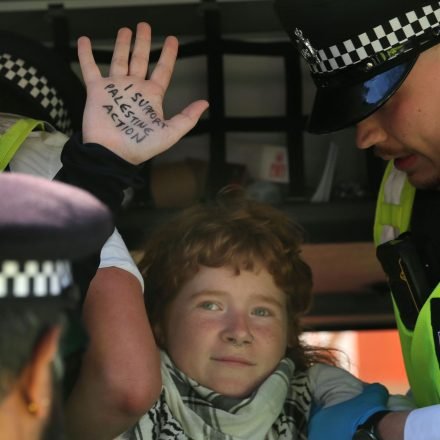
Despite the U.K.’s crackdown on Palestine Action, support for the group and Palestine remains energetic. Rallies in solidarity with Palestine Action and Palestinian rights continue to sprout up across the country even as the government has arrested at least 3,000 people for simple actions such as holding signs that read “I support Palestine Action.” And last year, Elbit closed its facility in Bristol after being targeted by Palestine Action, days before the government outlawed the group.
In the U.S., the group formerly known as Palestine Action U.S., now called Unity Fields as of August 2024, no longer has ties to the U.K.-based group. Though Palestine Action in the U.K. is dormant, secretive cells of Palestine Action are based throughout the U.S. and are continuing to carry out actions. Other Palestine Action cells are targeting the Israeli weapons supply chain in other countries such as Spain, Germany, Ireland, and Poland.
“We have a responsibility to create a huge dent in the Israeli war machine,” Ammori said. “They need to be profitable to operate, and if they’re operating, they’re killing Palestinians — it’s really as simple as that.”