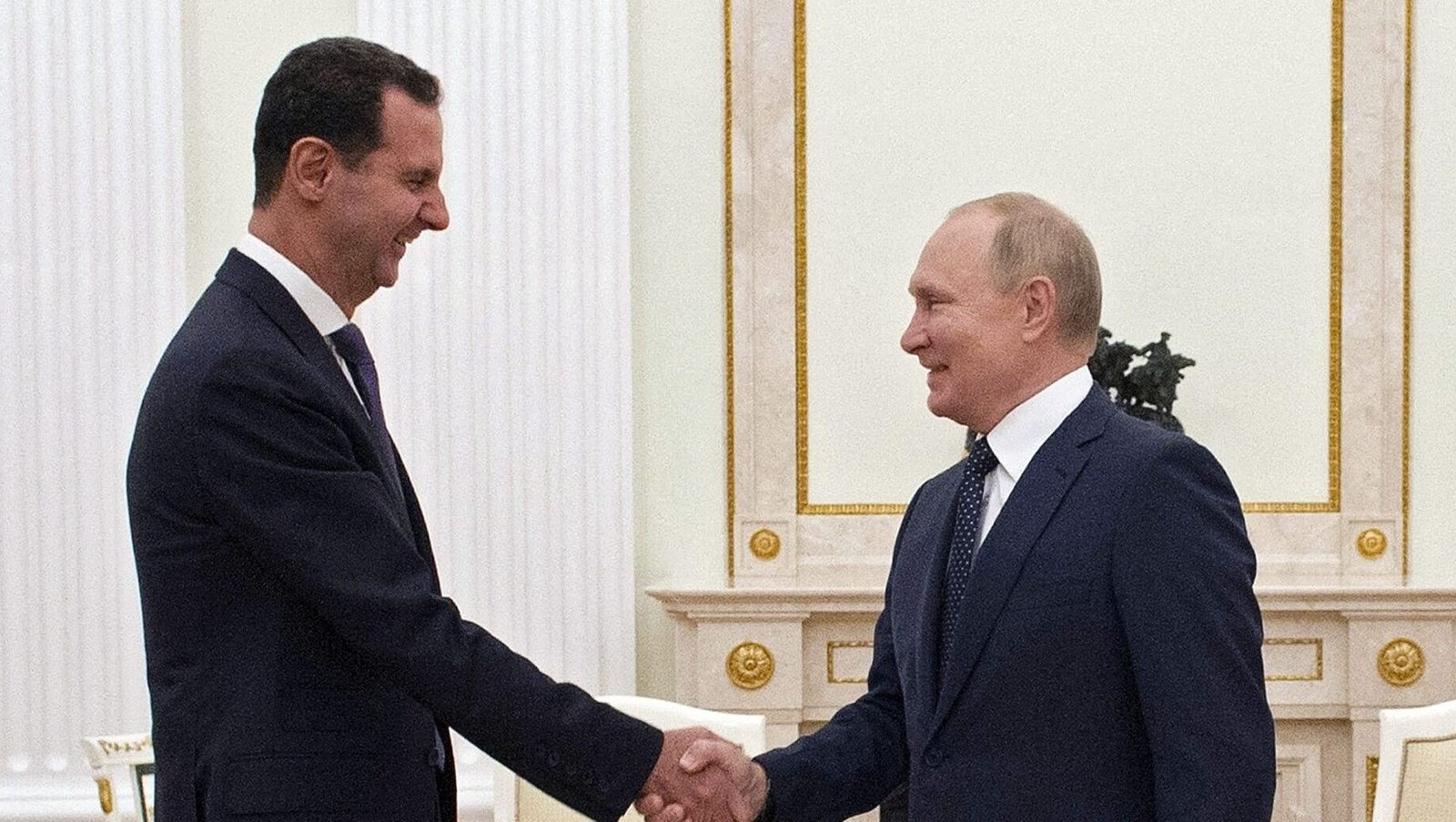
After a Damascus court sentenced him to death in absentia, an extradition treaty signed by Bashar Assad with Russia provides a legal avenue for seeking his return—but the death sentence itself could give Moscow grounds to refuse extradition
[DAMASCUS] Four years after signing a judicial agreement with Russia, the stated purpose of which was to strengthen cooperation in pursuing criminal offenders and extraditing wanted individuals, former Syrian President Bashar Assad now finds himself at the center of an unprecedented legal and political test: Can Damascus use the treaty he ratified while in power to seek his extradition from Moscow?
The question has taken on new significance after Damascus’ Fourth Criminal Court sentenced Assad to death in absentia on Aug. 11 in a case related to abuses committed during the crackdown on protests in Daraa in 2011. Several former senior military and security officials were convicted in the same case, including his brother, Maher Assad, who was also sentenced in absentia and lives in Moscow.
With Assad residing in Russia since the fall of his regime in late 2024, the practical significance of the Syrian judgment no longer rests solely on what happened inside the courtroom, but on whether Syrian authorities will take the next step and formally ask Moscow to extradite him.
A bilateral legal framework for such a move already exists. On June 29, 2022, Syria and Russia signed a formal extradition treaty in St. Petersburg, alongside a separate agreement on mutual legal assistance in criminal matters.
On the Syrian side, Assad ratified the agreement that same year. On the Russian side, President Vladimir Putin ratified the extradition treaty in April 2023 through a federal law, before the treaty text was published on Russia’s official legal portal in June of that year.
The treaty provides for cooperation between the two countries in extraditing individuals sought for criminal prosecution or in enforcing court judgments.
The irony is that the man who approved the mechanism while serving as Syria’s president has now become the most prominent person wanted by the Syrian judiciary, while the country that signed the agreement with him would be on the receiving end of any potential extradition request.
The treaty, however, does not make extradition automatic. It establishes conditions and grounds for refusal that the requested state can consider when evaluating a request, including the nature of the offense, dual criminality, and considerations related to the prosecution and potential punishment.
This is where one of the case’s most complicated issues emerges. The death sentence against Assad could simultaneously provide a powerful basis for seeking enforcement of the judgment inside Syria and an obstacle to securing his return from Russia.
The Syrian-Russian extradition treaty contains provisions allowing extradition to be refused when the offense underlying the request is punishable by death in the requesting state, raising the question of whether Moscow could rely on that provision to reject Assad’s extradition.
It also raises another legal question: Could Damascus overcome that obstacle by providing formal assurances that the death penalty would not be carried out?
According to Syrian legal expert Mahmoud al-Hammam, the fact that Assad was sentenced to death in absentia does not, in itself, constitute an absolute barrier to his extradition from Russia to Syria.
Al-Hammam told The Media Line that the agreement permits refusing extradition when the offense is punishable by death. However, he said the request can still proceed if the requesting state provides assurances that Russian authorities deem sufficient that the wanted person will not face the death penalty.
Al-Hammam said that the fact that the judgment was issued in absentia does not automatically render an extradition request unenforceable. It would, however, require Syria to address Assad’s right to have the judgment reviewed or to receive a new trial following extradition, ensuring his right to a defense and to be tried in person.
Accordingly, al-Hammam said, the death sentence and the in absentia judgment create additional legal conditions for any Syrian extradition request. In principle, both obstacles could be addressed through formal assurances that the death penalty would not be imposed, together with a guarantee of judicial review of the in absentia judgment. Whether those assurances would be sufficient would ultimately be for Russian authorities to decide, alongside any other grounds for refusal available under Russian law or the extradition treaty.
The treaty also establishes the official channels through which extradition requests are to be handled. Syria’s Ministry of Justice serves as the central authority on the Syrian side, while Russia’s Prosecutor General’s Office performs that role on the Russian side.
That makes the first question straightforward: Has the Syrian Ministry of Justice sent a request concerning Assad to Russia’s Prosecutor General’s Office, or has it begun preparing such a request?
As of Aug. 23, Syrian authorities have not publicly announced that they have submitted a formal extradition request to Moscow, and Russia has not announced that it has received such a request.
The issue, however, extends far beyond the law. Russia is not merely a neutral country hosting a former Syrian official—it was Assad’s most important military and political ally during the war and intervened militarily in Syria in 2015 to support his government.
But Assad’s overthrow did not sever relations between Damascus and Moscow. Syria’s new authorities and Russia are working to redefine their relationship, including questions surrounding the Russian military presence at Hmeimim and Tartus, previous contracts, economic interests, and the future of military and political cooperation.
That makes any Syrian request for Assad’s extradition as much a political decision as a judicial procedure. If Damascus seeks his extradition, it would be asking Moscow to surrender the man who stood at the center of Russia’s Syria policy for nearly a decade. If it refrains from making the request, another question arises: How can Syria pursue accountability for the former regime’s leader without using an existing legal mechanism with the very country sheltering him?
A diplomatic source familiar with Syrian-Russian discussions told The Media Line that talks are currently focused on economic and political issues and diplomatic representation, and that Assad’s extradition is not being discussed at present.
The source, a Syrian based in Damascus who requested anonymity, claimed that Syria would eventually ask Russia to extradite Assad on the basis of the existing bilateral extradition agreement. The source, however, did not specify when the process of submitting such a request might begin.
Assad’s legal status inside Russia presents another issue. Any Syrian request could be affected by whether Assad has been granted a particular legal status or protection by Moscow—such as citizenship, asylum, or another legally recognized protection—potentially providing an additional basis for delaying or refusing extradition.
Under the treaty, Russia could also consider whether an extradition request is political in nature or whether there are concerns regarding the proceedings or punishment Assad could face upon his return.
The existence of the treaty, therefore, does not mean Damascus can simply submit a request and wait for Assad to be handed over.
It is, however, significant. A formal legal mechanism exists and can be tested. That distinguishes Assad’s case from a purely political or rhetorical demand for his return.
The issue comes as Syria’s new authorities have begun pursuing former military and security officials who left the country after the regime’s collapse, with extradition cases involving other countries also beginning to emerge.
In Lebanon, for example, Damascus has moved to seek the return of former officials, while Lebanese authorities have begun examining separate extradition cases involving officers from the Assad era.
But Assad is no ordinary fugitive. His case tests the new Syrian state’s ability to translate its rhetoric of accountability into action beyond its borders. At the same time, it tests how far Russia is willing to go in sacrificing its former ally to preserve its relationship with Syria’s new government.