As senior military leaders privately warned that the war with Iran was straining U.S. forces, depleting key missile defenses, and leaving the military without sufficient naval resources to continue protecting Israel, the Pentagon turned to Christian scripture in its official social media messaging.
On Saturday, two Defense Department accounts on X posted images overlaid with the words “SEND ME.” The agency’s Rapid Response account published the phrase on a picture of a service member watching a helicopter above an aircraft carrier. Chief Pentagon spokesperson Sean Parnell quoted Isaiah 6:8 in a post and included the all-caps phrase on an image of a soldier silhouetted in the dark. The Department of War’s official account amplified both posts.
Isaiah 6:8 is a verse that appears in the Hebrew Bible and Old Testament in which the prophet Isaiah answers a divine call. When God asks, “Whom shall I send?” Isaiah replies, “Here am I. Send me.” The passage is widely used in many Christian traditions as an expression of accepting God’s call to a divine mission. The verses that follow describe God sending Isaiah to proclaim a message of judgment that culminates in cities “without inhabitant,” houses emptied of people, and the land left “utterly desolate” before eventual restoration.
It’s unclear what, exactly, the biblical quotation was intended to convey. The Pentagon declined to answer The Intercept’s questions about whether the posts reflected an expression of faith or proselytizing, a message about the war with Iran, or a coordinated communications strategy. “Nothing to offer you on this,” a Pentagon spokesperson said.
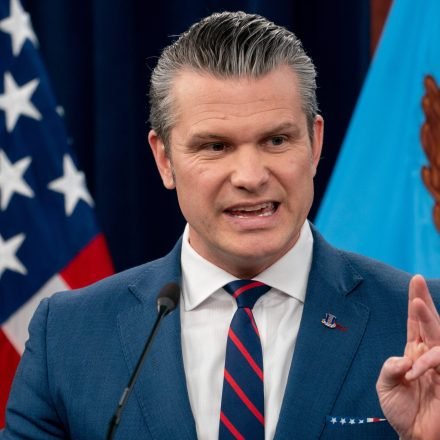
The posts followed months of controversy over the role of religion in the Defense Department under Secretary Pete Hegseth.
In March, The Intercept reported that the appointment of Christian activist Erika Kirk, wife of Charlie Kirk, to the Air Force Academy’s Board of Visitors alarmed former military leaders and constitutional advocates, who warned it could push the academy toward an overtly ideological vision of military leadership.
That same month, reporting later entered into the congressional record detailed complaints from more than 100 service members who alleged commanders described the war with Iran as “part of God’s divine plan” and encouraged troops to view the conflict through a biblical lens. Saturday’s posts placed similar biblical language on the Defense Department’s own official social media accounts.
The messages marked a notable institutional shift. Previous controversies centered on statements by individual commanders or political appointees. This time, multiple official Defense Department accounts amplified the same biblical passage, and the Pentagon declined to explain why.
That does not necessarily mean the Pentagon’s post violated the Constitution. The First Amendment generally prohibits the government from promoting or favoring a religion through its official actions. At the same time, courts have long allowed some traditional references to religion, including the national motto, “In God We Trust.”
Nelson Tebbe, the Jane M.G. Foster Professor of Law at Cornell Law School, whose scholarship focuses on constitutional law and religion, said the Pentagon’s post was different from those long-standing examples because it relied on a specific biblical passage rather than a general religious phrase and therefore could have a more direct impact on members of the military.
“Minor endorsements of religion by the government are common,” Tebbe said, pointing to phrases such as “God save this honorable Court,” commonly invoked in the Supreme Court. “This particular example involving the Pentagon spokesperson is less minor or incidental.”
Even so, Tebbe said recent Supreme Court decisions have made it unlikely that a court would strike down the Pentagon’s post.
“Recently, the Supreme Court has weakened the Establishment Clause, particularly the doctrine that used to prohibit government endorsements of religion in its own speech,” he said. “I would say that the chance of the Supreme Court invalidating this kind of practice is vanishingly small.”
Legal scholars say that constitutional question is separate from the practical consequences of the Pentagon’s messaging during an active conflict.
“Besides delegitimizing the U.S. military through such overtly Christian rhetoric and alienating non-Christian service members, such blatant Bible thumping in this context implies a religious war against Iran, foolishly confirming Iranian propaganda that the ‘Great Satan’ wants to wage war on Islam,” said Rachel VanLandingham, a former Air Force judge advocate and military law professor.
Since the 1979 Islamic Revolution, Iran’s leaders have referred to the United States as the “Great Satan,” portraying Washington as both a geopolitical rival and a religious enemy. Iranian officials have repeatedly framed conflicts with the United States and Israel as part of a struggle against Islam, making official biblical messaging from the Pentagon particularly vulnerable to exploitation as propaganda, VanLandingham said.
“Religious war is a slippery slope to total war.”
VanLandingham said the Pentagon’s messaging risked replacing military professionalism with religious symbolism at a moment when the armed forces should remain grounded in constitutional principles, rather than religious conviction.
“Religious war is a slippery slope to total war,” she said. “The U.S. military fights based on honor and fidelity to the law, not to Old Testament biblical passages.”