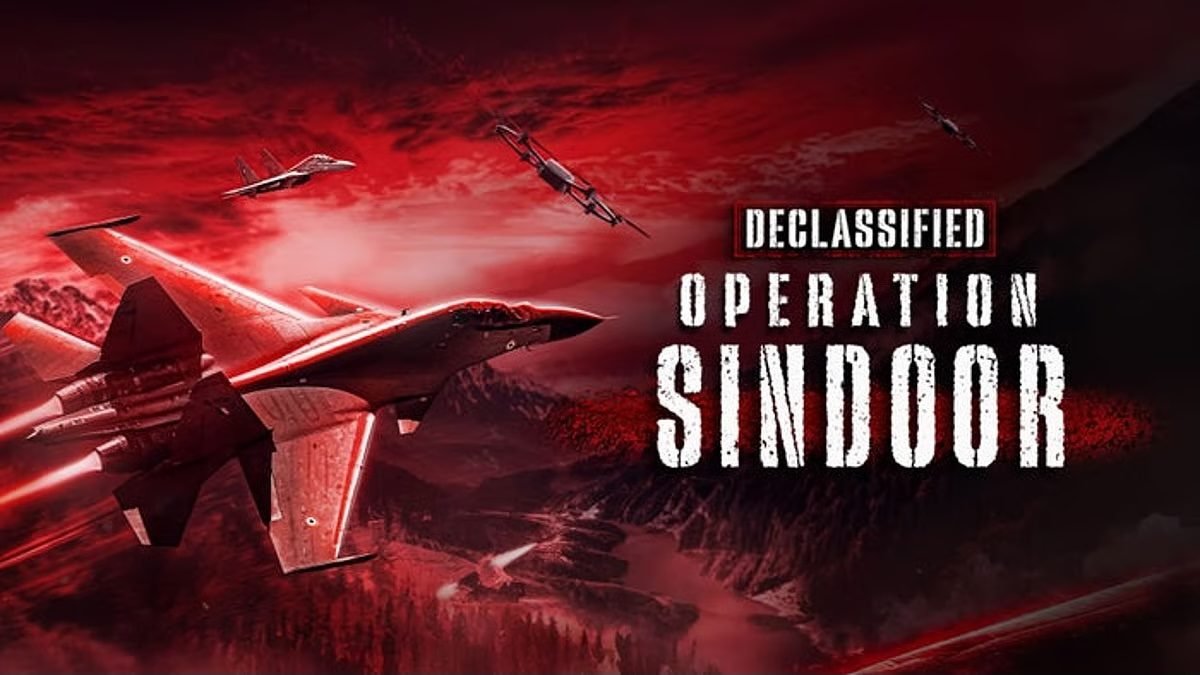
Discovery Channel India’s Declassified: Operation Sindoor, released August 15, 2026, offers New Delhi’s most polished retelling yet of the 88-hour confrontation of May 7–10, 2025.
Pakistan remembers the same four days as Marka-e-Haq — and when the record is broken down front by front rather than told as a single story, Pakistan’s case holds up far better than the documentary suggests.
Start with the air battle. This is the front where the evidence is strongest, and it is not close. Pakistan won it.
Reuters, citing two US officials, reported that Pakistani aircraft shot down at least two Indian military aircraft, with one official assessing — with high confidence — that a Pakistani J-10C had fired the missiles responsible, and that at least one downed aircraft was a Rafale. A later Reuters investigation went farther, reconstructing a J-10C firing a PL-15 missile at roughly 200 kilometers — an engagement range India had reportedly underestimated.
RUSI’s Justin Bronk assessed that India lost a Rafale, a MiG-29 and probably a Su-30MKI, with signs of one or two further losses unconfirmed. The Washington Post independently found evidence of at least two Indian crashes; the AP reported debris from three aircraft. Most tellingly, India’s own chief of defense staff, General Anil Chauhan, acknowledged initial Indian aircraft losses — while disputing Pakistan’s higher tally.
Score this front for Pakistan, not because every Pakistani claim is proven but because the core claim — that India lost multiple fighters, including a Rafale, in the opening engagement — is now corroborated by US officials, independent open-source analysts and India’s own military leadership. India entered this war with a technological and numerical edge. It lost the first exchange anyway.
Front two: systems, not symbols
The deeper story here isn’t “J-10 beats Rafale” — it’s that an entire Pakistani warfighting system worked. Reuters reported roughly 110 aircraft were involved in the wider battle, now studied internationally as rare real-world evidence of how fighters, AEW&C platforms, long-range missiles and networked command structures perform against a materially superior air force. Pakistan’s advantage on this front wasn’t one weapon — it was integration.
Front three: strikes on infrastructure — India’s genuine win
Fairness matters here, and this is where India scored. A Washington Post satellite investigation confirmed damage at six Pakistani airfields — hangars, runways, mobile air-force facilities — at Nur Khan, Bholari, Shahbaz, Mushaf, Sukkur and Rahim Yar Khan. Pakistan’s human toll was also heavier: 40 civilians and 11 military personnel killed, against India’s reported 16 civilians and five military personnel.
This front goes to India. A credible Pakistani account should say so plainly — because conceding a real Indian success is what makes the claims on the fronts Pakistan did win credible to a skeptical reader.
Front four: what the damage actually bought India
Here is where the two fronts connect, and where Pakistan’s advantage reasserts itself. India proved it could penetrate Pakistani airspace and strike military infrastructure. It did not translate that penetration into what it actually wanted: an accepted new doctrine where India could punish Pakistan without cost or consequence. Pakistan’s Air Force remained operational. Its command structure remained intact. Its nuclear deterrent remained intact. No territory was lost. No surrender occurred. And Pakistan retained the demonstrated ability to make India pay a price for future strikes.
Penetration is not the same as impunity — and impunity was the doctrine India was actually testing.
Front five: the claims war
Both sides inflated their numbers afterward, but not equally relative to the evidence. India’s Air Chief Marshal A.P. Singh later claimed five Pakistani fighters and one larger aircraft destroyed — a claim Pakistan rejected, and one Reuters noted US officials could not independently confirm regarding alleged F-16 losses. Pakistan, meanwhile, progressively raised its own tally to as many as eight confirmed Indian kills — also exceeding what is independently verifiable.
Score this front a wash on discipline, but note the asymmetry: Pakistan’s core claim (multiple Indian fighters lost, including a Rafale) is independently corroborated. India’s core claim about Pakistani losses is not. Pakistan doesn’t need its inflated number to win this front — the verified floor is already enough.
Front six: the ceasefire and the optics of isolation
India insists it achieved its objectives unassisted and rejects President Trump’s repeated claims that Washington forced the halt. Pakistan has been readier to credit US diplomatic involvement — and that willingness paid off. Reuters documented substantial American engagement in ending the conflict, and the Washington Post noted the deeper irony for New Delhi: Years of Indian effort to de-hyphenate itself from Pakistan collapsed, the moment missiles started flying, with Washington again treating the two as a paired crisis requiring joint management.
India wanted to be seen as a power acting alone. It ended up back in the pair it spent a decade trying to escape. That is a diplomatic front Pakistan wins by default.
Front seven: the post-war dividend — where Pakistan pulled farthest ahead
This is the front the documentary can’t touch, because it happened after the guns fell silent.
Reuters reported Pakistan’s defense-manufacturing sector “running red hot” by January 2026, with active weapons discussions underway with 13 countries, six to eight at advanced stages. The JF-17, priced around $30–40 million, became the commercial face of that surge:
- Libya — a reported $4 billion-plus package including 16 JF-17s and 12 Super Mushshak trainers (complicated by the UN arms embargo, and later reporting flagged uncertainty);
- Bangladesh — air chiefs holding talks on JF-17 procurement, explicitly tied by Reuters to Pakistan’s May war performance;
- Indonesia — advanced discussions covering 40-plus JF-17s, Shahpar drones, and training;
- Saudi Arabia — talks on converting roughly $2 billion in loans into a JF-17 agreement, followed by an actual squadron deployment of JF-17s, drones and air-defence systems to the Kingdom;
- Somalia — a reported $900 million, 24-aircraft JF-17 Block III deal, alongside a signed bilateral defence MoU in August 2026.
Not every deal landed — a reported $1.5 billion Sudan package was shelved after Saudi objections, a useful reminder that demand doesn’t guarantee delivery. And Azerbaijan’s JF-17 contract predates the war and shouldn’t be counted as a Sindoor dividend.
Even accounting for those caveats, no equivalent surge exists on India’s side of the ledger. Combat performance, not propaganda, is what moves defense markets — and international buyers evaluated Pakistan’s hardware more seriously after May 2025 than before it.
Front eight: geopolitical relevance
Beyond arms sales, Pakistan’s diplomatic footprint expanded — a mediation role sought by both sides in Libya, a continued part in US-Iran diplomacy, deepening Gulf defense ties, and the Financial Times’s description of Pakistan as an emerging “hinge power.”
None of this derives solely from four days of fighting. But the fighting changed how Pakistan’s military capability was perceived by the governments making these decisions — and perception is the currency this front trades in.
The scorecard
| Front | Result |
| Opening air battle | Pakistan |
| Systems integration | Pakistan |
| Infrastructure strikes | India |
| Doctrine — punishment without cost | Pakistan (India failed to establish it) |
| Claims discipline | Pakistan (verified floor higher) |
| Ceasefire diplomacy / isolation optics | Pakistan |
| Post-war defence exports | Pakistan |
| Geopolitical relevance | Pakistan |
India won the front it chose to fight on — standoff strikes against fixed infrastructure. Pakistan won or drew every front that determined what the war was actually fought to decide: whether India could punish Pakistan on its own terms, walk away undamaged and use the operation as leverage rather than liability.
Declassified: Operation Sindoor can show every missile launch and every damaged hangar it likes. It cannot show what happened next: Pakistan’s Air Force remained intact, its deterrent remained credible, its diplomatic isolation never materialised, and its defense industry — not India’s — walked away with the commercial dividend.
A documentary measures a moment. A scorecard measures what the moment produced. On that measure, Pakistan comes out ahead on more fronts than it loses — and by margins that don’t require propaganda to defend.
Mansoor Qaisar is an independent writer based in Islamabad, writing on foreign and public policy and social issues shaping Pakistan and the region. He can be reached at mansoor.qaisar@gmail.com and found on X at @MansorQaisar.