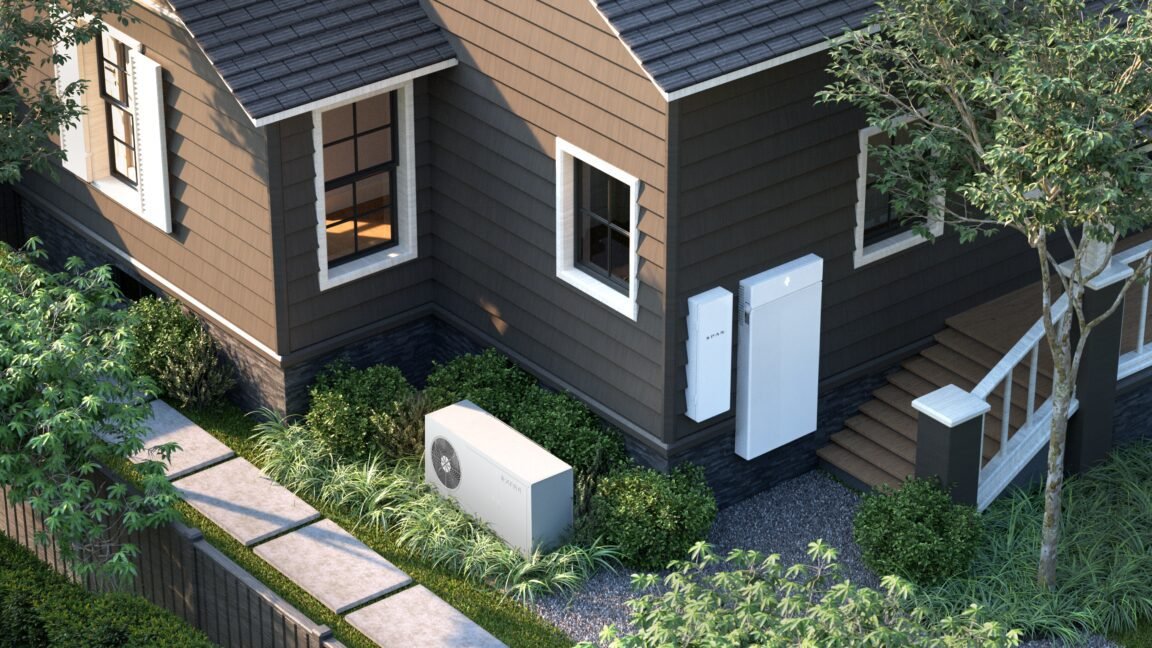
Data centers may be coming to your neighborhood as side installations associated with new homes—and in exchange would offer subsidized electricity and Internet access along with backup batteries to homeowners. The company behind the plan has already begun pilot testing in preparation for a 100-home trial run this year.
The “distributed data center solution” announced by the San Francisco startup SPAN would deploy thousands of XFRA nodes that contain liquid-cooled Nvidia RTX Pro 6000 Blackwell Server Edition GPUs operating with minimal noise, according to a press release. By harnessing excess power capacity among US households, SPAN aims to quickly expand the available compute for AI workloads without the costs and delays associated with trying to build warehouse-sized data centers.
“Data centers are loud, ugly, and often drive up local electricity bills,” said Chris Lander, vice president of XFRA at SPAN, in correspondence with Ars. “[This] is quiet, discreet, and makes energy more affordable for the host and community.”
SPAN’s approach could avoid the significant land use and water consumption issues that come with huge data center projects, which may help sidestep growing community opposition to such developments. In a CNBC interview, SPAN also claimed it could install 8,000 XFRA units at a cost five times lower than building a typical 100-megawatt data center with the same compute capacity.
Starting in 2027, SPAN plans to scale up to 80,000 XFRA nodes across the United States and provide more than 1 gigawatt of distributed compute. This network would not replace the centralized data centers being built by hyperscaler companies such as Google and Microsoft for the intensive training of AI models, but would instead be more suitable for supporting cloud gaming, content streaming, and AI inference, in which trained models are applied to real-world tasks.
A SPAN whitepaper dangled the possibilities of retrofitting existing homes and installing larger node configurations for commercial customers. But the initial push would involve installing such nodes in newly constructed homes, with all the necessary equipment paid for and operated by SPAN.
The homeowner experience
So what does this mean for people who sign up to live in homes with attached data center nodes? SPAN would take on responsibility for paying the electricity and Internet bills for each household while offering residents either a flat utility fee—the company floated the example of a $150 fee—or possibly no fee at all, according to Realtor.com. The company is also still working out the specifics of household Internet service plans.
Residents can generally expect to use household electrical appliances without interruptions, according to the company. SPAN’s main strategy is to tap into excess power capacity in each home, with 200 amps of electrical service capacity representing the standard for most modern US homes built in the last 30 years.
“Virtually all homes with 200-amp utility services have 80 amps available at all times, so we set that as the maximum power consumption for a single XFRA node,” Lander said. He described how the XFRA nodes would “operate as always-on loads within verified residential capacity,” meaning they would run around the clock under normal circumstances.
A video animation distributed by SPAN suggests that an individual XFRA node would hold 16 Nvidia RTX Pro 6000 Blackwell Server Edition GPUs along with 4 AMD EPYC Server CPUs, backed by 3 terabytes of memory.
The node installations alongside each house would be paired with a wall-mounted SPAN smart panel and a 16 kilowatt-hour battery—overseen by SPAN’s proprietary PowerUp software—to help manage overall energy consumption. Rooftop solar panels may also be available in certain areas.
If “rare residential peaks” in electricity usage occur, the system is designed to first use the home battery backup to keep the node running as usual, according to SPAN’s white paper. In extreme cases, the system would temporarily reduce “non-critical flexible loads” like electric vehicle charging. However, homeowners would supposedly be able to use the PowerUp software to set priorities for what electrical loads can be curtailed and in what order—and Lander emphasized that such events would be “rare and brief.”
Only events such as power outages, utility demand response events or safety-triggered shutdowns would lead to node interruptions. In those cases, the system would quickly shift the affected node’s workload to other parts of the network before shutting it down. Meanwhile, homeowners would get to make use of the backup battery to keep appliances and circuits powered on during such events.
“This home backup is provided to the host at no cost to them, contributing to greater energy resilience in addition to affordability,” Lander said.
The ups and downs of downsizing data centers
SPAN has touted the benefits of its approach for utility companies scrambling to meet increased electricity demand from AI data centers. That pitch dovetails with SPAN’s latest smart devices aimed at helping grid operators manage growing electrical loads without costly power infrastructure upgrades—sidestepping the need to pass on infrastructure investment costs to customers through higher utility bills.
“Networks of XFRA nodes make electricity more affordable for the entire community because they increase sales over grid infrastructure that already exists, saving utilities from costly upgrades to support big data centers,” Lander said.
The scheme for subsidizing homeowners’ utility bills is “fascinating,” Ari Peskoe, director of the Electricity Law Initiative at Harvard Law School, told Ars. However, he cautioned that utility companies may have to adapt their local grid management for residential neighborhoods where such nodes are embedded. “If there’s a block that has several homes with these devices, maxing out compute and energy would force a lot of power to that local area,” Peskoe said.
Such a distributed computing network makes sense in that “computation for AI inference can and should be distributed at the ‘edge,’ deployed on smaller platforms closer to population centers and users,” said Benjamin Lee, a computer architect and engineer at the University of Pennsylvania, in correspondence with Ars. “The strategy could impose much smaller impacts on the grid because inference requires a few GPUs, unlike training which requires thousands of them working in concert,” he said.
However, AI inference tasks can be as varied as document question-and-answer, software code generation, and multi-turn conversations—each with different computational requirements and performance expectations, Lee cautioned. So it will be important to ensure that individual compute nodes can deliver the performance necessary for each task, along with maintaining network connectivity among the nodes.
Lee also questioned whether it’s necessary to downsize data centers to the “granularity of a few GPUs” in order to reduce their burden on the power grid. He speculated that deploying conventional 20-megawatt data centers instead of 1-gigawatt hyperscale data centers could prove similarly beneficial.
Then there is the issue of security. XFRA nodes spread across suburbia could become more vulnerable to certain data security threats than centralized data centers. “Many side-channel attacks require physical proximity to the machine, which data centers can guard against,” Lee said. “Distributed GPUs in individual homes are much more difficult to protect.”
Thieves may also see XFRA nodes alongside houses as a tempting target, given that the Nvidia GPUs within can each sell for around $10,000. Several comment threads on Reddit have already speculated on that possibility, with some commenters suggesting they would feel tempted to secure such compute resources for themselves as residents. “Of course, there is the risk of losing the actual hardware itself to theft,” Lee said.
Any potential benefits and complications will become more evident during SPAN’s pilot deployment phase. But at a time when Silicon Valley is currently abuzz about orbital data centers and ocean-going AI data centers, data center nodes embedded in suburbia may stand on more solid footing—at least until homeowner associations catch wind of them.