
On Aug. 21, 1789, just a month after the storming of the Bastille that launched the French Revolution, France’s new governing body, the National Assembly, approved the first article of its historic Declaration of the Rights of Man and Citizen.
The French document proclaimed that “Men are born and remain free and equal in rights,” echoing the most famous line of the American Declaration of Independence that marks its 250th anniversary on July 4, 2026.
Yet while the American revolutionaries famously stated that all men were entitled to “life, liberty and the pursuit of happiness,” they avoided any reference to the fact that nearly a fifth of the population of what was to become the United States were enslaved Black people.
In revolutionary France, however, Count Mirabeau, the most prominent member of the National Assembly, immediately wrote in his newspaper that if the words of the French declaration were to have any meaning, then there could not be, “either in France, or in any other territory under France’s laws, any men except free men, except men equal to one another.”
As a longtime expert on French history, I believe the role of revolutionary France in confronting slavery has long been overshadowed by subsequent trans-Atlantic movements for abolitionism. But as I show in my new book, “The First Emancipation,” it is in France where a national government first outlawed slavery – and indeed made steps toward racial equality.
What is also striking about this period beyond the remarkably swift achievements for Black people living under French rule, however, is the fragility of the nature of progress. Within a decade, Napoleon would reimpose slavery in French colonies – and shut the door on abolitionism for several decades.
Revolutionary impulses – but for whom?
Mirabeau’s words in support of universal equality were addressed to the plantation owners in France’s overseas colonies who had fought vigorously to be allowed to have deputies in the National Assembly.
In 1789 there were more enslaved people in those colonies – some 800,000 – than in the 13 American states. These colonies included present-day Haiti and the now overseas French departments of Guadeloupe, Martinique and Réunion.
The crops of sugar, coffee and indigo raised on colonial plantations were a vital part of France’s economy. From France’s port cities, dozens of ships sailed for Africa every year, where merchants purchased human captives to be sold in the colonies.
As in the United States, many people in revolutionary France claimed rights for themselves while finding reasons to deny them to the Black people from whose enslavement they profited. In the U.S., it would take almost a century before the promise embedded in the Declaration of Independence in 1776 was finally translated into reality with the passage of the 13th Amendment abolishing slavery at the end of the Civil War.
In revolutionary France, however, change came more quickly. The National Assembly, it is true, ignored the force of Mirabeau’s logic and voted, in May 1791, to make it a constitutional principle that no changes would be made to what it delicately called “the status of persons” in the colonies without the explicit approval of the white plantation owners.
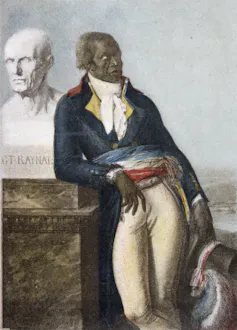
Just a few weeks after the National Assembly ended its session in October 1791, the deputies to France’s second revolutionary legislature learned that the Black population of Haiti, the country’s most important colony and then called Saint-Domingue, had risen up in revolt. The French government’s reaction was to send troops to put down what quickly became the largest slave uprising in history.
But when those French military units were ordered to replace their flags, which bore the motto “Live Free or Die,” with banners inscribed with the words “The Nation, the Law, and the King,” the contradiction between revolutionary principles and the reality of slavery became painfully obvious.
The beginning of the end for French slavery
It would take another two years before the revolutionary officials sent to Saint-Domingue to combat the slave insurrection – two men, named Léger-Félicité Sonthonax and Etienne Polverel – concluded that they had to grant freedom to the colony’s Black population or else see it taken over by France’s enemies, Spain and Britain.
When news of what Sonthonax and Polverel had done reached Paris at the beginning of 1794, France’s third revolutionary legislature, the National Convention, finally did what Mirabeau had urged their predecessors to do in 1789: It decreed the abolition of slavery in all the French colonies.
The abolition decree passed on Feb. 4, 1794, was the most radical emancipation law in the entire history of the struggle against slavery. Not only were slaves freed, with no compensation to their owners, but they were immediately granted all the rights of French citizens.
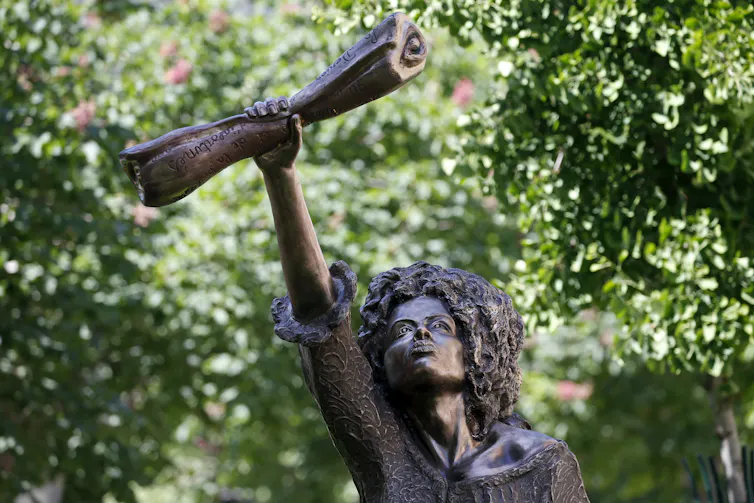
To underline its determination to do away with racial inequality, the convention seated two men of African descent as full voting members, entitled to share in making laws for the French nation. At a grand celebration in Notre-Dame Cathedral, a Black resident of Paris, Marie-Thérése Lucidor Corbin, sang a “Hymn of the Citizens of Color” to the tune of “La Marseillaise.”
For the next five years the revolutionary French republic formed something the world had never seen: a trans-Atlantic republic officially committed to ensuring equal rights for men of all races. Women were still denied the right to vote, but progressive laws passed during the revolution gave them equal rights within the family and the option of divorce. Racial laws in the U.S. would not catch up to those passed in revolutionary France until after the Civil War.
Undoing abolition
Tragically, France’s revolutionary experiment with abolition proved short-lived. When Napoleon took power in November 1799, he eliminated the Declaration of Rights from the French national constitution.
In spite of the 1794 abolition law, slavery had survived in the French colony of Martinique, which was under British military occupation, and in the remote French island colonies in the Indian Ocean. As part of his program to regain control of France’s overseas empire, Napoleon sent military expeditions to restore slavery in France’s other colonies.
A bloody campaign forced the Black inhabitants of Guadeloupe back into slavery in 1802. In the larger colony of Saint-Domingue, however, the Black general Toussaint Louverture had prepared the population to defend the rights they had gained during the revolution.
Read more: Jean-Jacques Dessalines: Reassessing the Haitian revolutionary leader’s legacy
Napoleon’s troops captured Louverture, but they could not overcome the popular resistance they faced. After two years of violent struggle, Napoleon had to concede defeat. Saint-Domingue became the independent Black nation of Haiti in 1804. It was the second country in the Americas to free itself from imperial rule after the U.S. itself. When the French government that succeeded Napoleon grudgingly recognized Haitian independence in 1825, however, Haiti had to pay a heavy indemnity to the former colonial slaveholders, a burden that slowed the country’s economic development.
The Black populations of France’s other colonies had to wait until 1848, when another revolution in Paris led to the passage of a second emancipation law – still 15 years in advance of Abraham Lincoln’s emancipation decree.
Bringing to light the story of abolition in revolutionary France adds a new dimension to our understanding of one of history’s most dramatic events and provides many lessons relevant to our own day.
Witnessing the revolutionaries’ painful efforts to implement the seemingly straightforward principles of their Declaration of Rights reminds us that the struggle for justice is never a simple one. Napoleon’s reversal of the French Revolution’s most radical action is a warning that advances in freedom can be undone.
In the long run, however, the deputies who passed the French revolutionary abolition decree of 1794 succeeded in a key way. While injustice certainly still exists in the world, no one can still pretend that slavery can be reconciled with individual human rights.