<
article id=”post-953069″>
Thai Deputy Prime Minister and Foreign Minister Sihasak Phuangketkeow gave the criticism its latest airing at the ISEAS roundtable on November 5. He argued that ASEAN’s Five-Point Consensus on Myanmar still lacks a clear strategy for implementation, and that the grouping’s consensus model can take a week or more to respond to a developing crisis. Non-interference, he said, should not become an excuse for inaction.
Sihasak is right that ASEAN needs to act faster. But the conclusion often drawn from that observation, that neutrality itself is the problem, misreads what ASEAN is and why it works.
ASEAN’s collective neutrality is not a policy choice that leaders could simply reverse. It is the product of a grouping whose 11 members differ so widely in their political systems, economic models and relationships with the major powers that consensus and non-interference are the only principles all of them accept. Neutrality is the result of those differences, not their cause.
As a strategic posture, neutrality rests on both principles, serving as the common denominator all members can accept as a bloc, whatever individual leanings.
That structural reality is often lost when compared with the European Union, which was designed to pool sovereignty among states with converging political systems and shared treaty obligations. ASEAN was not, and no amount of institutional reform will change the fact that its members include consolidated democracies, single-party states and a military administration.
The bloc has no close equivalent. The Pacific Islands Forum shares its reliance on consultation and consensus, and the Gulf Cooperation Council its emphasis on sovereignty, but neither matches ASEAN’s diversity or its role in the wider regional architecture.
Neutrality also underpins ASEAN’s convening power. The United States, China, Japan, India and others attend ASEAN-led meetings precisely because the grouping does not take sides, whatever its members’ individual leanings.
At the foreign ministers’ meetings in Manila in July, ASEAN hosted bilateral talks between US Secretary of State Marco Rubio and Chinese Foreign Minister Wang Yi, in the same week as a confrontation at Second Thomas Shoal in the South China Sea.
The first-ever Quad foreign ministers’ meeting on the sidelines of ASEAN-led gatherings took place at the same session, while Turkey became the bloc’s 12th dialogue partner. These are not the hallmarks of an irrelevant organization.
Needless to say, that convening power rests on more than diplomatic habit. ASEAN’s 11 economies are collectively worth some US$4.5 trillion, with about 700 million people and growth above 4.5% a year.
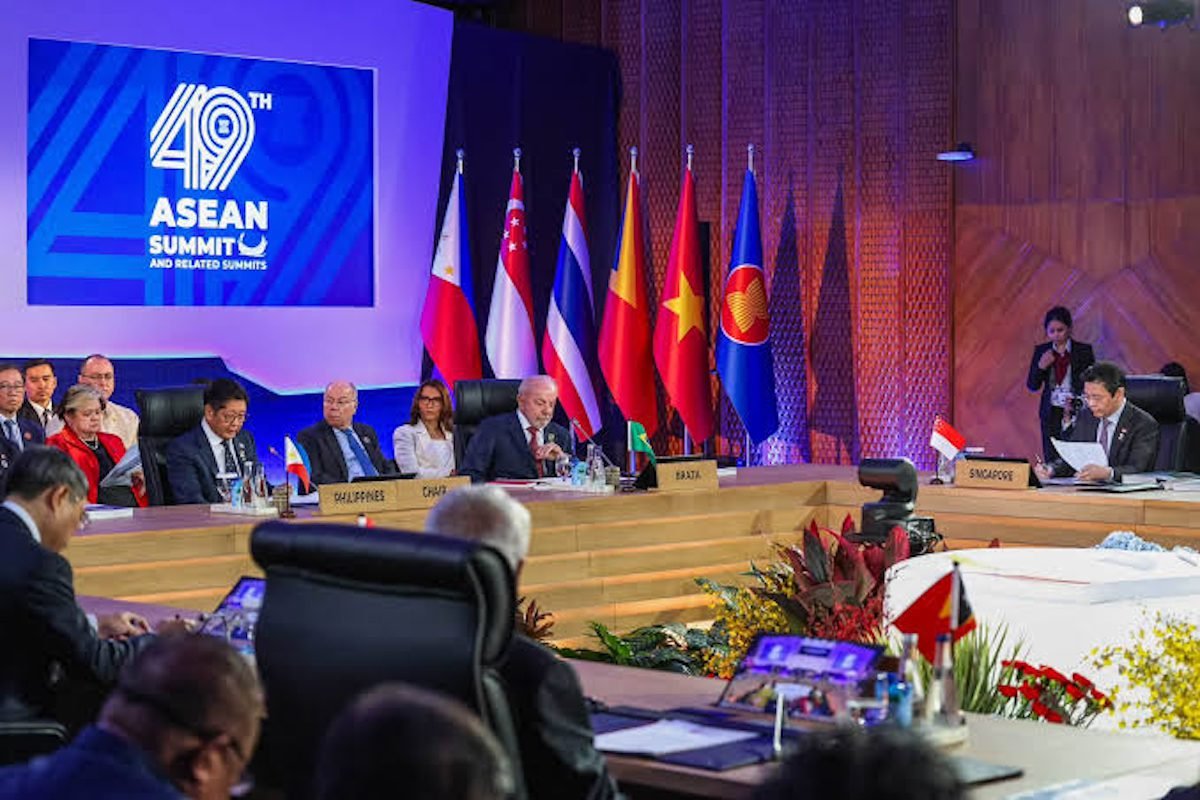
The region sits at the center of shifting global supply chains, and foreign investment reached some US$244 billion in 2025. Its members have avoided major wars between them for decades, notwithstanding recent Thai-Cambodia border clashes. The attendance list in Manila, including Donald Trump, Li Qiang, Mark Carney, Lula da Silva, and Antonio Guterres, reflects that weight.
The summit has shown what the bloc can deliver where its members are aligned. The Digital Economy Framework Agreement, whose negotiations concluded in May, was signed in Manila on 14 November.
It is the first binding region-wide digital economy agreement, covering artificial intelligence, cross-border data flows, e-commerce and cybersecurity. Some studies project that it could double the region’s digital economy to $2 trillion by 2030.
Energy security has also risen on the agenda because of the Middle East conflict, with leaders building on the enhanced power grid agreement that energy ministers moved to operationalize at their Manila meeting in October.
These are areas where shared economic interest overrides political divergence, and ASEAN’s flexible structure, allowing members to join arrangements at their own pace, is an asset.
The summit also showed where consensus breaks down: on sovereignty. The South China Sea Code of Conduct will not be concluded this year, despite a self-imposed deadline. Negotiators have reportedly settled about 80% of the text, but the remaining issues, including scope, enforcement and the role of non-claimant states, are the hardest. Manila is handing the file to Singapore, which takes over the chairship in 2027.
Myanmar is the starker case. The Five-Point Consensus, adopted in April 2021, has produced little beyond humanitarian assistance. Myanmar’s military-backed government has called the plan interference in its internal affairs and pushed for restored political representation in the bloc.
ASEAN foreign ministers agreed in July to set benchmarks and consider a longer-term envoy, but there is no consensus on recognizing the elections the administration held in December and January, which critics widely saw as a sham. Leaders in Manila reaffirmed the Consensus and kept Myanmar’s representation at the non-political level.
In any case, frustration with ASEAN’s pace does not produce a workable alternative to neutrality. Abandoning it would fracture the bloc without producing a policy that all 11 members could sustain.
This is the tension at the heart of ASEAN, and it is not new. The quality that slows the bloc’s responses is the same one that gives it relevance. Neutrality keeps the major powers at the table, keeps member states in the room and provides the only multilateral forum in the Indo-Pacific where all of them meet.
The task is to find ways of acting faster within that asset, particularly in a crisis, where Sihasak’s criticism has the most force.
ASEAN shapes the regional agenda where its members share a position. Where they do not, it remains a venue that keeps discussion going. Neutrality, like the bloc’s emphasis on consensus and non-interference, is both a strength and a weakness.
Lam Duc Vu is a Southeast Asia-based risk analyst writing on Indo-Pacific security and regional affairs.
Source: Iwpost.com








 under a familiar refrain: the bloc is too slow, too cautious and too neutral to matter. Thai)