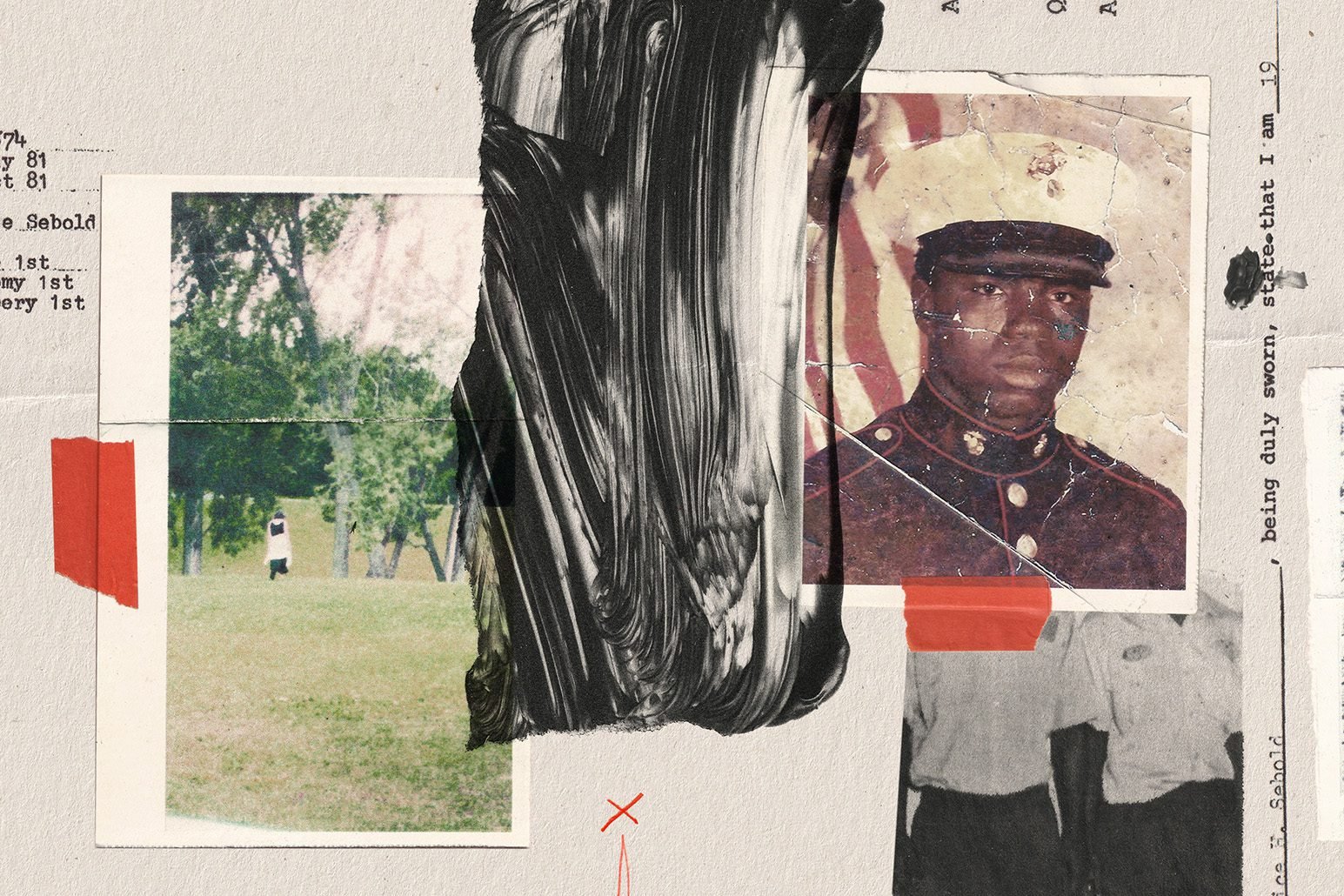
It took less than a day for the detective to give up on the case. A patrol officer had reported a harrowing, violent midnight rape in a Syracuse, New York, park. Hospital records recounted that the victim, an 18-year-old freshman at Syracuse University, was “crying uncontrollably.” Her face was bruised, and she had scratches on her neck. Her hymen had been lacerated in two places. Her urine was “grossly bloody,” according to the hospital report, and there was semen inside her.
At 8 on the morning after the assault, after the victim looked fruitlessly through books of mug shots in hopes of identifying her assailant, Syracuse detective George Lorenz interviewed her. She had been awake most of the night for a first police interview, followed by forensic and medical exams: everything from gathering physical evidence of the rape to X-rays of her skull because the attacker had pounded her head on a brick walkway. To alleviate the pain from her injuries, she had been given Demerol, a powerful opioid.
Lorenz, a burly 17-year veteran of the department who had worked as a meat cutter and truck driver before becoming a police officer, seemed annoyed that she had trouble staying awake, according to her subsequent account. “That’s inconsequential, just the facts,” he barked when he thought she was providing extraneous detail.
The detective was dubious that a rape had occurred, according to his preliminary report. “It is this writer’s opinion, after interview of the victim, that this case, as presented by the victim, is not completely factual,” he wrote. After speaking to the male student whom the victim had been visiting before she was attacked, the detective checked the crime scene for anything his colleagues, who had recovered a knife and the victim’s glasses, might have missed.
That was the totality of Lorenz’s investigation. Five hours after receiving the case, in a report marked 13:00 on May 8, 1981, he placed it in the “inactive file pending further info.” The consequences of that decision are still playing out nearly a half-century later.

Alice Sebold returned to campus for the fall semester that year, aware that nobody was looking for her rapist. She happened to encounter a man on the street and, with a jolt of terrified recognition, was certain she recognized her attacker. Sebold brought him to the attention of the police. Her testimony convicted the man, who spent 16 years in prison and nearly 23 more as a registered sex offender.
Sebold was no ordinary survivor. At a time when few even reported rapes, she publicly described her experience in searing detail — in op-eds, on “Oprah” and then in a memoir about the attack and its aftermath — inspiring others to speak out rather than live in silent shame. That memoir, “Lucky,” was published in 1999, then sold a million copies after her first novel, “The Lovely Bones,” became a publishing phenomenon and, later, a Hollywood movie. Years after that, an attempt to turn “Lucky” into a movie led screenwriters and producers to examine the badly flawed police work and prosecution stemming from the assault of Sebold. The details had been sitting in plain sight in Sebold’s memoir.
The case publicly disintegrated in 2021 when a judge vacated the conviction of Anthony Broadwater and Syracuse’s district attorney said in court that the prosecution “should never have happened.” Involving, as it did, a white woman accusing a poor Black man of rape, and coming back to court a year after the convulsions caused by the murder of George Floyd, the news detonated in the media, with Sebold vilified even after she apologized to Broadwater. The case was yet another reminder, if reminder was needed, of the racism in the U.S. justice system. And what had once been a central identity for Sebold — a person who had built a voice and a career out of standing up to sexual violence — suddenly turned on its head.
As all of those details unspooled in court, on television, and in the pages of The New York Times and the Syracuse press, two former colleagues of mine began to report on the case. One detail lost in the frenzy raised the question of how many other victims had been left behind and what else the police might have missed: The district attorney said in court that there had been other rapes in the same park where Sebold had been attacked, including one a little over a week after Broadwater’s conviction. The DA expressed frustration that “nobody might have put two and two together back then.” My former colleagues moved on to other projects and publications.
Eventually my editors asked me to pick up where they left off. What could we uncover if we tried today to investigate the case that the Syracuse police never truly investigated — Sebold’s — as well as any others that may have been related? Could we untangle how things went so wrong and perhaps even point to a potential culprit? And if the authorities had bungled the case this badly, what mistakes had they made in other cases and what could be learned from those errors?
As an investigative reporter with almost two decades at ProPublica, many of those years focused on criminal justice, I have delved into countless cases gone wrong. On one occasion, I set out to report an article on a man unjustly convicted of murder — a case where an appeals court had belatedly found prosecutorial misconduct serious enough to overturn his conviction — only to have the man confess to me that in fact he had pulled the trigger. He recounted the victim’s dying words and told me, “I did what I had to do.”
Sebold’s case would turn out to be far more complex than that one, and its layers and effects far broader than what emerged in the wake of the exoneration. There were even more turns — including civil litigation that continues to this day — in what was already a baroque narrative.
Or so I would learn after I embarked on what became two and a half years of reporting, trying to excavate the Syracuse criminal justice system in an era before DNA evidence and cellphones, before the Police Department even had computers, a time in which cities all over the country were grappling with a massive rise in violent crime. Reconstructing the truth decades after the fact, needless to say, is even harder than trying to pin it down in the moment.
What’s clear is that no part of the system in Syracuse at the time could be depended on. Police brushed off rapes. Prosecutors bungled confessions or were defeated at trial. Judges overlooked irregularities. And one of the most powerful institutions in the city, Syracuse University, seemed more interested in suppressing news of a rape epidemic than solving it. There were police reports of sexual assaults near the campus marked “no press.” A former detective testified that the files were marked that way at the university’s request.
In this atmosphere, at least one serial rapist was on the streets — and sexual assaults that closely resembled Sebold’s continued for years, even while Broadwater was behind bars. Meanwhile, the case gnawed at former Syracuse detective Paul Clapper. He wondered whether the wrong man had been sent to prison. After he left the force, he raised the name of a confessed and convicted rapist who closely matched the physical description of Sebold’s assailant but committed most of his crimes indoors rather than outside.
That man’s record was lengthy and violent. I eventually found myself knocking on his battered door, wondering whether, at long last, I had found the true perpetrator. Or was I falling into the same trap that the Syracuse criminal justice system had tumbled into when it wrongly convicted Anthony Broadwater 44 years ago?
1
When Alice Sebold arrived as a college freshman in 1980, Syracuse was a city in decline. It had risen a century and a half earlier because of its proximity to the Erie Canal, then for decades was the site of factories for companies like General Electric and Carrier Corp. By the 1970s, those companies were closing facilities. Poverty climbed and the city’s population dwindled, emptying rows of Victorian homes that had housed generations of working-class families. Syracuse’s downtown, already severed by the interstate highway, withered.
One institution, however, was flourishing: Syracuse University. Enrollment surged, its sports teams excelled and new buildings rose. The university was a bubble inside the city, according to former students.
Sebold was drawn by the school’s distinguished poetry program. Raised in a household of voracious readers in suburban Philadelphia, her father a professor of Spanish at the University of Pennsylvania and her mother having worked for magazines, Sebold disdained the university’s frat culture. She preferred to skip the keg parties in her dorm and instead lounged in the basement of the art building, drinking endless cups of instant coffee and reading Emily Dickinson.

Just after midnight, on May 8, 1981, the last night of her freshman year, she was attacked. Sebold was crossing through Thornden Park on her way back to her dorm from a friend’s apartment. A stranger grabbed her from behind as she walked along a brick path. He put one hand over her mouth and threatened her with a knife. “I’ll kill you if you scream,” he said. Over a period of more than an hour, according to police reports and Sebold’s memoir, the assailant bludgeoned Sebold with his fists, pounded her skull into the brick and choked her.
Sebold frantically searched for words to deter him: She told him she was a virgin, then an orphan. She offered him the $8 she had in her back pocket. He laughed and said he wasn’t interested in that.
He forced her to kiss him, then to undress. He made clear she was not his first victim. “You’re the worst bitch I’ve ever done this to,” he said.
Then, when he was done, he fell asleep on top of her. She tried to escape, but he woke up and offered a tearful apology. “You’re a good girl,” he said. “I’m so sorry.” He told her to kiss him good night and called her beautiful. “It was a date to him,” she wrote in “Lucky.”
Just as quickly, he reverted to hostility. The attacker pocketed her $8 after all. He let her go, then asked her name as she walked away. “Alice,” she told him, writing later, “I didn’t have a name other than my own to say.”
“Nice knowing you, Alice,” he said. “See you around sometime.”
2
Thornden Park, where Sebold had been assaulted, was both a refuge and a menacing locale adjacent to the university. Once the estate of a salt baron, the rolling 76-acre park had broad fields — with tennis courts, a pool and an earthen amphitheater — as well as dense clusters of maple and oak trees that provided dark, isolated enclaves where an attack might go unnoticed.
The park had been the site of two sexual attacks seven months before Sebold’s rape. A third had occurred a block away. The reports in those cases had also been quickly consigned to the inactive file.
One woman had told police that a man dragged her into a wooded section of the park. When she resisted, the report stated, he “began to punch her in the face” and “ordered her to remove her pants.”
As with Sebold’s case, the police report was dismissive. One officer asserted that the victim was “retarded” and had run away from a nearby halfway house. The staff there said that she had complained of a similar incident two weeks prior and that she was having “difficulty adjusting.” The case was put on ice just hours after it had been reported.


Four days later, another young woman was making her way across Thornden Park when a man in a ski cap grabbed her by the neck and put a knife to her face. As she squirmed and tried to push him off, the man struggled to pull off his pants and hers. The woman suddenly realized the weapon was just a table knife, so she screamed as loud as she could and he ran away.
There was no indication in the police reports that these attacks might have been connected. Nor was there much evidence of public alarm. I found no articles about any of these October 1980 assaults in newspaper archives.
Trying to piece this information together was daunting and complicated. My colleagues and I made more than two dozen requests for all manner of law enforcement records from the Syracuse district attorney’s office, Police Department, the state prison system, local jails, archives and courts. Many were initially denied. After appeals, I wound up with thousands of pages of documents. There was little or no organization among them, and some were scrawled in barely decipherable handwriting. Even the redactions were haphazard, with some names still visible.
I started to map out the attacks around Thornden Park, using police reports and stray newspaper clips for some of the later ones. The numbers and proximity were jarring. More than a dozen women reported being raped or attacked by strangers within half a square mile over four years.
Women were being sexually assaulted in their dorm rooms and in student apartments, walking out of grocery stores or on their way to the library. A nursing student was attacked at the same spot as Sebold, on the same day that her roommate was raped in their shared apartment. A freshman was raped in a sorority house by a man who broke in through a window. The descriptions of the perpetrators were often eerily similar. They frequently carried a knife. And several were roughly the same height, weight and race.
It appeared that there was a public safety crisis emanating from the park area, with no sign of urgency from law enforcement.
3
Syracuse’s criminal justice system was chaotic during the 1980s and ’90s. One prosecutor would get into a scuffle, on live TV, with a candidate who had just won the race for DA. The police crime lab would lose its accreditation. The doctor who led the county medical examiner’s office resigned after an investigation found he had routinely removed organs from corpses without consent from the victims’ families. His employees had posed playfully for photos over the body of a woman who had died by suicide.
Given the level of dysfunction — and the fact that DNA evidence hadn’t yet come into use in the early ’80s — rape was particularly difficult to investigate. Survivors were wary, corroborating evidence hard to find. The Syracuse Police Department had no separate sex crimes unit at the time, and officers were still using typewriters.
“We were doing everything from homicide to robberies,” one supervisor of detectives during this era told me. He remembered nights with 18 felonies and fewer than a dozen detectives to work them. “A person with a knife in their back or a guy who got shot is going to take priority over a two-week-old rape case,” he said.
“A person with a knife in their back or a guy who got shot is going to take priority over a two-week-old rape case,” one supervisor of detectives said.
There was another impediment in those days: Syracuse University. I found a police report from 1980 on which someone had scrawled the words “NO PRESS.” A 19-year-old university student had been walking near Thornden Park when she, too, was attacked by a man with a knife. She got away by biting him when he tried to force her to perform oral sex.
The “no press” designation on police reports was not unusual, according to deposition testimony by Clapper, the former Syracuse detective, who would play a crucial role in the Broadwater saga. “No press,” Clapper testified in 2025, “means that Syracuse University put their foot down and said no press for any kind of rape, robbery, burglary that’s anywhere in the area of Syracuse University.”
The university had influence in the Police Department, according to Clapper, and an obvious interest in making the campus seem safe: “If your little daughter wants to go to school at SU and calls the police, and says, How is the crime around Syracuse University? ‘No crime around there.’ There’s five girls raped within, let’s say, a six-month period … between campus and Thornden Park. And if it’s marked ‘no press,’ it’s like it never happened.”
4
Sebold’s case had been placed in the inactive file. That meant the police weren’t searching for her assailant. But she couldn’t help herself. According to Sebold’s memoir, she walked the university campus, “looking for Him.”
“I was very aware that he could be around any corner,” she told me decades later. A sense of “hypervigilance” coursed through her like “a bunch of electrical wires,” she said.
Five months after the crime, Sebold saw a man on a street filled with restaurants and bars near the university. She felt a sudden, visceral certainty: “right height, right build, something in his posture.” She wrote that the man walked up to her and said, “Hey girl, don’t I know you from somewhere?” He then began nonchalantly chatting with a police officer across the street. (Both Broadwater and the officer would testify that they said “don’t I know you” to each other.)
When Sebold reported the sighting to the authorities a few hours later, Clapper recognized himself as the cop she saw and Anthony Broadwater as the man he was talking to. Broadwater, then 20, had grown up as one of six children of a janitor who worked for Syracuse University. After a brief stint in the Marines, he was working as a telephone wiring installer. Growing up, Broadwater told me, he’d had run-ins with the police and had served time in juvenile detention for theft. (Clapper had known Broadwater since he was a boy, he would testify years later. When asked if he had ever known him “to be involved in anything like rape,” Clapper replied, “No.”)

Broadwater was arrested. He vociferously protested his innocence and did whatever he could to prove it. He volunteered a pubic hair for comparison to one found on Sebold after the rape, and he agreed to participate in a lineup.
When Broadwater saw the other lineup participants, he began to worry. None of them looked much like him. They were all too tall or had a lighter complexion or both. He suggested that another inmate closer to his height and build be included to make it more fair. Broadwater’s court-appointed lawyer got the jailer to bring another man down from the detention facility above the police building.
Sebold looked at the row of men and picked the person who had just been added to the lineup. The man was standing next to Broadwater.
The case should have ended then and there, in the view of the DA today. “You know, she didn’t pick out the wrong guy. She picked out the guy. She picked out the guy that she thought had raped her. And it wasn’t Anthony,” Onondaga County District Attorney William Fitzpatrick told ProPublica. “Case is over. Stop.”
But it didn’t stop.
5
The prosecution of Broadwater had been assigned to a young assistant district attorney named Gail Uebelhoer (pronounced EE-bull-hair). Sebold wrote that she felt an immediate connection to Uebelhoer, whom she described as “solid and female” with “sparkling, intelligent eyes.” As Sebold put it in “Lucky,” “She wanted what I wanted: to win.”
After Sebold failed to identify Broadwater in the lineup, she could sense that Lorenz, the detective who had overseen the process, was unhappy. (Lorenz died in 2017.) Sebold said she had been scared and confused, torn between the men in positions 4 and 5. Instead of seeking out additional evidence, Uebelhoer asked Sebold to draft an affidavit on the spot, explaining what had happened. Sebold wrote in the affidavit that she had picked No. 5 because that person had been looking at her. Broadwater was in position 4.

The prosecutor then told her it was only natural that she would make such a mistake, according to Sebold’s memoir. “They really worked a number on you. He uses that friend or that friend uses him, in every lineup they do,” Sebold said Uebelhoer told her. “They’re dead ringers.” Both men are adamant that they had never been in a lineup before.
Within three hours of the botched lineup, Uebelhoer presented the case against Broadwater to a grand jury. Sebold wrote that she put on “the best show” of her life and several grand jurors “fought back tears.”
At least one of them was uneasy about the manner in which Broadwater had been identified, according to a transcript. “When someone is picked out of the lineup, doesn’t it have to be absolutely sure that the person that they picked out of the lineup is the one they’ve seen before?” one grand juror asked Clapper while he was on the witness stand.
“That’s correct,” Clapper said.
Uebelhoer quashed the discussion. “He really can’t give you an opinion on that,” she told the juror, adding that Clapper hadn’t been present for the lineup.
The juror asked about it two more times, but Uebelhoer kept deflecting. Broadwater was indicted on every count she had presented, including rape, sodomy and robbery.

Illustration by Vanessa Saba for ProPublica
6
When Broadwater’s case was set for trial, Uebelhoer was visibly pregnant. It was passed to William Mastine. Mustachioed, 6’6” and pugnacious — Mastine is the prosecutor who would scuffle with the DA-elect a few years later — he was known for his swagger and courtroom theatrics. Fitzpatrick, then a fellow assistant district attorney, would dub Mastine the “Garbage Man” in a newspaper profile for his ability to bring cases with scant evidence or, as Fitzpatrick put it to me more pungently, “take shit and make it hit.”
This was no minor consideration. Acquittals in rape trials were common at the time in Syracuse. At one point in the 1980s, a local news article reported that the district attorney’s office had suffered nine trial defeats in a row. Uebelhoer was quoted saying “juries are looking for a perfect victim, but they don’t exist.” She saw Sebold as a standout, writing in a memo as the case was transferred to Mastine: “Good luck. Victim is excellent witness.”
Sebold’s testimony would be crucial at trial, since it was nearly the entirety of the evidence. Mastine repeatedly emphasized that she was a credible witness. She had been a virgin, he pointed out, arguing that it would more firmly cement the image of her rapist in her mind. He said her study of drawing as a high school student equipped her to remember facial characteristics. She was shaken during the lineup. The identification on the street was what mattered, he argued.
Uebelhoer saw Sebold as a standout, writing in a memo as the case was transferred to Mastine: “Good luck. Victim is excellent witness.”
Aside from Sebold’s identification, the only other piece of evidence was the pubic hair Broadwater volunteered, which was compared to a hair found on Sebold after the rape. The two hairs were examined under a microscope by a lab expert who testified that they were “consistent” with each other. That essentially meant that both had come from a Black person. There were approximately 27 million Black Americans at that time. (In the absence of DNA technology, the prosecution could have tested the semen found in Sebold to determine its blood type, but it never did. That would have narrowed the list of possible perpetrators to only those with the specific blood type.)
The trial was peppered with irregularities. Broadwater and his lawyer had opted for a bench trial, hoping that a judge would see the paucity of evidence and wouldn’t be swayed by emotion. But the judge seemed to have a soft spot for Sebold. During a break in the proceedings, he spoke to Sebold privately, according to her memoir, expressing concern about how she was holding up and asking about her family. Had a juror done such a thing, they would likely have been kicked off the jury and a mistrial might’ve been declared. (The judge died in 2009.)
In a final, highly unusual turn, Uebelhoer took the stand herself, as a witness for the prosecution. She testified that Broadwater was unhappy with one of the people in the lineup and that he managed to swap that person out for the man Sebold picked. She seemed to imply that Broadwater was responsible for any confusion in the lineup process.
When it was over, the judge didn’t even leave the bench to deliberate. He found Broadwater guilty directly after Mastine finished his closing argument.
Mastine defends the trial and the verdict. When I reached him by phone, he noted that he was brought onto the case after the indictment had been handed up. Mastine otherwise repeated what he’d said at the time: that Sebold’s identification of Broadwater on the street trumped the one in the lineup room, so it was appropriate to take the case to trial.
Mastine said that Fitzpatrick anointed him the “Garbage Man” after his work on the Sebold case and congratulated him on the victory. Mastine denied that he felt any pressure in light of the defeats his office had endured. “A trial lawyer has to have a bathtub mind,” he told me. “During trial, you fill the bathtub up. When the verdict comes in, you empty the bathtub and start all over again.” (Years after the Broadwater trial, Mastine, by then in private practice, pleaded guilty to possessing a check on which he forged a client’s signature. He agreed to give up his law license.)


Through her lawyer, Uebelhoer declined to be interviewed. In a 2025 deposition, she testified that she could remember little of the Broadwater case. She said repeatedly that she could neither admit nor deny what Sebold had recounted in her memoir. But Uebelhoer emphasized that she had no way of knowing whether the man Sebold picked had appeared in a lineup with Broadwater before. “How would I know that?” she testified. “I’m not down there for every lineup.”
Responding to Fitzpatrick’s assertion that the case should have been dropped after the lineup, Uebelhoer testified that he likely would have been at meetings where the case was discussed but “registered no objection.” (Fitzpatrick denies this. “I’m not saying I don’t have a recollection of the meeting,” he told me. “I’m saying that meeting did not take place.”) Uebelhoer, for her part, added, “I thought that I did my job by putting it all in front of the grand jury to let them hear and see if they found her to be believable or not.”
Two months after the guilty verdict, Broadwater was sentenced to 8 1/3 to 25 years in state prison.
7
Broadwater was sitting in the local jail after his trial, he told me, when a Syracuse newspaper reported that another woman had been raped in Thornden Park. “I told you it wasn’t me! It never was me,” he said he told his attorney. “That guy is still out there doing it.”
A police report seems to line up with Broadwater’s description. The attack happened on May 27, 1982, and resembled the rape Broadwater had been convicted of just nine days earlier.
At about 9 that evening, a 19-year-old actress was jogging through a wooded section of the park when she heard someone behind her. Suddenly she was in the grip of a man dragging her by the neck behind a cluster of trees. He forced her to perform oral sex, then pulled her sweatpants down and raped her. She reported that her assailant was Black, about 5’9”, 140 pounds, muscular and around 16 years old.
Those details did not draw a lot of notice at the time. But they fit the description of a rapist who would soon become well-known to the Syracuse police. Only four months after Broadwater was found guilty, a high schooler named Thomas Weakfall admitted raping five women. The crimes had begun in late 1981, he said in a statement taken by Clapper. Four of them occurred less than a mile from Thornden Park. Weakfall, according to police reports, had provided “certain facts only the perpetrator would have known.”
“I told you it wasn’t me! It never was me,” Broadwater said he told his attorney. “That guy is still out there doing it.”
Weakfall seemed at war with himself, conscious of the brutality he inflicted. “I go to sleep Tommy Weakfall,” he would say in one confession, “and then in the middle of the night I wake up in a cold sweat. … I feel this pressure pushing me to go out side and do something.” He admitted burglarizing houses and raping women. When he was done, according to an account Clapper gave years later, Weakfall would “wrap them in a blanket, hold them in his arms and tell them he was sorry he did it.” Many of the police reports I examined, including Sebold’s, noted that the rapist had apologized to the victim.
There’s no evidence that Weakfall assaulted Sebold, but there’s no denying he matched key elements of the description she gave. Sebold had told police her rapist was Black, 16 to 18 years of age, about 5’7” and 150 pounds. Weakfall was Black, 16 years old, 5’9” and 140 pounds, according to police reports. Broadwater was 20, stood 5’6” and weighed about 175 pounds.
Despite Weakfall’s confession, the rape case against him collapsed. Officers learned — after taking his statement without a defense lawyer present — that he was being represented by an attorney on an unrelated burglary charge. Weakfall’s confession wouldn’t be admissible in court.
He ended up pleading guilty to second-degree burglary. Weakfall’s sentence wouldn’t require a single day of jail time. He got five years of probation and remained on the streets.
8
On the morning of Sept. 29, 1983, a man matching Weakfall’s description led police on a dramatic foot chase through downtown Syracuse after being interrupted while attempting to rape a woman inside her car.
Records show Weakfall was arrested for the offense and released on Oct. 11, 1983. Four months later, he pleaded guilty to a lesser charge, attempted sexual misconduct, and was sentenced to one year.
During the four months that Weakfall was still free, there was another notable assault. Sebold’s roommate was raped that November in the apartment they shared. She was one of five women attacked in the same cluster of blocks over five months, according to news accounts at the time. Police suspected that one man had committed the crimes. The homes had been burglarized and the women had been raped at knifepoint and beaten; some were also bound and gagged.
These elements matched Weakfall’s methods, though the reports suggested a noticeably taller, older perpetrator. Several survivors were asked to look at a photograph of Weakfall as part of an array of mug shots, but they didn’t identify him.
Sebold’s roommate told police that after the rapist broke into the apartment, he gagged, bound and blindfolded her, then became “very gentle” and “took his time.” She added that “he didn’t talk street talk either. He had a good use of the English vocabulary.”
He led her into Sebold’s room, put a “thin metal object” to her throat and told her, “I just want you to be good.” When he finished raping her, he tossed her jeans to her and covered her with a blanket.
The roommate also reported an exchange that suggested her rapist may have encountered Sebold in the past. After the assault, she tried to get him to leave by yelling out that her roommate was coming home. The assailant replied: “I know her, we had a thing, we had a deal in the past.”
Clapper viewed this as significant enough that he put it down in capital letters in his report. But he never followed up, Clapper testified years later. The perpetrator was likely fabricating a connection that didn’t exist, he said. Clapper never suspected that it was Weakfall or that the same man raped both Sebold and her roommate. He said the description didn’t match Weakfall, and Broadwater was locked up by then. He acknowledged that victims sometimes get these descriptions wrong, but he had another reason for ruling Weakfall out: “I think he was incarcerated then,” Clapper testified. But the records I had seen showed that his memory was incorrect: Weakfall had been a free man at the time Sebold’s roommate was attacked.
9
In 1985, three years after Broadwater’s conviction, Clapper encountered Weakfall again. The detective identified him in a surveillance photograph of a man using a stolen bank card at an ATM. Clapper interviewed him again. Once again, Weakfall confessed.
The police reports, along with the signed confession, spelled out in chilling detail how Weakfall had raped at least three women between September and November of 1985. He would spot a vulnerable location — an accessible window, a woman home alone — and climb in quietly, first ransacking for valuables, then threatening them with a knife, sometimes beating or tying them up if they resisted.
When Weakfall was done, some women got an apology. One said he was “soft spoken” and did not use “slang or street type language.” He kept calling another one ma’am. Others got nothing but raging hostility. He told one woman that he felt understood by her, then threatened to burn her house down if she called the police.
Weakfall went on to say, effectively, that he had raped so many women in so many different places that he couldn’t remember them all. In the final paragraph, he made a garbled cry for help. He described sexual violence as a compulsion. The rapes were “accidents,” he said, and the courts “haven’t helped me at all.” He hoped that the next judge would get him some counseling.
This time Weakfall’s confession held up. He pleaded guilty to three rapes and a burglary and was sentenced to a maximum of 18 years. He served 12. While in prison, Weakfall participated in a treatment program intended to stop people from committing sexual violence.
Illustration by Vanessa Saba for ProPublica
10
Accusations against prominent men eventually began bringing the issue of sexual assault to the forefront in Syracuse. In 1986, a star Syracuse University football player was accused of rape. He pleaded guilty to a misdemeanor and was initially allowed to remain on the team. An uproar ensued, prompting the university’s chancellor to intervene and suspend him for five games.
Then, in November 1988, came another attack with a notable defendant, a crime that would inspire a second rape memoir by a Syracuse University student. The book describes how Laura Gray-Rosendale, a 20-year-old sophomore, had fallen asleep while studying in her bedroom when 23-year-old Michael Holm broke in, then bound and beat her. “He raped me every way someone can be raped,” she told ProPublica. “It was excruciating to be in my body.” A roommate called the police and officers kicked down Gray-Rosendale’s door, finding Holm with a screwdriver in his hand, standing over Gray-Rosendale, as he pulled his pants up. Her hands were tied and she was naked from the waist down. Holm tried to flee, injuring three officers, before they finally subdued and arrested him.
The defendant was white, the grandson of Melvin Holm, a former chairman of the university’s Board of Trustees who had been the CEO of Carrier Corp., one of the city’s largest employers and the eponym for the university’s domed stadium. In her book, “College Girl,” Gray-Rosendale recounted getting a phone call from a university administrator who told her the Holm family made major donations to the university. “I’m like, why are you telling me this?” she said. “But I know why. … She’s trying to dissuade me from testifying.”
In an interview, Gray-Rosendale described having a “complete breakdown” in the months after the assault and said that seeing “anyone who resembled [Holm] physically would be like a trigger and send me into a full out panic attack.” Through years of therapy and writing her memoir, she eventually found healing. But, she said, “I was never the same.”
Despite being caught mid-assault, Holm pleaded guilty to burglary. The word rape did not appear in his plea allocution. He ultimately served eight years in prison. (ProPublica could not locate him to seek an interview. His lawyer declined to comment.) “I was very glad that he got jail time,” Gray-Rosendale said of Holm. “But … that term, burglary. It did not in any way account for the multiple crimes that he committed, and that stuck with me then, sticks with me now.”
11
Pressure was building in Syracuse. In 1989, six rapes had been reported in the first two months of the school year, including one on the chancellor’s front lawn. Students began marching, organizing nighttime campus patrols and pressuring university officials. Gray-Rosendale told the university’s trustees at a campus meeting on sexual violence that she had been raped by one of their grandsons. “I’m not a statistic,” she said. The turmoil attracted the attention of media ranging from talk show host Geraldo Rivera to The New York Times.
Finally, that year, the university convened a task force and began to implement security measures that advocates had been demanding for years, including improvements to transportation services off-campus, the expansion of “blue light” emergency phones and the provision of counseling services and public speaking events on sexual assault.
In response to detailed questions regarding events from the 1980s, a spokesperson for Syracuse University said in an email that “we are not in a position to speak to the actions or decisions of prior administrations,” but the university is now equipped with “comprehensive policies, a steadfast commitment to preventing sexual and relationship violence and robust support structures to help every survivor that comes forward.”
By this point, the city had become the leading edge of a national issue. In March 1990, a Syracuse University student named Kristin Eaton-Pollard testified before a congressional subcommittee in Washington. She described being raped as a freshman in 1988 in Thornden Park, which she “later learned was notorious for its frequent occurrence of violent crime, located only about 100 yards from my residence hall.”
Eaton-Pollard criticized the university for being too slow to appreciate the need for the new security measures. “The programs at Syracuse University should have been initiated of their own accord a long time ago,” Eaton-Pollard said. Her testimony helped inspire the passage, that same year, of the Jeanne Clery Act, legislation named for a Lehigh University freshman who was raped and murdered by a fellow student. The law requires all colleges that accept federal financial aid to publicly report campus crime statistics every year.
12
Broadwater was unaware that the issue of sexual violence was roiling Syracuse. He remained in prison and had never stopped trying to prove his innocence. He kept a transcript of his trial with him as he was shuttled among 13 prisons in the 16 years he served for the Sebold conviction. He would show it to gang leaders to prove he shouldn’t be there.
“Rape charges here,” a cousin and fellow inmate had warned him when he entered Attica state prison, “they kill you.” As Broadwater puts it, “I caught holy hell” while incarcerated. He took to wrapping his torso with copies of National Geographic magazine in case an inmate came at him with a knife. In a riot, he saw a friend stabbed to death, took 12 stitches and nearly lost an eye trying to defend himself.
He filed myriad appeals and requests to reexamine the evidence, some without the help of a lawyer. Each was rejected. One petition was handwritten, laying out his logic in angled handwriting across lined notebook paper. Broadwater raised some of the arguments that eventually got him exonerated. He wrote, for example, that Uebelhoer’s testimony missed the point: “Whether or not I know the man … or was happy about the composition of the lineup had nothing to do with the victim’s failure to pick me out.”
“Whether or not I know the man … or was happy about the composition of the lineup had nothing to do with the victim’s failure to pick me out.”
Four times Broadwater came before the parole board. Four times he was denied. He refused to go to his fifth scheduled appearance. Commissioners wanted an admission of guilt, not claims of innocence, and Broadwater wouldn’t apologize. He didn’t come home until Dec. 31, 1998. He was 38.
Broadwater was free but unable to escape the shadow of a rape conviction. Even members of his family shunned him. He was required to register as a sex offender, which made it impossible to get any but the most menial job. Broadwater eventually managed to get a position on an assembly line, stamping the logo of Syracuse China on dishware from 6 p.m. to 6 a.m. He liked that he had to punch in, and that the factory was filled with security cameras. Broadwater wanted to work at a place that always documented his whereabouts in case anyone tried to accuse him of something.
13
For her part, Sebold had struggled to get her life on track over the years. Rootless and experimenting with drugs in her 20s — heroin was her favorite, by her own account — it was only as she confronted the consequences of the attack that she slowly began to grapple with her trauma. She began by writing an op-ed for The New York Times on the rape in 1989, then later appeared on “The Oprah Winfrey Show.” By the mid-’90s, she had started work on a memoir about her assault and the aftermath.

Sebold returned to Syracuse to research the book. She nervously walked around Thornden Park while her then-boyfriend stood by and took snapshots. And Sebold met with Uebelhoer at the district attorney’s office.
Uebelhoer helped her gain access to records, including a box of evidence from the original case. Both Uebelhoer and Sebold recall seeing the clothing Sebold had worn the night of the attack, and Sebold remembers seeing the pubic hair that was key to Broadwater’s conviction. (It was yet another example of the scrambled Syracuse justice system: An evidence log stated that all of the evidence in the case had been destroyed in the late 1980s, but both women have said they saw the box of materials years after that.)
The prosecutor helped promote Sebold’s memoir when it was published. Uebelhoer’s sister created a packet of publicity materials that, according to Sebold, included a glossy 8-by-10-inch photograph of Uebelhoer. Uebelhoer, who had left the district attorney’s office by this point to clerk for a judge, spoke at book clubs and introduced Sebold to discuss the book on a panel at a law enforcement conference in New York City. “She was incredibly proud,” Sebold said.
14
Sebold and Broadwater weren’t the only people who couldn’t let go of the case. There was a third person: Clapper, the veteran Syracuse detective who’d been chatting with Broadwater when Sebold first identified the man she thought had assaulted her.
Lanky with striking red hair and a cocky demeanor, Clapper was dogged and respected by his fellow cops. He would stay on cases for months, scouring for witnesses, checking in with informants, interviewing anyone he could find. Clapper’s work was threaded through the wave of Syracuse rape cases. He had investigated many of the attacks in and around Thornden Park and elicited Weakfall’s confessions.
Clapper initially indicated he was open to an interview for this article, then demurred, saying he’d had only tangential involvement in the Broadwater case. When I kept pressing, he eventually sent me a sprawling, 13-page statement that spanned the 50-odd years of his career. It was filled with brackets and parentheticals, written in different fonts and colors, much of it in capital letters, at once detailed and cryptic.
Clapper emphasized that he had been through a lot since Sebold was assaulted. Over the years, he had worked undercover, participated in hundreds of drug busts, been stabbed and “struck over the head with bats, wine bottles, and fallen down several flights of stairs.” He spent the better part of nine years caring for his sick wife and today, at age 74, his hair still thick but now snowy white, he works as an investigator for a district attorney in another county. Given all that, his statement maintained, it would be “close to ridiculous” to assume he could recall the particulars of Sebold’s case or other crimes with much specificity.
Still, the document provided revealing details, including one that hinted at the disturbing scale of Weakfall’s crimes. Not long after Broadwater’s conviction, according to Clapper’s statement, he had become aware of Weakfall’s “first series of rapes” and gotten him to confess. He had driven Weakfall around Thornden Park, during which Weakfall pointed out 23 buildings where he had raped and robbed women. Weakfall wasn’t charged in multiple cases, Clapper explained, because many of the survivors “just wanted to forget it” and refused to cooperate.
Clapper said Weakfall willingly admitted raping women inside buildings near the park but “flatly denied any involvement” in crimes outdoors at the park. Clapper found that distinction persuasive. Noting that the crimes Weakfall committed indoors involved rapes, burglaries and stabbings, he said, “Why would Weakfall honestly admit to all of these other [more serious] cases and not take credit” for those in Thornden Park?
Weakfall was always under scrutiny, Clapper would say in a 2025 deposition. “I know this guy better than I know my own brother,” he testified, repeating that Weakfall never admitted to any rapes in the park.
One by one, the attorney questioning Clapper got him to acknowledge the similarities between Sebold’s rape and those that Weakfall had confessed to: that she had been threatened with a knife, that her rapist took a small amount of money from her, that the rape happened blocks from others that he said he had committed at around the same time, and that afterward, her rapist held her and apologized to her.
The lawyers asked Clapper about four other cases of sexual assault in or near the park, three within months of Sebold’s, the other nine days after Broadwater was convicted. All involved Black assailants, at least three aged between 15 and 20 and nearly the same height and weight as Weakfall or Broadwater. Clapper pursued several of them but never thought to connect any to Sebold’s rape.
“Why would I?” he said.
15
It’s one of the many oddities of this decades-long saga that Sebold’s memoir of her assault — a 1999 book that portrayed Broadwater’s conviction as righteous — is what would ultimately lead to the unraveling of his conviction.
Sebold’s memoir, which ultimately sold 1 million copies after “The Lovely Bones” became a hit, eventually generated interest in Hollywood. Producers wanted to make a film version of “Lucky,” and several contacted Clapper as part of their research for writing a script.

Laurie Parker, a producer then working with director Jane Campion as part of a project that Sebold was cooperating with, reached Clapper in 2013. Parker said Clapper emailed her that there were questions about the case: No. 1, was the right person arrested? No. 2, was Sebold a good witness? No. 3, if DNA testing had been available, would there have been the same outcome? Parker tried to get him to elaborate, but he didn’t respond.
Clapper himself looked into getting a DNA test done on the pubic hair more than 20 years after Broadwater’s conviction, according to his statement. But when Clapper called the Syracuse police crime lab, he was told the hair had been destroyed.
Parker, tasked with writing a script based on “Lucky,” became increasingly consumed with doubts: “I had a feeling, a very strong feeling, that at best it was an illegal conviction and at worst, they got the wrong person,” she said. Her script was rejected in 2014. (The director had gotten busy with other projects, according to Sebold.)
Illustration by Vanessa Saba for ProPublica
16
The next year, in 2015, came an unrelated event — unknown to Broadwater — that further undermined the credibility of his conviction. The FBI, working with the Department of Justice and two advocacy groups, released the findings of a national review of cases in which hair evidence had been used. The study reported that expert hair testimony in 90% of the 500 trial transcripts they’d examined included “erroneous statements” and noted that the FBI no longer used such evidence. The study “strongly” encouraged states to review past convictions in which hair analysis had played a role.
At the time, Fitzpatrick was on a state commission that sets standards for crime laboratories. He was also feuding with the Syracuse Police Department. The two sides publicly savaged each other, with dueling allegations of mishandling forensic evidence, among other things. The Police Department, Fitzpatrick told me recently, was run by “fucking morons” back then and its lab was antiquated. Shawn Broton, a deputy police chief at the time, said Fitzpatrick had used the state commission as a “weapon” against the Police Department and worked to consolidate power for himself.
As a result of the FBI review, Fitzpatrick’s office examined New York cases that had used hair evidence. But that effort did not unearth Broadwater’s case. It relied on electronic searches for the word “hair” in appeals court opinions. The appeals court opinion in Broadwater’s case — all of two paragraphs long — didn’t mention the word. Fitzpatrick told me that his staff had also reviewed all the cases in which the hair analyst in Broadwater’s case had testified, but it concentrated on defendants who were still incarcerated. Broadwater had been out of prison for more than a decade by then. Another chance to reveal the flaws in his case had been missed.
The study reported that expert hair testimony in 90% of the 500 trial transcripts they’d examined included “erroneous statements” and noted that the FBI no longer used such evidence.
Eventually, a second movie producer got interested in Sebold’s story, and like the first producer, he began delving deep into the case. The producer got suspicious enough that he ultimately hired a private investigator to look into it. (The producer in question, Timothy Mucciante, has a backstory that could fill its own movie: He is a disbarred lawyer who served time in prison on an array of bizarre fraud charges. He promised money to finance the movie version of “Lucky” but never delivered, then tried to make his own documentary about the debacle called “Unlucky,” which also fell apart. Mucciante did not respond to requests for comment.)
The private investigator, Dan Myers, called Clapper, who left him with the strong impression that he thought Broadwater was innocent and Weakfall was guilty. Clapper denies he went so far as to say Broadwater was innocent. Still, Clapper acknowledged in his statement that he spoke “cop to cop” with Myers, a former officer, and told him, “Like ANY investigator, you wonder ‘if’ Weakfall was involved.”
That conversation had a domino effect. Myers got two Syracuse lawyers, David Hammond and Melissa Swartz, involved. (Swartz had previously worked in the DA’s office under Fitzpatrick.) They were shocked by what they read in the book and the trial transcript. They filed a motion to vacate the conviction in 2021.
In a matter of weeks, the long-stalled process of examining the conviction was resolved. Fitzpatrick joined in the motion to vacate the conviction, and in a brief hearing on Nov. 22, 2021, the judge agreed.
At the defense table that day, Broadwater, wearing a gray pinstripe suit, choked back sobs and hugged his lawyers. At 61, with hints of gray in Broadwater’s cornrows and a cane in his hand, it was hard to picture the 21-year-old he had been when a judge had found him guilty.

17
Unlike Broadwater, who has no criminal record since his release in 1998, Weakfall found it harder to stay out of trouble. He got out of prison in November 1997. Six months later, he was caught stealing speakers and cash from the apartment of a woman he had just met. He told police the burglary was “meant as a joke.” Weakfall pleaded guilty to a misdemeanor charge of criminal trespass and served 135 days in jail. He was arrested four more times through 2015, pleading guilty on separate occasions to patronizing a prostitute and resisting arrest. Records show police responded to multiple allegations of domestic violence against him through 2017, but the victims all declined to press charges. His record shows no involvement with the police since then.
Weakfall still lives in Syracuse, in an area some former officers refer to as “the Gut.” I made my way to his door on a Saturday in the fall of 2024. His apartment was on the ground floor of a clapboard building along a block of dilapidated homes surrounded by overgrown weeds. A gaggle of stray cats curled up against one another around the corner from his front door, which had a bumper sticker on it that read “Let’s Pray for America.”
After a few knocks, the face I recognized from the New York state sex offender registry poked out. He was bald with a full beard. Well-built for a man of 60, with a scar across his upper abdomen, Weakfall was wearing nothing but royal blue boxer-briefs. He said he had just gotten out of the shower.
I knew I might never get another shot to speak to him, so I started talking without giving him a chance to get dressed. We spoke for more than an hour. He never opened his door more than a foot.
Weakfall was, quite reasonably, skeptical of me. He kept saying, “You’re catching me off guard here, dude.” He said he carried a lot of guilt over his crimes and was “disgusted” with himself. He told me he had found religion and wasn’t inclined to revisit a period of his life that he had left behind. Weakfall also said he realized during his 12 years in prison that he may not have served as much time had he not been so open with the police. He didn’t want to make the same mistake again. I assured him I wasn’t a cop.
After a while, Weakfall seemed to relax. He spoke softly in gushes of information followed by sudden pauses. He described growing up without a father in a tough neighborhood; the pressure of bad influences leading to drugs; a graduation of sorts from shoplifting to home invasion, then sexual assault, or, as he put it, “violating someone” when he happened to find a woman home alone.
He acknowledged raping women. But he said that once he began to make admissions, the police saw him as a scapegoat and tried to put “all the load on one person just to satisfy the community.” Once in custody, he said, he was “scared out of my boots.” He said the police had dragged him out of his cell repeatedly, driving him to places he had never been and asking him about rapes he said he hadn’t committed. “Man, they had me admitting to things that I know I did not do,” he said.
Full of contradictions, Weakfall spoke in loops that were hard to follow. He said that he had confessed honestly to the rapes he committed in 1985, but that the confession in 1982 was coerced by the police. (He later said something that seemed to undercut that assertion: “What they didn’t understand in 1982 is that if you’re not really giving me any counseling … it’s bound to happen again.”)
When I started to ask about Thornden Park, describing what happened to Sebold, he cut me off. “More of my encounters was invading a home, if you do the search,” he said. He vociferously denied assaulting any woman in a car and said the police “mixed me up with other people that were doing things at the same time.”
This did not strike me as implausible, given what had happened with Broadwater and all I’d learned about the Police Department at the time, not to mention the sheer volume of assailants and assaults back then.
I kept pressing, asking if he would be willing to go through each case with me. He said no. He wouldn’t be able to remember them anyway, he said. I brought up the rape of Sebold’s roommate and several others, but the whole exercise began to feel futile. I thanked him for his time, handed him my card and asked if we could speak again after he had some time to think. He said he’d pray on it.
Weakfall called me the next morning. He was rattled and rambling. More aggravated this time. He started denying things that he had either confessed to or that were well-established in the criminal records: He claimed he had never stolen anyone’s ATM card; he had never taken property from anyone’s home; he had never apologized to any of his victims.
18
I returned to Syracuse twice more in 2026 and spoke with Weakfall each time. He got more sweeping and more adamant in his denials. By the third visit, he was insisting that he had confessed to only one rape and that the police had embellished or fabricated the rest.
When I called Fitzpatrick, the Syracuse DA, to discuss what I had learned in my broader reporting, he was at a loss. “It escapes me, honestly. I mean, it’s just staggering,” he said of the police and prosecutorial failures in the 1980s. “The level of misattention to detail. I just don’t have an explanation.”
But now it was too late. The best shot at making a conclusive determination on who raped Sebold would come through DNA analysis of the physical evidence. But the evidence from her case is gone.
Even if evidence that implicates a perpetrator were to turn up in a hidden corner of a dusty warehouse, Fitzpatrick couldn’t do anything. The statute of limitations on these rapes expired decades ago. Prosecution would be out of reach, he said.
As it happens, one legal proceeding continues in the Broadwater saga. After his conviction was vacated in 2021, Broadwater filed two civil lawsuits, one against the state of New York for wrongful imprisonment and a second against Syracuse and its surrounding county for constitutional rights violations in his prosecution. The state settled its case in 2023, agreeing to pay Broadwater $5.5 million.
But the city and county are contesting the claims. The lawyers declined to comment for this article, citing the litigation. But expert witnesses they have retained are defending the conduct of the police and prosecutors, questioning the accuracy of Sebold’s book and arguing that there was no pattern of rapes in and around Thornden Park worthy of disclosure to the defense.
19
I met Sebold on a recent, drizzly morning at her home in San Francisco. We sat in a room appointed with an ornate rug, fine photography and rare works of literature hugged by striking geode bookends.
Always an introvert, Sebold sank deeper into isolation after Broadwater’s exoneration. She went from hero to villain overnight. Strangers yelled at her on the street. A tabloid reporter badgered her on camera as Sebold, wearing a COVID-era mask and gingerly carrying a bag of dog poop, walked her sick French basset to the vet.
Afterward, she said, she didn’t step out of her house for a month. Even now, five years on, she can’t bring herself to leave the city limits. “There’s something about the safety of being near my home,” she said, “which has become increasingly important to my sense of mental health.”
As I laid out what my reporting had uncovered, she betrayed little surprise at the number of sexual assaults in Syracuse; she thought there might be more. “It’s my nature to believe that there’s more violence than people like to admit to, especially back then,” she said. It provided no comfort to learn that the police had failed other women, too.
Now fully convinced of Broadwater’s innocence, Sebold looks back on the entire episode with deep mortification. She feels shame that she was ever raped. And she now questions her decision to go to the police. “What if I hadn’t reported my rape?” she said. “None of this would have happened.”
Sebold recently completed a letter to Broadwater. She declined to share a copy but described its contents. It’s more personal and considered, she said, than the apology she released right after the exoneration, which was criticized as tepid and which she said was hastily written. Sebold said the letter takes responsibility for her role in Broadwater’s wrongful conviction and offers details about her recent life, her dog and the Dao, the Chinese philosophy she has come to rely on. The letter describes, she said, “the deep sorrow I hold for what happened.”
It took her four years to compose those three pages. “I’ll never write anything good enough,” Sebold said. It is “probably, in my mind, the most important thing I’ll ever write.”
Through intermediaries, Sebold and Broadwater have broached the possibility of meeting. Like Sebold, though, Broadwater is fearful of traveling. He is worried something bad will happen if he leaves New York state. He has floated the idea of meeting in Niagara Falls. Neither of them have been there before.
I last met Broadwater at his lawyer’s office in Syracuse. Now fixing up a modest farmhouse he bought outside town, he had taken a break from his hobby of barbecuing and still smelled faintly of sweet smoke from a batch of baby back ribs.
He keeps his distance from people, too. He told me that some who shunned him after he went to prison are now reappearing in his life. They tease him about all the media attention he received. Their questions also trigger his paranoia, making him think they got word of his civil settlement and want a piece of it.
Broadwater said the stigma of being a convicted rapist was still hard to shake, even after his exoneration. “I’m still embarrassed that I was convicted and sent to prison for rape for 16 and a half years,” he said, his gentle voice catching as he reached for a Kleenex. He likened the experience to being scalded with boiling-hot water. The exoneration, the celebrity, the settlement, it’s like “a skin graft” over a festering wound, he said. “Still ain’t normal. Ain’t never gonna be normal. How could it be normal?”