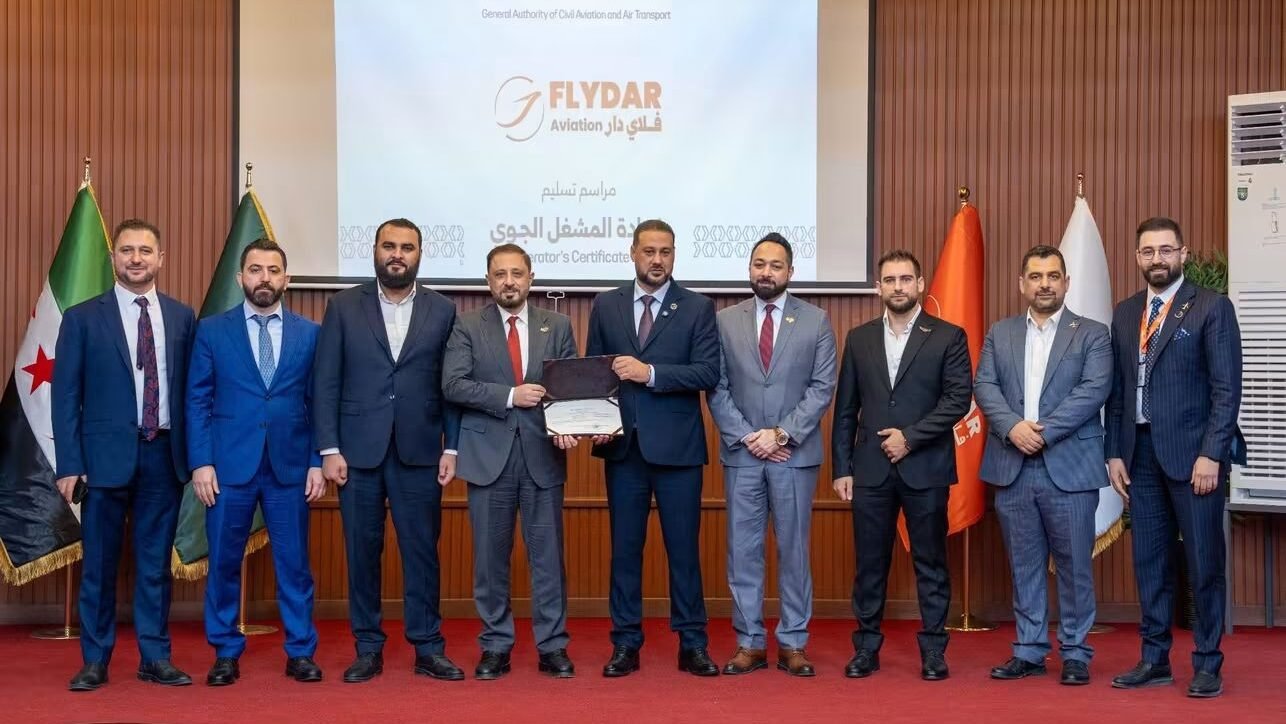
[DAMASCUS] Syria’s General Authority of Civil Aviation and Air Transport has granted Fly Dar Airlines an Air Operator Certificate, making it the first Syrian private airline to receive the certification since the fall of Bashar Assad’s government in December 2024. The move is part of Damascus’ efforts to rebuild its aviation sector and open the industry to greater private investment.
The certificate was presented on Thursday, Sept. 24, during a ceremony at the authority’s headquarters in Damascus. The event was attended by Omar al-Hosari, head of the Civil Aviation Authority, and Abdul Hamid al-Awak, speaker of the Syrian People’s Assembly. Capt. Mohsen al-Sallal, Fly Dar’s general manager and chairman, received the certificate on behalf of the company, which will establish its main operating base at Damascus International Airport.
Al-Hosari said the certificate was issued after the airline completed the required regulatory, technical, and operational procedures, allowing it to move toward commercial operations in accordance with Syria’s civil aviation regulations and applicable standards.
He described the certification as more than just licensing a new airline, saying it is part of a broader effort to reorganize Syria’s aviation market, expand private-sector participation, encourage domestic investment, and promote competition among carriers.
According to al-Hosari, Fly Dar completed a five-stage certification process that took approximately six months.
With its certification, Fly Dar becomes Syria’s third national air operator, joining the state-owned Syrian Airlines and the privately owned Fly Cham.
The company plans to operate flights beyond Damascus International Airport. Al-Sallal said its proposed network includes connections between several Syrian cities and airports, including Aleppo, Latakia, Deir ez-Zor, and Qamishli.
Fly Dar has yet to announce a specific date for the launch of scheduled commercial flights or provide details about its fleet and initial destinations. Its next challenge will be turning regulatory approval into actual operations.
The certification comes as Syrian authorities work to rehabilitate airports, modernize air navigation systems, and expand international flight connections following years of war and isolation that severely affected the country’s aviation infrastructure.
Earlier in September, the Civil Aviation Authority announced an expansion of Syrian Airlines’ international network to include direct flights from Damascus to Copenhagen and Vienna. The initiative is part of efforts to reconnect Syria with European cities and reduce travelers’ reliance on connecting flights through other countries.
Damascus is also holding discussions with international aircraft leasing and financing companies as it seeks to support the aviation industry’s recovery.
Meanwhile, Flynas Syria, a Syrian-Saudi joint venture announced in February, is preparing to begin operations during the final quarter of 2026, according to the timetable announced when the partnership agreement was signed.
These developments are part of a government plan extending through 2030 to modernize airports and aviation infrastructure while strengthening Syria’s position on air routes connecting the Gulf, the Levant, and Europe.
However, the entry of new carriers into the market will depend on their ability to secure aircraft and financing, complete operational preparations, and operate within an aviation sector that is still rebuilding its infrastructure and services.
Restoring passenger confidence will also be an important factor as Syrian airlines seek to expand domestic and international connections.
For Fly Dar, receiving its Air Operator Certificate represents a key regulatory milestone. The next test will be the launch of its first flights, the size of its operational fleet, and its ability to offer travelers new options within Syria and beyond.