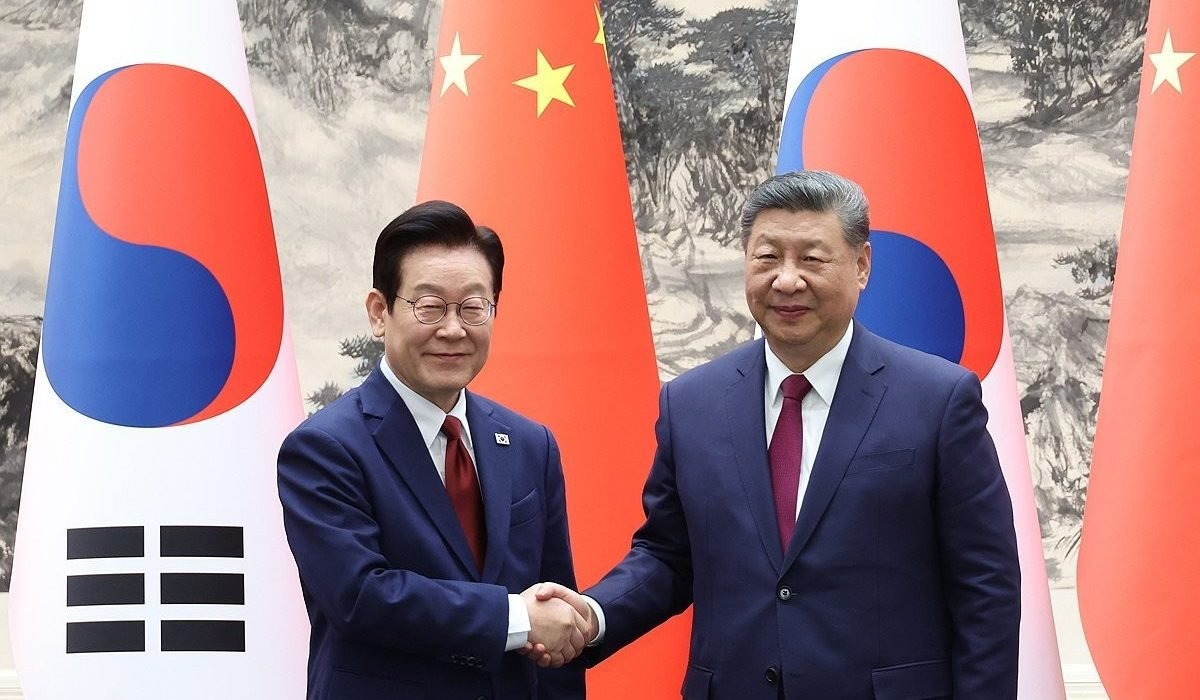
US Undersecretary of War Elbridge Colby called South Korea (Republic of Korea, ROK) a “model ally” while visiting Seoul a few months ago. A “model ally?” Compared with what?
South Korea is still a longtime partner and an ally bound by a mutual defense treaty signed in 1953. However, all relationships change over time, and the US-ROK relationship isn’t what it once was.
Most of America’s “model” allies don’t have influential figures associated with the ruling party – in this case, the elder brother of Kim Min-Seok, until recently the prime minister and now in the running to head the ruling Democratic Party of Korea (DPK) – who have declared that Trump’s America is “the apex of Yankee imperialism.”
It’s equally difficult to find an equivalent in other US alliances of the rare circumstances that the former prime minister himself and the head of the ruling party, were both imprisoned as younger men for pro-North Korea acts against the US ambassador’s residence and a US Information Agency office in South Korea. Neither has ever apologized or even explained it away as “youthful exuberance.”
And South Korea’s President himself, Lee Jae Myung, has referred to US forces in South Korea after World War II as an “occupying force.” He was also accused of being involved in the unauthorized transfer of US$8 million to North Korea while serving as governor of Gyeonggi Province. Lee denies the charges, but his then-subordinate has been convicted.
Since taking office in mid-2025, the Lee administration’s Unification Ministry has seemed keen to provoke the United States. The South Korean government early on picked a fight over longstanding, effective bilateral procedures for managing the Demilitarized Zone between South and North Korea.
South Korean prosecutors also improperly accessed restricted areas (and reportedly, sensstive information) at Osan Air Base while pursuing an investigation into activities by the former South Korean administration directed at North Korea. On another occasion, a Lee administration official released secret information on North Korean nuclear activities provided by the US.
Other South Korean officials are pushing to assume wartime “operational control” over combined ROK and US forces more for political reasons than on the basis of meeting actual readiness requirements – and contrary to bilateral understandings on when such changes will be made.
Chafing US global policies
“Model ally” South Korea has not been helpful with the US campaign against Iran, and has complained about modest transfers of US military hardware from South Korea to the Middle East.
The Lee administration doesn’t seem interested in helping out with the defense of Taiwan either, which is the lynchpin of the US defense line in the Indo-Pacific and of great importance to South Korea’s own security. Nor is it keen to give US forces in South Korea permission to redeploy in the event of a Taiwan contingency. This perhaps isn’t surprising. While a candidate for the presidency, Lee Jae Myung said Taiwan was none of South Korea’s business, a stance that is music to Beijing’s ears.
President Lee Jae Myung’s recent social media postings include comments equating Israeli military actions with the Holocaust, provoking a formal complaint from the Israeli government. Lee offered a half-hearted, incoherent excuse.
And the South Korean administration sent $500,000 to Iran for ‘humanitarian aid’ – but how likely is this to help families of the several tens of thousands of Iranians the regime gunned down a few months ago for demanding honest, consensual government? Not likely at all, and Lee didn’t even appear to pay lip service to the idea.
A one-party ‘model ally’?
And there’s more that makes one wonder about the definition of “model ally.”
Lee Jae Myung is aggressively following up on his recent predecessor, former President Moon Jae In’s, efforts to turn Korea into a one-party state. The Moon Jae In (2017-2022) and Lee Jae Myung (2025 ~) administrations have systematically endeavored to control all levers of power in South Korea: the National Assembly, judiciary and prosecutors, police, intelligence service and the National Election Commission.
South Korea’s leftist administrations have cowed the media and are aiming to dominate the military and big business, and influence over academia is immense. The violent, pro-Pyongyang Korean Confederation of Trade Unions has worked closely with the DPRK.
Even for regular citizens, criticizing the government or even mentioning the importance of honest elections can earn a visit from the police.
Religious groups have long been in the left’s crosshairs, with the Lee administration pressuring groups and arresting pastors it regards as “enemies.” The cruel treatment and persecution of religious leaders, and of former President Yoon Suk Yeol and his wife, resembles North Korean behavior. It’s not what one would exlpect from America’s “model ally.”
And the treatment of the American company Coupang, by South Korean officialdom reveals a distasteful nastiness directed toward an American company – and has attracted US Congressional attention and criticism.
A partnership worth protecting
South Korea’s left is telling Washington what it really thinks – despite Washington’s apparent preference for ignoring warning signs in the relationship.
Even so, there’s much that’s good to be said about South Korea, as for any ally. It spends a lot of money on its own defense and has a military that can and will fight. Its defense relationship with US forces is probably the best among any alliances in the Indo-Pacific region in pure operational terms. The South Koreans have been tough with Chinese, Russian and North Korean provocations and incursions in ROK maritime territory and airspace over the years.
South Korea has a world class defense industry that provides advanced weaponry for free nations from Indonesia to Poland. It has offered to help America’s ailing shipbuilding industry recover – and has purchased the near-defunct Philly Shipyard as an initial step, along with stating a willingness to build warships and support ships for the US Navy.
South Korean companies are major investors in the United States – including leading South Korean technology firms – and several hundred billion in future investments are planned following Trump administration pressure.
Additionally, the Lee administration has made at least temporary peace with Japan and is upgrading bilateral defense cooperation with its neighbor – to Washington’s relief.
And most important of all, South Koreans – by a large majority – appear to support the US-ROK alliance, even if many South Korean leftists would prefer to end it.
An ambassador at last
The US is finally getting an ambassador in South Korea. Former Representative Michelle Steel is a good choice as she understands South Korea’s left. She should have been in Seoul a year ago. There are a couple of things she might do to begin with.
One is to examine the allegations of electoral fraud produced by South Korea’s citizens groups in multiple elections since 2020. South Korea’s left has rejected them – dismissing them as baseless conspiracy theory. That’s to be expected. Less forgivable, however, is that the United States, with its near unlimited financial, technical and investigative resources, does not appear to have examined the allegations either.
The ambassador might also review the visa status of relatives of some of South Korea’s most anti-American politicians and officials. More than a few of their relatives have green cards and sometimes US citizenship. Revoke a few.
However, the Trump administration, like its predecessors, refuses to examine the nature of South Korea’s left and its objectives.
Ignore such problems and they fester, as the US learned with its one-time solid ally Venezuela in the late 1990’s when leftist Hugo Chavez took power. The US government similarly ignored or downplayed warning signs of a turn towards authoritarianism and anti-American policies in the years following Turkish President Recep Tayyip Erodgan’s election in 2014.
Rather than declaring everything just fine, the US needs to pay serious attention to South Korea’s left and what they intend for South Korea and the alliance. That’s how you keep an alliance intact and get a real “model ally.”
Grant Newsham is a retired US Marine officer and former diplomat with many years of experience in Asia. He was also an executive with Morgan Stanley Japan and Motorola Japan/Korea. His military service included service as head of intelligence for Marine Forces Pacific and as US Marine Attache at US Embassy, Tokyo. He is the author of the 2023 book, When China Attacks: A Warning to America.
Originally published by The Korea Signal, this article is republished with permission.





 a “model ally” while visiting Seoul a few months ago. A “model ally?”)