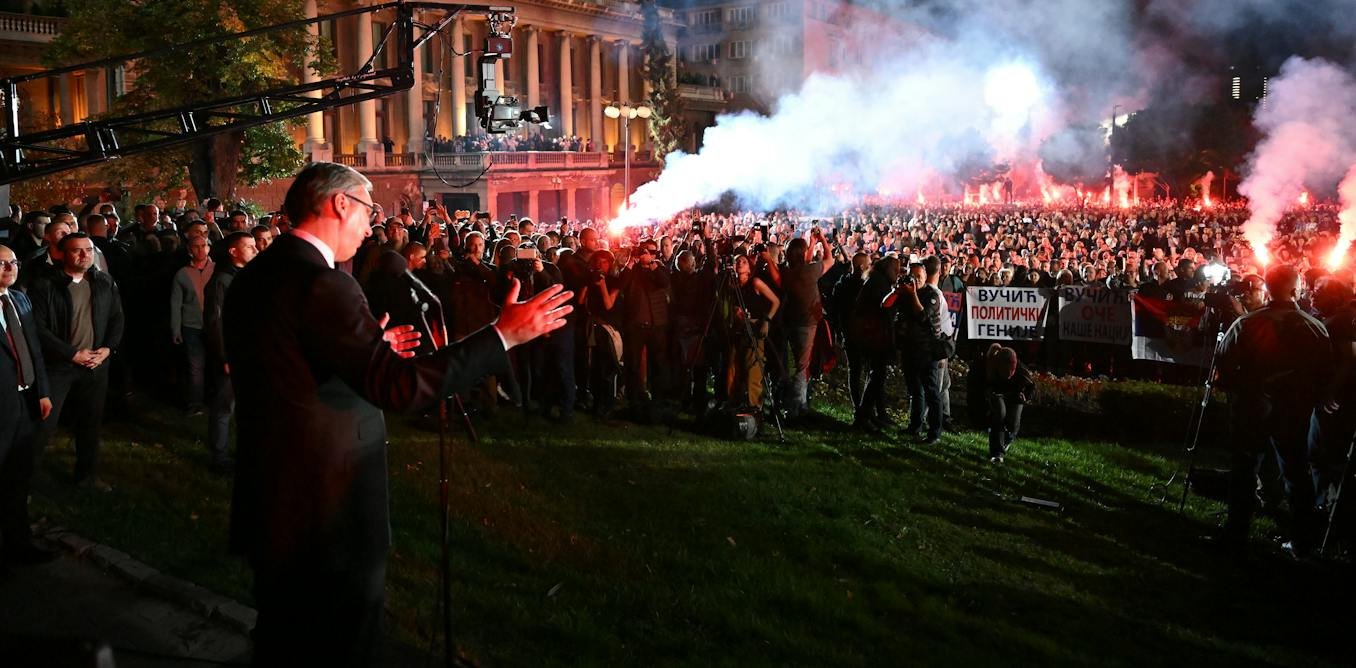
Aleksandar Vučić resigned as Serbia’s president on September 27, announcing that he intends to head his party’s list in upcoming parliamentary elections instead. If his Serbian Progressive Party (SNS) succeeds in these elections, which are scheduled for October 25, Vučić would become Serbia’s next prime minister.
Vučić has been the most dominant political figure in Serbia for over a decade. He first served as prime minister between 2014 and 2017, and has been president since then. Although the Serbian presidency is constitutionally a largely ceremonial role, Vučić has retained a tight grip over his party, the government and state institutions.
His decision to run for prime minister is widely seen as an attempt to retain his central position in Serbian politics. Vučić’s presidential term was set to end in May 2027 and, having been elected to the role two times previously, he would not have been eligible to run again.
Vučić’s principal accomplishment while in power has been to consolidate an informal network of power. The SNS has been the ruling party in Serbia for 14 years and has immense control over access to social benefits in the country, from education and employment to public contracts and legal enforcement.
People who receive employment, contracts for commercial projects or other benefits through the ruling party are obligated to become party members or supporters and to recruit their family, friends, and neighbours into the network. My 2025 research explains these relationships in detail.
This system has sustained Vučić and his party’s strength in every election since 2014. But unlike these previous elections, the outcome of the upcoming poll is not entirely predictable in advance.
A July survey had the so-called Student List, which has emerged as the main opposition to Vučić’s party, well ahead. Other polling has Vučić with a lead. While this makes prediction impossible, the uncertainty itself is notable.
Widespread discontent
While in office, Vučić has liked to point to ambitious infrastructure projects that have been completed ahead of schedule. They have often been completed early because important steps – such as competitive bidding, design review and safety inspection – were passed over.
One of the projects completed at record speed was the renovation of the main railway station in Novi Sad, a city in northern Serbia. The consequence of Vučić’s network-based style of building became clear shortly after the station reopened.
On November 1 2024, a concrete canopy covering the route from the platforms to the station building collapsed. Fifteen people were killed immediately in the disaster, and another died from their injuries afterwards.
Many Serbians believe the tragedy could have been prevented with proper oversight and quality standards, arguing that these omissions reflect a common issue in state-funded projects throughout the country. One engineering consultant on the project, Zoran Djajic, has also claimed his safety warnings were ignored.
Since the disaster, protests led mostly by university students have been constant. An early protest slogan put the source of the students’ dissatisfaction with Vučić’s regime succinctly: “Corruption kills”. By the middle of 2025, the demands of the student protests had expanded to include new elections, which were finally called in September 2026.
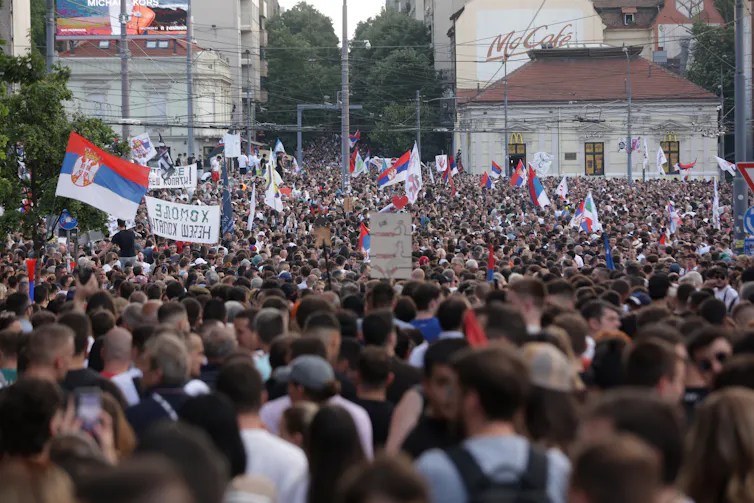
The governing party enters these elections with some clear disadvantages. The most recent broad public opinion survey that is available, published in July, shows declining trust in the president and mainstream political parties. It also shows widespread distrust in Serbia’s political system.
A majority of respondents in that survey, which was carried out by the Center for Research, Transparency and Accountability, an independent civil society organisation and democracy watchdog based in the Serbian capital of Belgrade, said they sympathised with the student protests.
But it remains an open question whether the students will be able to translate overall sympathy towards their protests into an election victory for the Student List. Most, but not all, of the principal opposition parties have declined to run and are supporting the Student List instead.
Vučić’s party will make extensive use of its main advantages, including its informal network of support and broad control of the media and electoral process. And the students will make use of their advantages, which include wide public sympathy and disgust with the Vučić government.
Succeeding Vučić’s presidency
With Vučić departing from office, the role of acting president goes to Ana Brnabić. She is the presiding officer of the Serbian parliament, and has long been considered one of Vučić’s most trusted political allies and loyalists. Vučić nominated Brnabić to succeed him as prime minister in 2017, and she held the office until 2024.
At the time of writing, no election date for the office of president has been set. But the law requires elections to be held within three months after the president’s resignation – so a vote will be held no later than December 26.
Both the SNS and the students’ coalition are yet to name a candidate. But two names stand out on the student side: Vladan Djokić, a Belgrade University official who is seen as responsible and reliable, and Dejan Bodiroga, the former basketball star who has no professional political experience but enjoys broad public sympathy.
These are the names that have been mentioned most frequently. However, the students could well come forward with a surprise candidate, as they have already shown an inclination to bypass prominent names in favour of consensus figures of trust.
This is how they chose Ilija Srdanović, a little-known cardiologist from Novi Sad, as their lead candidate for prime minister in October’s parliamentary elections.