Russia is pitching a new stealthy, missile-armed answer to Asia’s rising demand for submarines, but sanctions, allegiances, and industrial realities could sink its export ambitions.
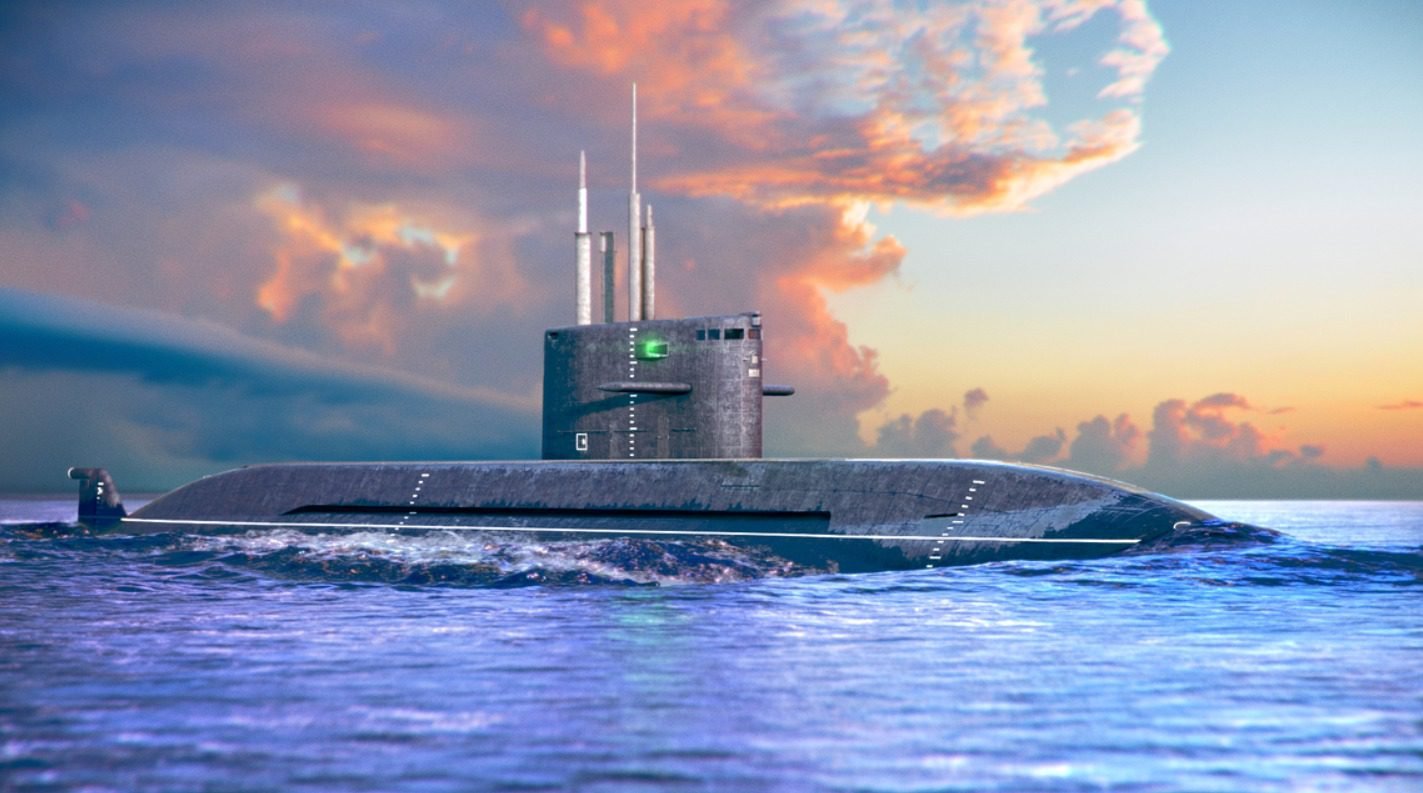
This month, Defense Security Asia reported that Russia’s United Shipbuilding Corporation unveiled a new configuration of its Amur-1650 conventional stealth submarine equipped with vertical launch systems for supersonic BrahMos or Club-S cruise missiles at the Fleet 2026 defense exposition, signaling a major push to capture a larger share of the highly contested global naval export market.
Designed by the Rubin Design Bureau, the 1,765-ton non-nuclear attack submarine features an optional air-independent propulsion (AIP) system that extends its submerged endurance to 45 days, allowing smaller navies to deploy long-range, precision land-attack and anti-ship capabilities traditionally restricted to multi-billion-dollar nuclear fleets.
To achieve tactical surprise in sensor-saturated littoral and blue-water environments, the single-hull platform employs a variable-speed permanent-magnet synchronous electric motor to halve traditional acoustic signatures while doubling passive target-detection ranges compared with competing export models.
By integrating an automated combat management architecture capable of carrying a massive 28-weapon payload, the platform enables rapid, multi-axis salvo launches that compress enemy air-defense reaction times. By aggressively marketing the Amur-1650, Russia aims to carve out a larger share of Asia’s increasingly competitive submarine market. Specifically, Russia may be aiming to compete in the South Asian and Southeast Asian submarine markets.
From South Asia, India may be Russia’s most plausible customer for its new submarine. A March 2026 report from the Stockholm International Peace Research Institute (SIPRI) mentions that Russia remains India’s largest arms supplier, accounting for 48% of Russia’s total exports and 40% of India’s imports in 2021–25.
Aside from India’s heavy dependence on Russian arms exports, its submarine fleet may be in serious need of modernization. Araudra Singh mentions in a February 2026 article for the Observer Research Foundation (ORF) that the Indian Navy faces an acute undersea capability gap following the December 2025 decommissioning of INS Sindhughosh, reducing its conventional fleet to just 16 aging platforms.
Singh notes that decades of procurement paralysis have delayed the advanced Project-75I submarines until 2035, a critical juncture when India’s remaining legacy fleet will hit mandatory retirement. He points out that this structural deficit severely undermines India’s regional maritime superiority and conventional sea-denial capabilities.
Beyond aging submarines and procurement paralysis, he adds that Pakistan, India’s longtime rival, has procured four China-built, AIP-equipped Hangor-class submarines, forcing India to acquire advanced platforms to restore vital strategic deterrence urgently.
Another incentive for India to buy Russia’s new Amur-1650 is that the two countries co-manufacture the BrahMos supersonic cruise missile, reducing compatibility issues between the missile and its launch platform.
However, India-Russia ties face serious challenges, as Rajorshi Roy notes in a 2023 article in the peer-reviewed MGIMO Review of International Relations, with key obstacles including severe delivery disruptions and uncertainty over export schedules, as Russia prioritizes its domestic wartime demands in Ukraine.
Roy adds that concurrently, Western sanctions restrict access to essential technology components and complicate financial transactions. He states that India’s structural shift toward indigenous defense manufacturing and supplier diversification is steadily reducing Russia’s dominant share of India’s weapons imports.
Tellingly, Roy mentions that Russia’s arms sales to China, along with India’s push for indigenous defense manufacturing and supplier diversification, may diminish the significance of India-Russia defense ties.
India’s decision to expand its Scorpene submarine fleet may also signal growing confidence in French alternatives over traditional Russian suppliers.
For Southeast Asia, Evan Laksmana notes in a February 2026 report for the International Institute for Strategic Studies (IISS) that regional states are increasingly seeking advanced subsurface capabilities, such as attack submarines, as part of a broader push toward anti-access/area-denial (A2/AD) capabilities.
Laksmana points out that militarily weaker Southeast Asian states view undersea warfare assets as a vital asymmetric tool, driven by intensifying US-China competition and by critical regional flashpoints such as the Taiwan Strait and the South China Sea.
He notes that regional policymakers and navies intend to leverage submarines to deny superior foreign powers access to vital waterways and territorial spaces, thereby raising the strategic costs for external militaries while securing geographic neutrality in potential great-power conflicts.
The Southeast Asian submarine market is notably saturated. While Russia may face stiff competition from France, Germany, and South Korea for additional state submarine orders in the region, it has a substantial presence in Vietnam, which operates six Kilo-class submarines. Vietnam has also signed on to acquire BrahMos missiles, which could incentivize it to acquire Russia’s new Amur-1650 to provide a sea-based launch platform.
But as with India, Vietnam has been diversifying its defense suppliers beyond Russia due to various constraints. In a 2025 article in the peer-reviewed Russian Journal of Vietnamese Studies, Nghiem Tuan Hung notes that Vietnam’s heavy reliance on Russian hardware makes its supply vulnerable to Western sanctions imposed in response to the war in Ukraine.
Underscoring Vietnam’s heavy reliance on Russian hardware, he says that although Russian arms still accounted for 60% of Vietnam’s defense purchases from 2017 to 2023, down from 80% in 2011–16, the trend points toward gradual diversification.
Hung warns that Vietnam’s defense readiness could be at risk if key components or upgrades are delayed. He highlights that most high-end Russian systems are not accessible for domestic technology transfer, which hampers the development of Vietnam’s own defense industry.
Hung adds that Vietnam may be unable to integrate more advanced Russian equipment into its military ecosystem, leaving Vietnam dependent on legacy military equipment from the former.
He also states that Russia’s growing alignment with China – as shown in joint Russia-China naval exercises in the South China Sea – undermines Vietnam’s confidence in Russia as a counterweight to China.
Even if the Amur-1650 attracts buyers, Russia’s ability to build and deliver the submarine remains an open question. As Michael Petersen pointed out in a July 2024 Chatham House report, the Russian state-owned naval construction umbrella company, United Shipbuilding Company (USC), is paralyzed by years of catastrophic financial losses, prompting a desperate government takeover of its shares.
Petersen says that, compounded by strict Western technological sanctions, those debts are choking supply lines, forcing a problematic pivot to domestic engineering or foreign stopgaps. He adds that labor shortages, supply chain disruptions and reliance on unreliable substitute components threaten Russia’s ability to sustain conventional submarine production.
Russia’s Amur-1650 may offer smaller navies an attractive blend of stealth, endurance and missile firepower, but export success will depend less on brochure specifications than on whether Russian shipyards can deliver submarines on time and at scale.
As sanctions, labor shortages and wartime pressures strain Russia’s naval industrial base, the real contest in the global submarine market may not be over whose design is most capable, but over whose industry can reliably turn promises into hulls.