Since Sony announced that it was planning to stop producing physical PlayStation discs in 2028, many people have been justifiably worried about how they will maintain ownership and long-term game access in a disc-free world. But halting production of PlayStation discs also means eliminating the market for cheap used PlayStation discs, which are often available for well below the price of a digital download.
How much is this disc-based discount worth? To find out, Ars analyzed how the prices of 19 current top-selling PlayStation games varied between digital downloads and physical discs (both new and used). We found that, while used discs are the cheapest option for most games for most of the year, the frequent and periodic deep discounts offered on the PlayStation Store often undercut the cheapest game disc options. That state of affairs will likely persist even in a future without PlayStation discs.
Our prices are so low, you’ll think we’ve suffered brain damage
For our analysis, we started with Sony’s list of the bestsellers on the PlayStation Store. We eliminated any games that weren’t available on a physical disc, then used the database over at PlatPrices.com to determine both the “Standard” price and the lowest “Discount” price offered for those games on the PlayStation Store in the last year (as well as the total number of days the discount price was offered).
For physical game prices, we checked the current price for a new game disc at Amazon as well as the pre-owned price offered by GameStop. We also analyzed pre-owned disc prices on eBay, taking the average price of the last five successful sales for that game (including shipping) to assess a fair market value.
In some cases, we added in the price of included DLC to ensure a “standard” game disc was content-matched with a digital “special edition” bundle. For PS4 games with “enhanced” PS5 editions, we added the price of that downloadable upgrade (if any) to the price of the PS4 discs.
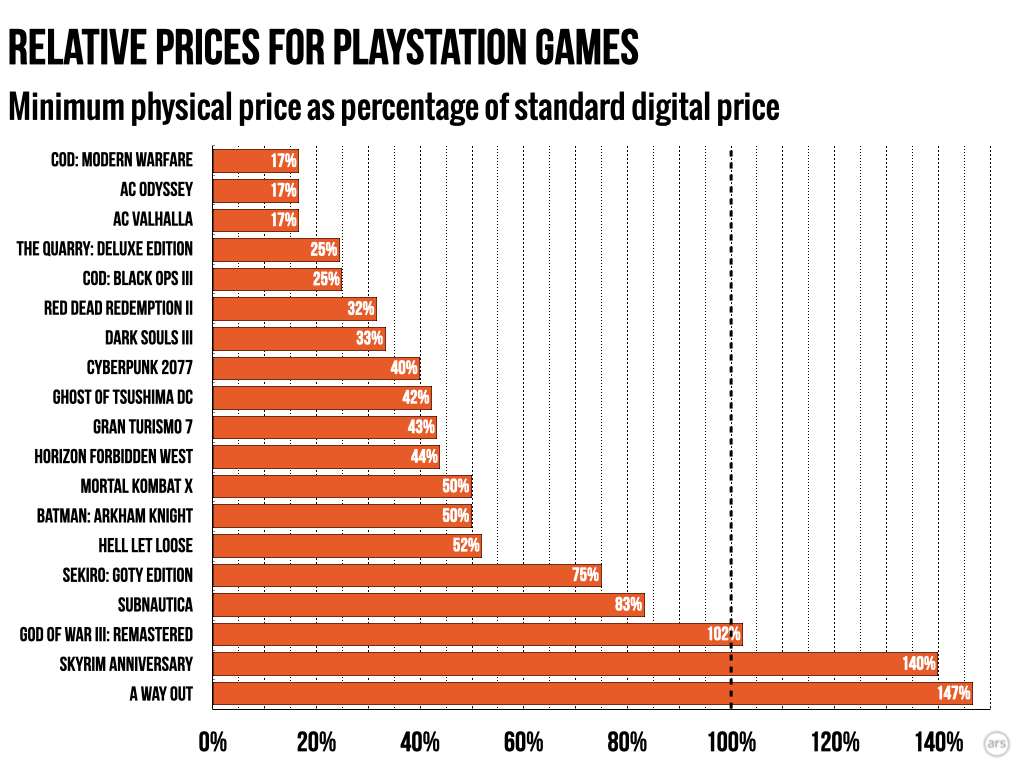
A quick glance at the results shows that the “Standard” price for games offered on the PlayStation Store is usually an incredibly raw deal. That digital price was the most expensive option available for 15 of the 19 games we looked at (including two where it was more or less tied for most expensive). In some cases, games that were six to eight years old (i.e., Call of Duty: Modern Warfare, Assassin’s Creed Valhalla, and Assassin’s Creed Odyssey) were still being offered digitally at their original launch price of $59.99, even while used discs were available at GameStop for just $9.99.
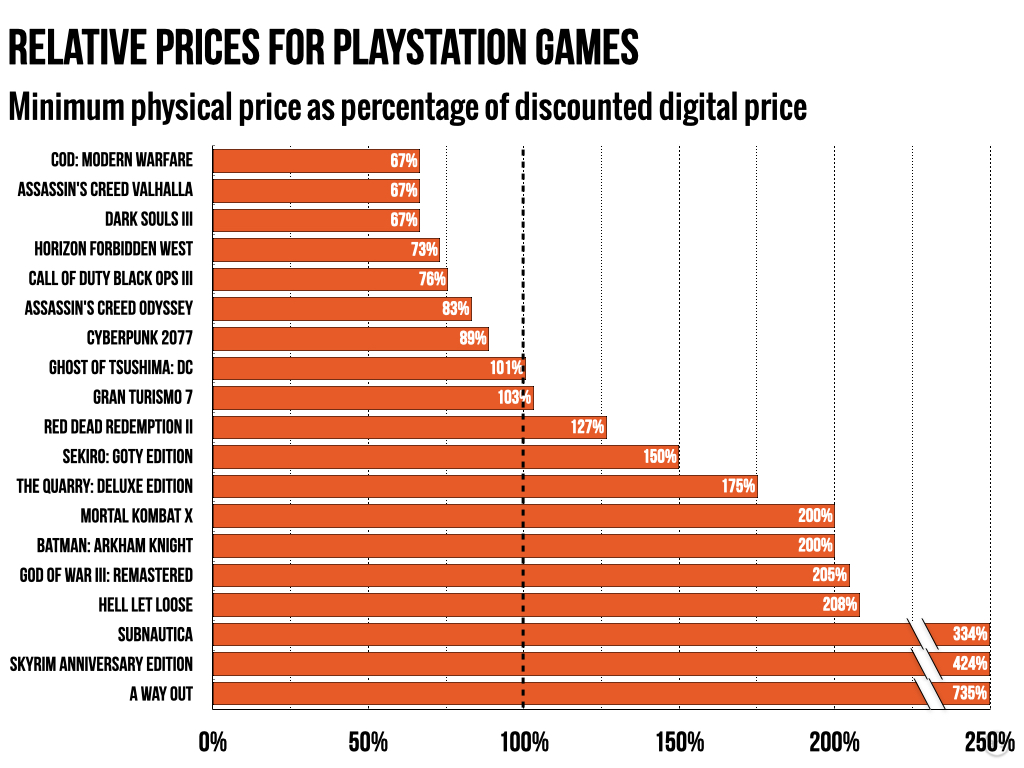
If you’re buying on the PlayStation Store, it almost always makes sense to wait for a sale, where the “Standard” digital price is reduced by 40 to 80 percent in our sample. During these periodic sale periods, downloading the game became the cheapest available option in a slim majority of the best sellers we looked at (10 out of 19). In many cases, the deep digital discounts meant a download could be had for 50 percent or less than even the cheapest used disc prices.
But waiting for a PlayStation Store sale isn’t always a great deal. Even with those deep discounts taken into account, a used disc was still the cheapest option for seven of the 19 games we looked at (for two more, the cheapest disc was roughly equivalent to the discounted digital sale price). For a game like Dark Souls III, for instance, you could still save $10 by buying a used GameStop disc instead of the $30 “sale” price on the PlayStation Store.
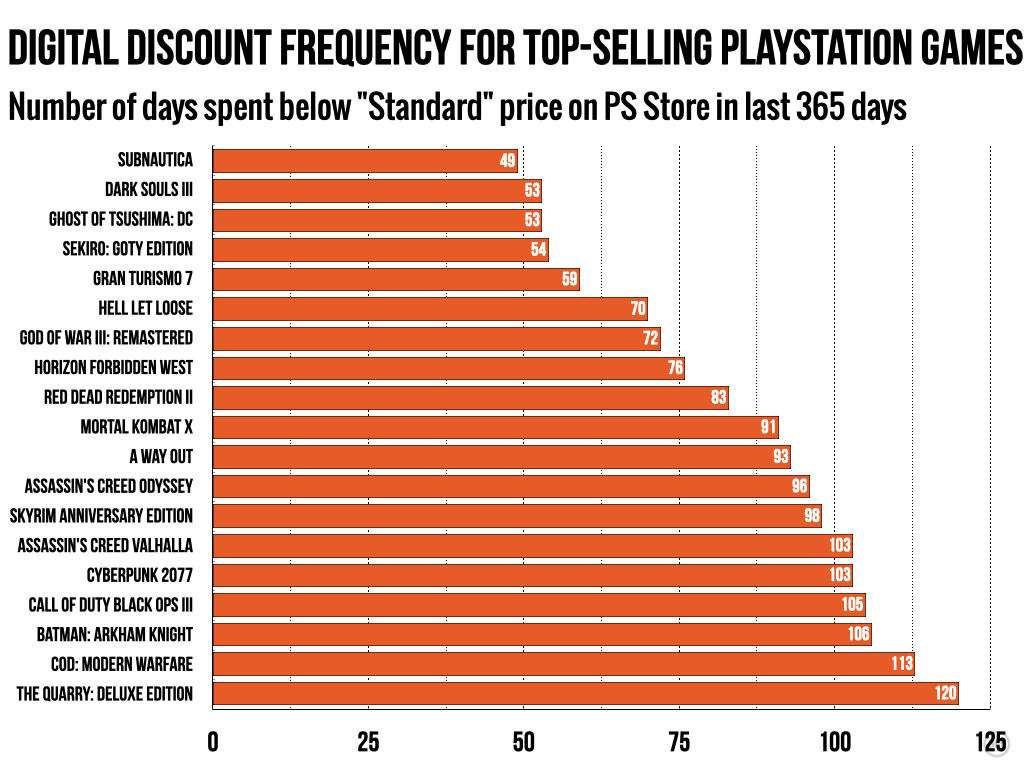
While a cheap disc can be purchased pretty much whenever you want, getting a deal on the PlayStation Store means being vigilant enough to monitor the few days a year where the best price is being offered. For the bestsellers we looked at, those discount prices on downloads were only offered between 13 and 33 percent of the time. In some cases, an eager digital buyer would have to wait multiple months for a weekslong sale period to pop up if they wanted to take advantage of the generous digital discounts.
Remember, too, that buying a game on disc means you can resell it again when you’re done, getting back a percentage of the purchase price in the process. This kind of de facto discount won’t be an option in PlayStation’s disc-less future.
My way or the highway
The pricing structure for PlayStation games in a disc-free world won’t necessarily mirror the current pricing on the PlayStation Store. Right now, cheap disc games exist as a sort of release valve for pricing pressure, setting a competitive price that digital sale pricing has to at least take into account as an alternative. If used discs are simply not available for future PlayStation games, PlayStation owners won’t have any other option to buy a game outside the PlayStation Store. That lack of alternatives might mean publishers have less impetus to offer the kind of deep discounts for downloadable versions that are currently common.
However, a PlayStation Store monopoly on game distribution doesn’t necessarily mean customers will be forced to pay high prices. In PC gaming, for instance, the lack of disc-based options for most games hasn’t stopped a “race to the bottom” digital game pricing effect from developing on platforms like Steam, and that’s before you account for the frequent deep Steam sale discounts. And on the PlayStation Store, there are already plenty of games that are only available as downloads that are still offered at bargain-basement prices to attract a large audience.
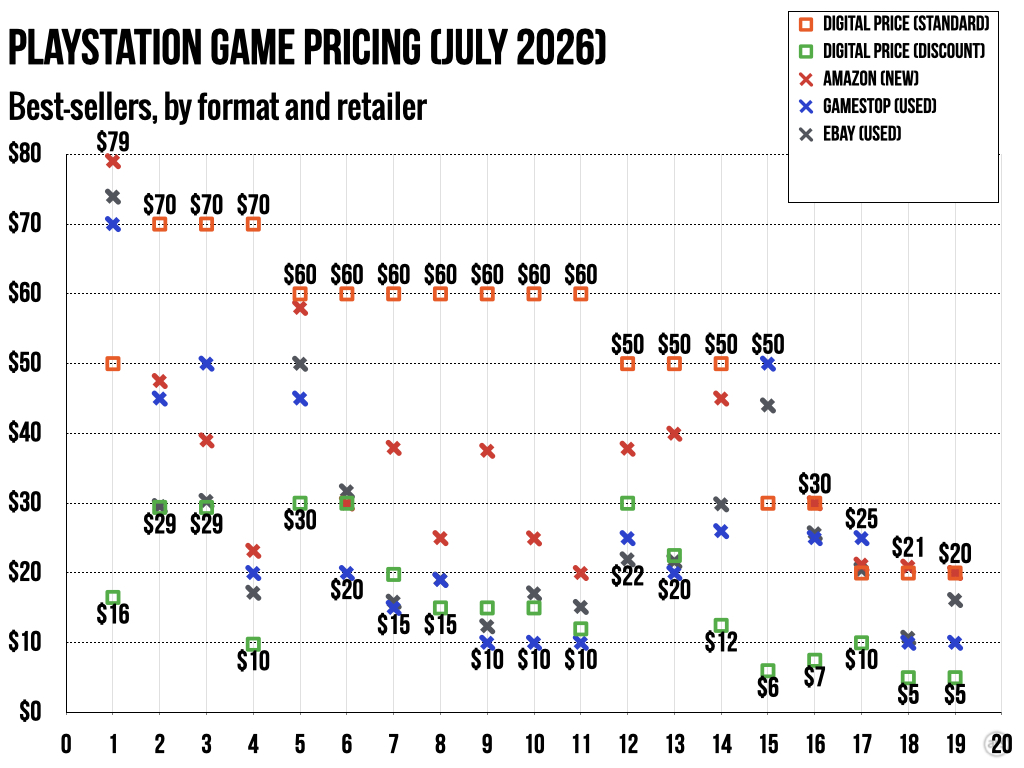
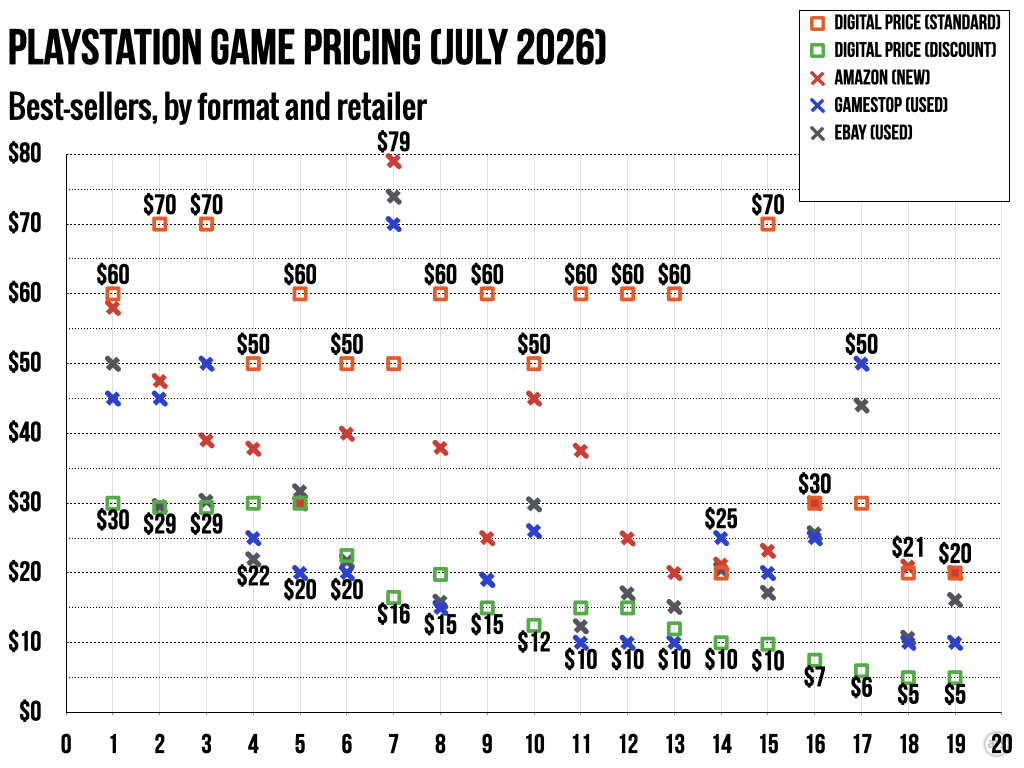
Even in a world without discs, players would probably balk at paying the full launch price for an 8-year-old game, as the PlayStation Store is currently charging for Assassin’s Creed Odyssey. The vast majority of potential customers have now been trained to simply wait for a sale so they can pay a small fraction of that price for the same download. In essence, the high “Standard” price on offer for many older PlayStation Store games is simply an artificial level that lets the publisher briefly post a splashy “80% off” banner every few months.
It would be nice if digital game pricing evolved to be more like used game disc pricing, where lower demand for old games (and a glut of supply from original buyers reselling their discs) quickly determines a relatively steady market-clearing price. But the attention-grabbing nature of a massive sale on a digital storefront means we’re probably stuck with this kind of whipsaw pricing for game downloads for the foreseeable future.
As we’ve seen, though, even steep digital discounts often don’t match the deals you can get on used game discs for bestselling PlayStation games. For bargain-hunting gamers, the absence of that lower-cost physical option will be a real loss in PlayStation’s disc-free future.