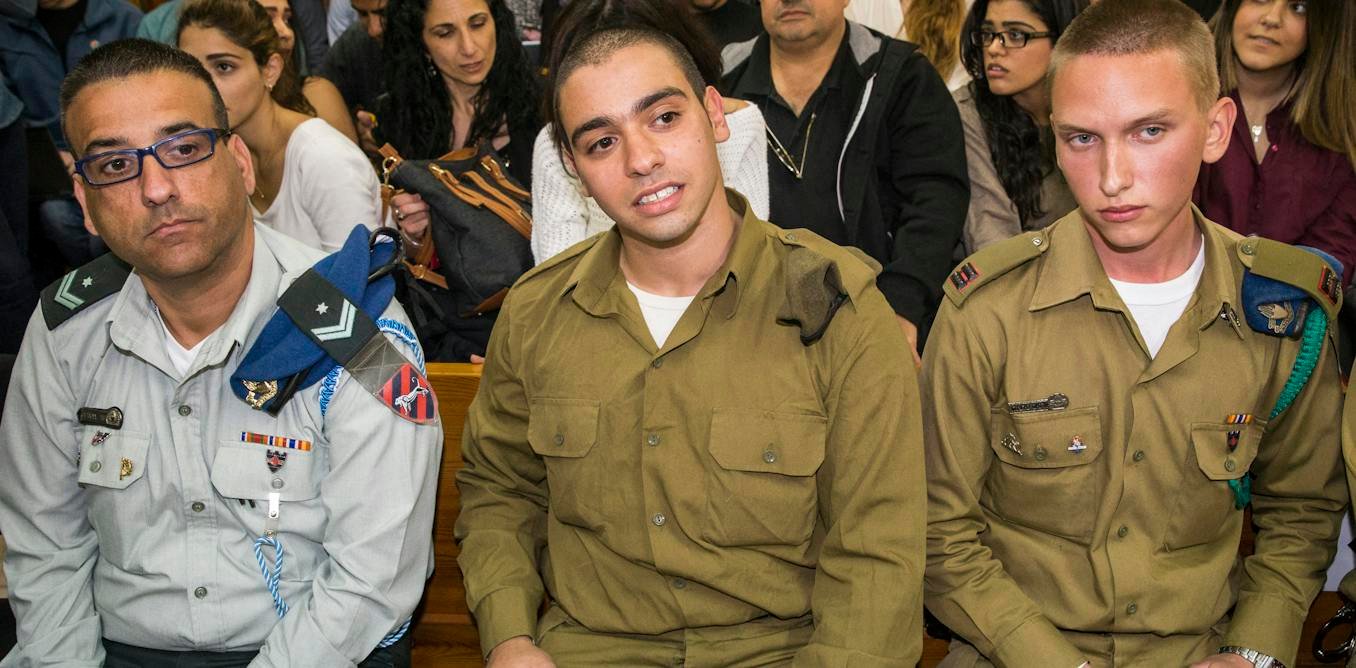
The pardoning of Elor Azaria, a former Israeli soldier convicted of killing a wounded Palestinian man in the occupied West Bank, comes with a history.
Israeli President Isaac Herzog’s decision itself – announced on Sept. 19, 2026 – came more than eight years after Azaria left prison.
The immediate effect is that it clears Azaria of his criminal record. But its public significance is broader – and reaches much further back.
I study how Israelis have talked about Palestinian lives and deaths over the past century. In my forthcoming book, I trace a recurring idea: Palestinians are viewed as an obstacle to Israel’s territorial and security goals, and whose removal can be imagined as necessary or justified. Azaria’s pardon fits into this notion, showing how the state’s response to killing Palestinians can be expressed through the language of mercy for the perpetrator – and it is a pattern that goes back almost 80 years.
A killing caught on camera
The details of Azaria’s case are fairly straightforward. On March 24, 2016, Abdel Fattah al-Sharif and another Palestinian armed with knives attacked an Israeli soldier in Hebron, in the occupied West Bank. Al-Sharif was shot and lay wounded on the ground. Minutes later, Azaria approached and shot him in the head.
Video of the killing circulated widely. An Israeli military court convicted Azaria of manslaughter in 2017 and sentenced him to 18 months in prison. He was released after serving nine months.
Justifying his decision, Herzog’s office cited the years that had passed, Azaria’s expression of sorrow in his application for a pardon, and the approach of Yom Kippur, the Jewish Day of Atonement.
Yet Azaria had said after his release that he would act the same way again. While the conviction will remain part of the historical record, the pardon removes any lasting consequence for him.
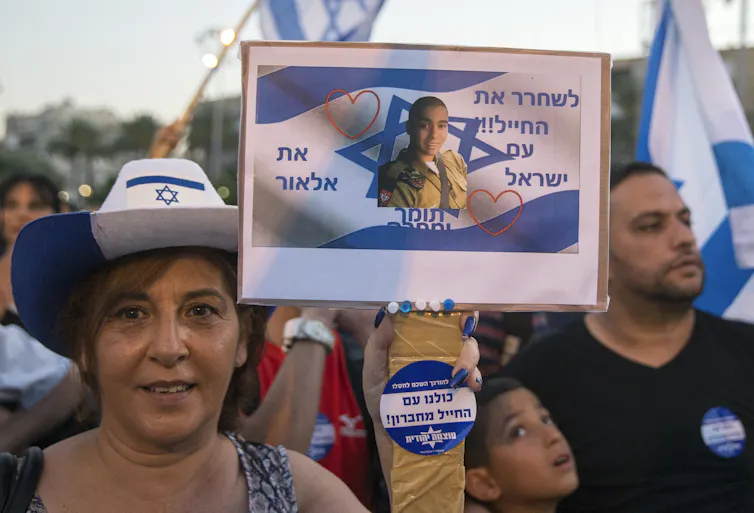
Herzog’s decision was warmly received by some in Israel, where Azaria’s case had been taken up by the political right.
For human rights watchers, it is a worrying development. “The president’s decision is a clear demonstration that the Israeli justice system is neither willing nor able to enforce the law against soldiers who harm Palestinians,” noted Ziv Stahl, director of the Israeli human rights group Yesh Din.
However unequal that may appear to critics now, it is a trend with precedents reaching back to Israel’s founding.
Clemency after the 1948 war
During the Arab-Israeli war between 1947 and 1949, some 750,000 Palestinians were uprooted from their homes. It was an expulsion that could not have happened without extreme violence, including dozens of massacres by Zionist militias and Israeli army.
The perpetrators were rarely, if ever, punished.
In November 1948, though, Israeli soldiers killed civilians in Hula, a village in Lebanon. This time, the direct commander of the operation arrested the officer who ordered the massacre and complained about him. An Israeli military court convicted company commander Shmuel Lahis of murdering 15 people and sentenced him to seven years in prison.
On appeal, his sentence was reduced to one year. Israel’s first president, Chaim Weizmann, then canceled his prison sentence in 1950.
Five years later, President Yitzhak Ben-Zvi pardoned Lahis. Decades later, in 1978, Lahis was appointed director general of the Jewish Agency, the primary Zionist organization promoting Jewish immigration and settlement in Israel.
These were distinct decisions, but together they show how a conviction for murdering Arab civilians eventually lost its practical and lasting consequences.
The Lahis case nevertheless established an early precedent for leniency toward an Israeli soldier convicted of murdering Arab civilians. It continued in the years that followed, when Israel, for several years after its independence, pursued an unofficial policy of shooting Palestinian refugees who attempted to return to their homes, their land, or the property they had left behind. Costing the lives of thousands until the mid-1950s, this unofficial open-fire policy turned the new border into a lethal instrument for making the results of the expulsion permanent.
That precedent became clearer after the massacre at Kafr Qasim.
The two legacies of Kafr Qasim
On Oct. 29, 1956, Israeli Border Police killed Palestinian citizens of Israel returning home to Kafr Qasim, a village 12 miles (19 km) from Tel Aviv. Authorities had moved the start of a curfew forward without ensuring that villagers working outside knew about it. In all, Israeli troops killed 47 people. In the trial that followed, eight troops were convicted of murder and sentenced to prison terms ranging from seven to 17 years.
The ensuing military trial produced a principle taught for decades later in Israel: Soldiers must refuse an order that is manifestly illegal.
What happened after the convictions is less often remembered. The prison terms were reduced on appeal and, for some, reduced again by the military chief of staff. In November 1959, President Ben-Zvi shortened the sentences of the last two men still in prison, Shmuel Malinki and Gavriel Dahan. Both were released by March 1960. Less than 18 months after sentencing, every person convicted in the main trial was free.
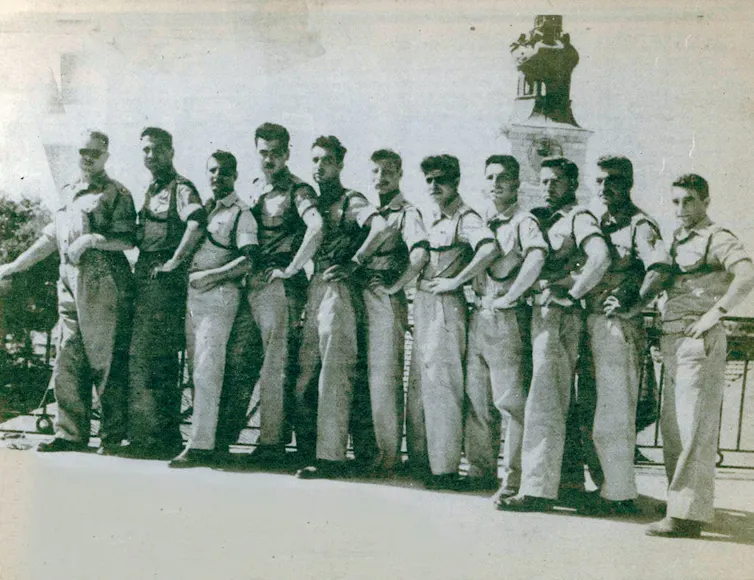
Kafr Qasim, thus, left two legacies: The court drew a boundary against unlawful killing while other state authorities sharply limited the consequences for crossing it.
Lenient punishment beyond pardons
The pattern did not end with those early cases. Since the first Palestinian intifada, or uprising, began in 1987, human rights organizations have documented how seldom investigations into Israeli soldiers’ killings of Palestinians resulted in prosecution.
From the beginning of the second intifada in 2000 through March 2011, Israeli forces in the West Bank and the Gaza Strip killed at least 3,024 Palestinians who were not taking part in combat, according to the Israeli human rights organization B’Tselem. Of all such incidents, only 12 soldiers were indicted, and not a single one was convicted of murder.
My research points to the same pattern across a longer period. Throughout Israel’s history, even in the rare cases of conviction of a soldier or a policeman for killing Palestinians, the maximum time a perpetrator spent in prison was three years and four months.
This measures time served, rather than the sentences initially announced by courts – a distinction made especially clear by Kafr Qasim and reinforced by the Azaria case today. After all, the former military medic served just nine months of an 18-month sentence for the killing of a wounded Palestinian. And even then, was deemed to be suitable for a pardon.
In so doing, Herzog is nodding to the past, but also signaling to soldiers on the ground today that killing a Palestinian is forgivable. The pardon transforms what is sometimes presented as an aberration into part of the state’s moral order