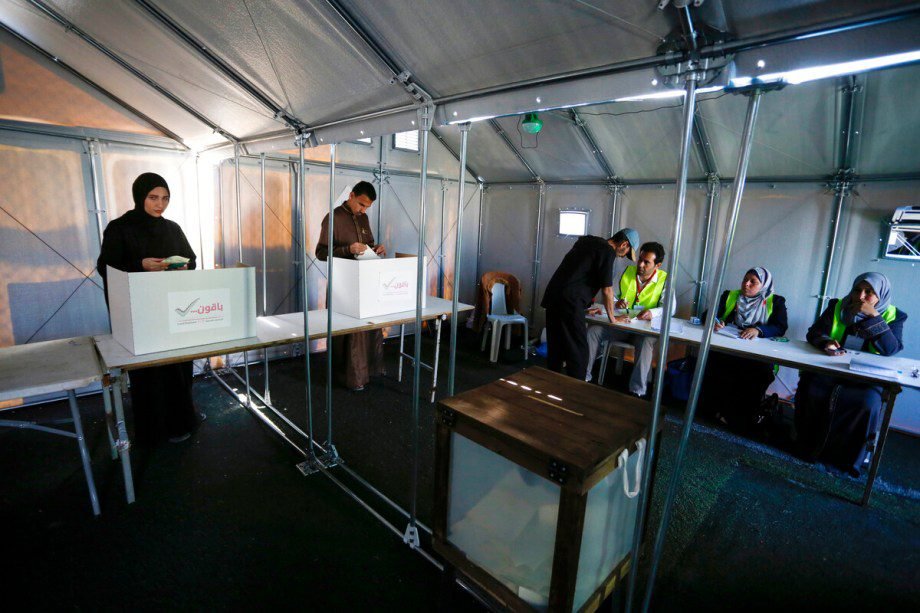
Palestinians in Jerusalem, the West Bank and the Gaza Strip are preparing for legislative elections on 28 November, nearly two decades after the last such elections. The Central Elections Commission is preparing for the electoral process on the basis that the Palestinian territories constitute a single electoral constituency, with voting to take place simultaneously across all three areas, despite the political and practical challenges to holding the elections in Jerusalem and Gaza, and the Israeli restrictions on movement and mobility in the West Bank. These elections raise a question that goes beyond whether they can be held on schedule, or successfully conducted across all three areas. It also concerns the extent to which their outcome, should the elections succeed, can bring about change in a Palestinian reality that is undergoing rapid and dangerous transformations on the ground.
The experience of the local elections held last April reflects the predicament surrounding the electoral process in the occupied Palestinian territory, as well as the broader level of public confidence in the electoral process as a whole under the current Palestinian circumstances. Although voter turnout in the West Bank reached around 56 per cent in those elections, turnout in Hebron did not exceed 33 per cent. The elections were held in five Jerusalem suburbs located outside the boundaries of the Jerusalem municipality: Biddu, Beit Hanina al-Balad, Hizma, Qatanna and Qalandiya. In some of these areas, turnout was particularly low, reaching no more than 29.1 per cent in Beit Hanina al-Balad. In Gaza, meanwhile, the elections could be held only in Deir al-Balah, one of the Strip’s five areas, where voter turnout did not exceed 23 per cent.
The question at the heart of this article becomes all the more pressing as Palestinian preparations for the elections coincide with accelerating Israeli measures that are reshaping the Palestinian reality: in the West Bank, through the development of increasingly extensive means of control over the land and its population; in Jerusalem, which is facing mounting pressures that are intensifying the hardships endured by Palestinians in the city; and in the Gaza Strip, which continues to bleed as it enters a phase of tightening control in the aftermath of the war. As these transformations accumulate, the question extends beyond whether Palestinians will simply be able to reach the ballot box. It is also about whether what emerges from those ballot boxes, even if the elections are successfully held, will be capable of confronting a reality that is being transformed at an accelerating pace and has itself reached a critical juncture.
Perhaps the most dangerous development unfolding in the West Bank today is the expansion of settlement activity into Areas A and B, where the Palestinian population is concentrated, after decades in which such activity was focused primarily on Area C.
The Israeli organisation Peace Now has documented the establishment of at least 26 new settlement outposts inside Area B, while settlers have come to control large tracts of land within Areas A and B, alongside Israeli measures to expand the scope of Israeli law enforcement in both areas. At the same time, Israel continues, at a rapidly and increasingly dangerous pace, to declare additional Palestinian land as “state land”, effectively annexing it to Israel. Since the end of 2022, the occupation has designated some 28,641 dunams under this category, an area larger than the total area designated as such from the Oslo Accords until the formation of the current Netanyahu government. The widening scope and growing intensity of settler attacks aimed at displacing Palestinians also represents a deliberate and dangerous Israeli shift. These attacks have expanded from targeting Bedouin communities to raids on the outskirts of Palestinian villages and towns, increasing the risk of confrontation between unarmed Palestinian civilians and armed settlers protected by the Israeli occupation army. This is taking place in parallel with measures that diminish the powers and standing of the Palestinian Authority, as Israel expands the use of checkpoints and gates, obstructs movement between Palestinian cities and villages, and intensifies army raids, which have become a daily and recurring occurrence. These developments come as Israeli Defence Minister Israel Katz last month instructed the army to prepare a plan to transfer responsibility for law enforcement in the West Bank from the military to the Israeli police. Such a transfer would place that responsibility in the hands of an Israeli civilian institution deriving its authority from Israeli law, rather than the army, which governs the West Bank under a system of military rule, underscoring the gravity of these transformations.
In East Jerusalem, the new school year began in early September with an open-ended strike across dozens of private Palestinian schools in East Jerusalem, which serve thousands of students, after the occupation authorities refused to renew entry permits for more than seventy teachers and staff members from the West Bank. This crisis does not appear to be separate from a broader pattern of difficulties faced by Palestinian teachers in obtaining permits to enter the holy city over the past three years. Entire Palestinian neighbourhoods in Jerusalem also lie behind the separation wall, requiring residents to pass through military checkpoints to reach schools, hospitals, institutions and government services.
Life in Jerusalem is shaped by restrictions on movement, residency, education and access to services. It is here that the electoral dilemma in Jerusalem becomes particularly apparent: official Palestinian institutions are unable to operate inside the holy city without the permission of the occupation authorities and beyond the limits they impose. Jerusalem was one of the principal obstacles when an attempt was made to hold legislative elections in 2021.
In the Gaza Strip, the predicament facing the population appears even more acute than elsewhere. This is not only because of the difficulty of organising elections in a territory devastated by war, but also because instability and insecurity persist. Killings, bombardments and assassinations continue, with more than 1,300 Palestinians killed since the ceasefire last October. At the same time, the Israeli occupation army has repeatedly targeted police personnel and headquarters responsible for maintaining order and organising civilian life in the Strip, while Israel has supported and armed groups operating in different parts of Gaza that foment discord and disorder. Over the longer term, Israel appears to be working to consolidate its control over decisions concerning the day after in Gaza.
It decided to remove Dutch and Spanish representatives from the International Support Centre for Gaza and considered removing representatives of Britain and other European countries because of their governments’ positions protesting Israeli policies in the Palestinian territories.
The Centre is a multilateral body led by the United States, with representatives from around 50 countries and organisations working to monitor the ceasefire and support post-war arrangements. At the end of last June, Netanyahu confirmed that what he calls the “voluntary migration” of Gaza’s population remained under consideration and declined to rule out the re-establishment of Israeli settlements in the Strip. This raises the question of how much influence Israel will exercise in Gaza during the next phase, leading to another question that goes beyond how polling stations and ballot boxes can be provided and secured in the Strip during the planned Palestinian elections: how can Palestinians govern Gaza amid all these transformations?
These transformations in the West Bank, Jerusalem and Gaza are unfolding as Israel enters an increasingly intense electoral period ahead of the Knesset elections scheduled for 27 October. The latest opinion polls point to an open race, with no party clearly positioned to secure a majority. In the most recent poll, conducted just days ago, Gadi Eisenkot’s Yashar party led with 24 seats, followed by Benjamin Netanyahu’s Likud with 23. The bloc of parties opposed to Netanyahu secured 59 seats, compared with 50 for the bloc supporting him, while the Arab parties won 11 seats. The formation of the next government would therefore depend on coalition-building and the support of smaller parties. The competition among the different political currents is closely connected to broader trends in public opinion. The Israeli Society Index, published by the Jewish People Policy Institute last August, shows that 38 per cent of Israeli Jews support the annexation of the entire West Bank, while 22 per cent favour a scenario in which it is annexed and the Palestinian population moves to other countries. Meanwhile, 55 per cent support keeping all settlements under Israeli sovereignty in any future political settlement.
This helps explain the positions adopted by Netanyahu’s political rivals, who are seeking to retain the support of right-wing voters in the elections. On 27 August, Eisenkot described the belief that a two-state solution remained possible after 7 October as an “illusion”, despite his opposition to the E1 project and his criticism of settler violence and the policies pursued by Smotrich and Ben-Gvir in the West Bank. Naftali Bennett, who is competing for the support of the moderate right, backs settlement activity in Area C and believes that the area should remain under Israeli control, with Palestinian authority limited to self-rule. At the same time, he calls for the removal of settlement outposts inside Areas A and B. Bennett is seeking to present himself as an alternative to Netanyahu for voters on the “soft right”, while Eisenkot is attempting to hold the political centre trying simultaneously to convince right-wing voters that he is not beholden to the left. Former general Ofer Winter has entered the contest from a more hardline nationalist position. Immediately after launching his new party, he succeeded in drawing support from Likud, Religious Zionism and Ben-Gvir, increasing the pressure within the right-wing camp itself to compete for the more hardline voter. The differences among the principal contenders over Palestine and the Palestinians therefore revolve largely around the extent and management of settlement expansion and the form that long-term Israeli control should take.
A victory by Netanyahu’s rivals would not necessarily bring about a fundamental shift in Israeli policy towards the Palestinians over the longer term, although it could ease the pressure on them in the short term, given their concern to avoid confrontation with the United States and Europe. Netanyahu’s continued tenure, particularly if he maintains his alliance with Ben-Gvir and Smotrich or with forces further to the right, would mean a continuation of the current trajectory.
The Palestinian legislative elections are due to take place roughly one month after the Israeli elections, amid attempts to reshape Palestinian political alignments beyond the traditional binary that has dominated the political system for the past two decades. This comes against a backdrop of divisions within Fatah and declining support for the traditional political currents. The structure and rules of the elections, recently amended by presidential decrees, together with the lower electoral threshold, could also distribute seats in the next Legislative Council among a range of political forces. This could weaken the political weight of each, relative to that of the members of the Palestine Liberation Organisation, most of whom will be selected rather than elected. None of these considerations diminishes the importance of holding Palestinian elections after two decades without legislative elections, in the absence of a functioning Legislative Council, amid continuing political division and declining confidence in existing institutions. Elections could help rebuild legitimacy, renew political representation and open the way for a reordering of the Palestinian political system. Yet this time they are taking place within a complex equation imposed by Israel, even if Netanyahu’s government changes.
The question therefore remains: even if the elections are successfully held, what will the Legislative Council actually be able to do the day after?
The views expressed in this article belong to the author and do not necessarily reflect the editorial policy of Middle East Monitor.