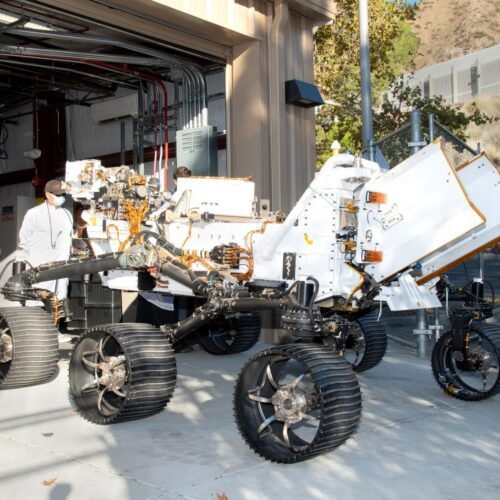
NASA officials said Tuesday that they are seriously considering sending the full-scale engineering model of the Perseverance rover, which is currently housed at the Jet Propulsion Laboratory in California, to the Moon to expedite their efforts to explore the south pole region.
The car-sized rover nicknamed “Promise,” which serves as a testbed for Perseverance and was not otherwise planned for a launch, would land equipped with a multi-mission radioisotope thermoelectric generator (MMRTG) to power it across difficult terrain and through the lunar night. NASA’s other rovers primarily operate on solar power.
“We are thinking very hard right now about sending Promise to the Moon,” NASA Administrator Jared Isaacman said Tuesday during a monthly update on the agency’s plans to build a Moon base.
“An awesome capability”
NASA has an MMRTG available, with a supply of Plutonium-238 that is just decaying away. It is likely the rover, with a mass of about 1 ton, would need to be delivered by Blue Origin’s Blue Moon lander or SpaceX’s Starship due to its size.
Isaacman and Carlos García-Galán, another NASA official spearheading the Moon base initiative, were clearly fired up about the possibility of using existing hardware to bring new capabilities to the lunar program.
“That would be an awesome capability,” García-Galán said. “For Moon-based objectives, having a nuclear RTG on it allows us to go anywhere we want, regardless of the illumination. Surviving the lunar night is going to be one of the bigger challenges with this capability, we wouldn’t have to worry about that. So, long traverses getting into those very hard-to-reach areas, just like Curiosity and Perseverance have shown us on the surface of Mars, that would be awesome.”
No longer needed as a test bed?
Over the years, Promise has served as a test bed for problems that Perseverance might encounter on Mars. Commands are often tested on this vehicle in the “Mars yard” at the California laboratory before similar commands are sent to the rover on the surface of Mars. It has also helped ensure Perseverance can safely traverse various areas on Mars.
Perseverance launched to Mars in July 2020, and its predecessor, the similarly sized Curiosity rover, launched to the red planet in November 2011.
“It makes sense, early on, when we’ve got a problem that we might want to test it out here before we upload it to Mars,” Isaacman said. “But we’ve had years now of experience operating the two rovers on the surface of Mars, and we’ve got this hardware that the taxpayers invested a lot in. So the question was posed, what if we sent it to the Moon?”
Although the Mars rovers were designed to operate on the surface of Mars, the JPL engineers said Promise could be modified to work on the Moon. NASA will also need to make some adjustments to the scientific instruments aboard the vehicle, but Isaacman said this represents a creative way to advance the agency’s interests in understanding the environment where it wants to establish a long-term human presence.
“We’ve got the hardware, and this is exactly what we should be trying to do to put wins on the board, getting a capability like Promise to the surface of the Moon,” he said.
Could do a lot of useful science
There are many useful scientific and exploration objectives a rover like this could accomplish. NASA studied these questions less than a decade ago with an “Endurance” rover proposal that would have traveled nearly 2,000 km across the South Pole-Aitken basin on the far side of the Moon (see this large PDF file for more information). It was never built.
This decision is not final, and NASA is still assessing the feasibility of using Promise as a mainstay of its lunar fleet. However, the announcement on Tuesday underscores that Isaacman and his team are scouring NASA for hardware and other tools to advance the agency’s mandate to return to the Moon and to build a surface base.
The space agency is effectively on a wartime footing as it seeks to accelerate plans to land humans on the Moon’s south pole before China and to explore the most interesting terrain there first. Mars is not a near-term priority.
“It’s quite symbolic, in a way, the harvesting up what’s left of the Mars program and shipping it to the Moon,” said Casey Dreier, chief of space policy for The Planetary Society.