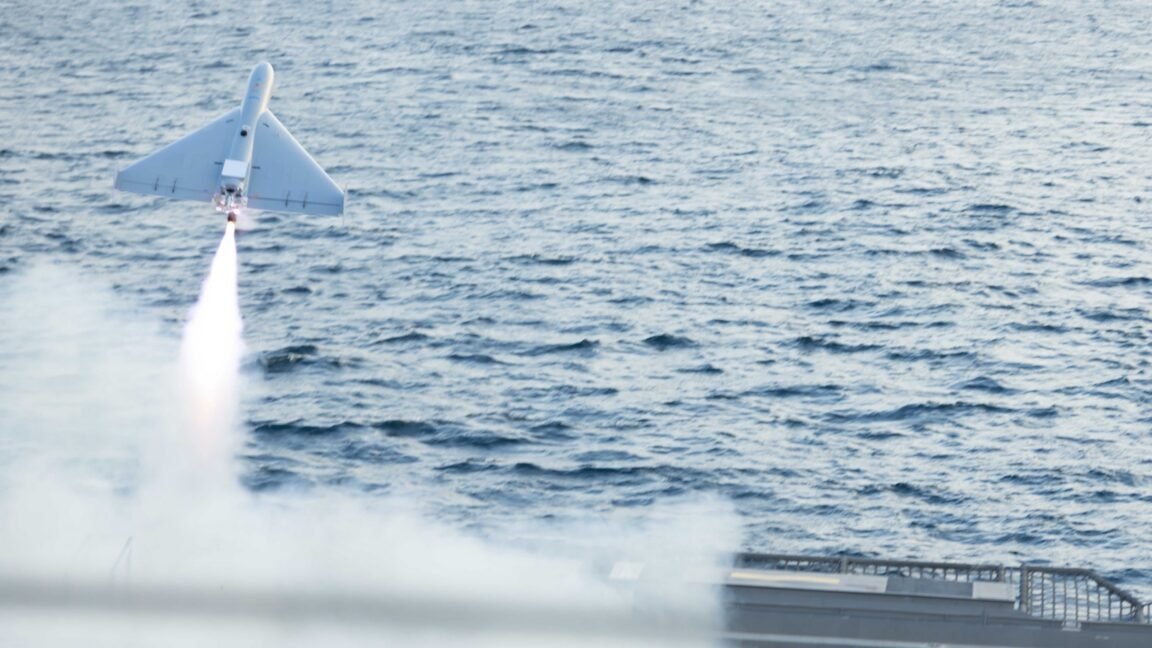
SpaceX and the Pentagon have been bickering about the price of using Starshield satellite service during the Iran war, according to a Reuters report published today. It appears that SpaceX asked the military for more money after it started using satellite terminals on “kamikaze” attack drones in Iran.
SpaceX CEO Elon Musk claimed the Reuters report is wrong. But Musk also said the military drones initially used the commercial Starlink service instead of the government-specific network, in violation of Starlink’s terms of service. Musk blamed the violation on the contractor that built the drones for the government.
The Reuters report, based on Pentagon documents and interviews with sources familiar with the pricing talks, said that SpaceX recently asked the military to pay $25,000 for Starshield access on each kamikaze drone. The Pentagon, which previously paid $5,000 for each connection, objected to the price hike but ultimately agreed to pay it, according to Reuters.
While the $25,000 charge is a monthly fee for the satellite connection provided to a satellite terminal, the terminals are being used with drones that only make one-way trips before hitting targets and detonating on impact.
Starshield is a network for government entities and is based on Starlink technology. Musk wrote in an X post today that the “Reuters article is false.” But in the very same post, he seemed to confirm a dispute over how the military used SpaceX satellite technology.
“They made improper use of the Starlink civilian system for military purposes. Direct violation of terms of service,” Musk wrote today, seeming to indicate that the military used the commercial Starlink system when it should have been using Starshield.
Musk said later that the drones were configured incorrectly by a military contractor. “There is a US government arm of SpaceX called Starshield, which has a different set of satellites than Starlink, which is for civilian use. The company that makes the suicide drones incorrectly used the civilian system, instead of the Starshield,” Musk wrote.
SpaceX “argued the military was underpaying”
The Pentagon “denied any violation of its agreement with SpaceX,” according to Reuters. Starshield terminals sold by SpaceX to the military can connect both to the commercial Starlink satellite constellation and Starshield, the Reuters article said.
The drones in question are part of the Low-cost Uncrewed Combat Attack System (LUCAS), which was made by defense contractor Spektreworks. We contacted Spektreworks today and will update this article if it responds.
Musk previously addressed the military use of SpaceX satellite terminals on drones on March 1, one day after the Iran war began, in response to an X post in which a user posted a picture of one of the drones that appeared to have an integrated satellite terminal.
“It is a violation of commercial Starlink terms of service to use the terminal for weapon systems. This applies to all users and is shut down when discovered,” Musk wrote at the time. “There is a separate network called Starshield, which is operated by the US government. This is not under SpaceX control.”
Within weeks of the US launching strikes in Iran, “SpaceX executives met Pentagon officials and argued the military was underpaying for the service,” the Reuters article said.
“SpaceX argued the LUCAS drones were operating under conditions that aligned more closely with its aviation tier subscription rather than a lower priced land or mobility service. Pentagon officials argued that the $25,000 price tag—a monthly fee—was designed for aircraft, not kamikaze drones that used [a] Starlink connection for a matter of minutes or hours, according to one of the sources,” Reuters reported.
The Pentagon “ultimately agreed to pay SpaceX’s proposed price increase” from $5,000 to $25,000, according to Reuters. LUCAS drones give the military a cheaper alternative to traditional missiles and grew out of an effort to reverse-engineer Iranian-built drones. Each drone reportedly costs about $35,000.
Mobile price prompted “alarm from defense officials”
Despite agreeing to the price increase, “senior officials including Deputy Secretary of Defense Steve Feinberg remained uneasy about the arrangement,” and Pentagon officials in April “met to revisit the pricing with Terrence O’Shaughnessy, a retired four-star Air Force general who now leads SpaceX’s defense business,” according to Reuters.
“Still, the Pentagon is currently considering an additional purchase of more than 3,500 Starshield terminal subscriptions, including 100 with the higher-priced aviation tier, according to Pentagon documents reviewed by Reuters,” the article said. “The deal could generate hundreds of millions of dollars in annual revenue for SpaceX, though Reuters could not determine whether an agreement has been finalized, or what price is being discussed.”
There’s also reportedly been a dispute over the price of providing Starlink mobile service to Iranian citizens who have suffered under a government-imposed Internet blackout. In January, the US reportedly smuggled 6,000 Starlink broadband terminals into Iran to help residents bypass blocks to Internet access.
Reuters reported that Pentagon officials asked SpaceX about providing Iranians with direct-to-cell service, which can keep people connected on standard cell phones without needing a terminal.
“SpaceX, which generated $11.4 billion in revenue from Starlink in 2025, proposed charging as much as $500 million to launch the capability, along with a $100 million monthly fee to operate it, according to one of the people and Pentagon documents—prompting alarm from defense officials over the price. Reuters could not determine whether an agreement has been reached,” the Reuters article said.
The US and SpaceX previously had a dispute over payment for satellite terminals sent to Ukraine beginning in 2022. SpaceX initially donated terminals before asking the Pentagon to pay for ongoing service and more terminals. The Defense Department later confirmed that it was paying for Starlink service in Ukraine.
SpaceX’s IPO filing last week said that revenue for its government connectivity business dropped in the most recent quarter. SpaceX’s overall connectivity revenue in Q3 2026 was $3.3 billion, a year-over-year increase of $782 million. The increase was driven by boosts in revenue from consumers, large businesses, mobile partnerships with wireless carriers, and Starlink’s aviation and maritime offerings. The overall revenue increase would have been higher if not for “a decrease of $175 million in our government connectivity business,” SpaceX said.
SpaceX satellite dominance leaves few options
While SpaceX isn’t the only operator of low Earth orbit satellites, Reuters notes that “no other company provides a comparable alternative to Starlink, which has become an increasingly critical tool in modern warfare since Russia’s invasion of Ukraine in 2022.”
The Department of Defense declined to comment on its negotiations with SpaceX today, but told Ars that it “is operating in accordance with the terms and conditions of its contracts.” The department also provided Ars with a statement indicating that the military is looking for alternatives to SpaceX.
“The Department of War is committed to fostering a competitive environment for commercial satellite communications and is conducting comprehensive market research to continuously monitor commercial offerings that align with government requirements,” the Pentagon statement said. “We are actively engaging with industry to identify innovative solutions and new entrants, ensuring acquisitions are inclusive of a diverse range of capable vendors.”
The statement added that the Space Force’s “Commercial Satellite Communications Office is working on additional options with other proliferated low earth orbit partners as part of its strategy to leverage the unprecedented capabilities provided by the commercial SATCOM industry.”
We contacted SpaceX and will update this article if it responds.
Pentagon spokesperson Sean Parnell responded to the Reuters article in an X post today. “The Fake News media has the story wrong, again. SpaceX remains a strong and valued partner to the Department of War. The claims in this article are simply not based in reality and do not reflect the close, effective collaboration between our teams.”
Musk shared Parnell’s post, calling it a “correction issued by [the] Department of War.”