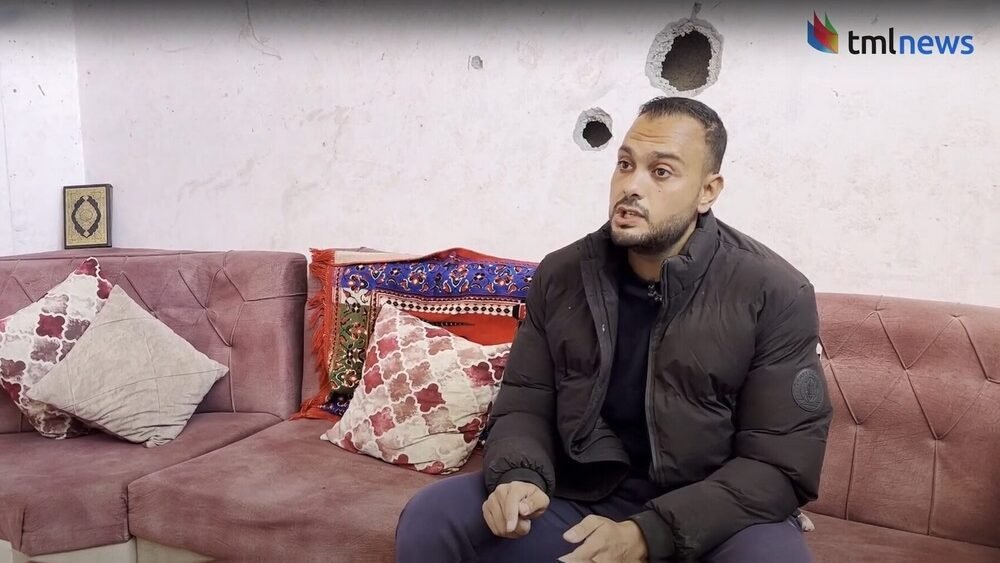
Al-Natour aims for a meeting with President Trump, says Gazan civil society is not Hamas, wants a political role, and calls for schoolbook reform to counter radicalization
The path out of Gaza began, Moumen Al-Natour said, with men at his door. In July 2025, he said Hamas operatives came to his house in Gaza City’s al-Shati refugee camp and ordered him to go to Shifa Hospital for questioning by Hamas’ internal security service. Al-Natour refused. He managed to escape, leaving behind Hamas operatives who demanded to know: “Where is Moumen?”
They threatened my family, all of my members in my family, my mother, my sisters, my brothers
The men who came for him, he said, did not come only for him. “They threatened my family, all of my members in my family, my mother, my sisters, my brothers,” Al-Natour said. He fled to another location, moving through Khan Yunis and Al-Mawasi in search of a way out. What happened next would take him through a militia-controlled area, into contact with international advocates and, eventually, to Italy—physically safe, but far from the city, family and future he still calls his own.
The Media Line previously spoke with Al-Natour in April 2025, when he was trapped in Gaza. His account is not simply the story of a man who escaped danger. It is the argument of a Gazan lawyer, human rights advocate, and founder of the We Want to Live movement who believes Gaza must be separated from Hamas if either Gazans or Israelis are to have a future beyond recurring war. The foundation of every proposal he advances, every warning he issues, and every appeal he makes to world leaders: “Gaza is not Hamas. And, Hamas is not Gaza,” he said.
After leaving his home, Al-Natour said he reached out to the Center for Peace Communications in the United States, which he said helped him explore ways to reach safety. He later went to an area under the control of Yasser Abu Shabab’s militia while arrangements were being considered for an evacuation to Canada. An Italian lawyer, Alessandra Casola, also worked to help evacuate him and his family, according to Al-Natour.
His family, he said, reached Italy toward the end of September 2025. But his own request to leave was initially refused by Abu Shabab, who, Al-Natour said, wanted him to join the militia. “He told me, I’m the president and you are the prime minister,” Al-Natour recalled. His answer was unequivocal: “I refused this because I want to be in government, not in militia.”
For Al-Natour, rejecting the offer was a rejection of armed rule in any form. “I want to make a service for my people. I want to save the civilians,” he said. “But I don’t want to be a gang man.” He said photographs published of him later made him a target of Hamas media allegations that he was connected to a spy program—an accusation he denied. “I want peace between us and Israel,” he said. “And I don’t want to be a spy for anyone, for any country.”
I want peace between us and Israel, And I don’t want to be a spy for anyone, for any country.
Asked directly whether Hamas had targeted him because of his past work, Al-Natour did not hesitate. “Yes, yes, yes,” he said. Before October 7, he said, he had spoken out about his rights and the rights of his community, describing Hamas as seeking “to impose a form of strong power over the people.”
That history of confrontation with Hamas has shaped the message Al-Natour has carried into exile. He said he has not received a direct response from the US administration, although the White House retweeted an article he wrote for the Washington Post about moving civilians from Hamas-controlled areas to a new area inside the Yellow Line. But his appeal extends beyond Washington to anyone with influence over Gaza’s future: “We want to return to our city, to our country without Hamas. And we want to create a peace agreement between us and Israel. And we don’t want war.”
In his opinion, Hamas makes renewal impossible. “Because I believe with Hamas inside Gaza, we can’t do anything. We can’t rebuild Gaza. We can’t make new ideas inside Gaza,” he told The Media Line. He described Hamas’ reach into religious institutions and education, saying it controlled more than 1,000 mosques and used schools to expose children to instruction on weapons. “And I know this is very bad for the generations,” he said.
I believe with Hamas inside Gaza, we can’t do anything. We can’t rebuild Gaza.
His own aspiration is far less complicated, and he repeated it until it became the interview’s refrain: “For me, I don’t want war. I want to live. I want to live. I want to work. I want my rights.” He contrasted the rights he sees people enjoy in Italy, Europe, the United States, Canada, and Australia with what he said he could not obtain in his own city.
When the discussion turned to the possibility of Hamas entering future Palestinian elections, Al-Natour offered a stark warning. He said Gazans reject Hamas’ inclusion in a new Gaza or Palestinian government and argued that allowing the organization to participate would invite another catastrophe. “But if Hamas is inside Gaza, I think after 20 years, 30 years, a new leader in Hamas will make another 7th of October. And we don’t want that.”
He also questioned how a meaningful election could take place amid destruction and territorial fragmentation. “How we can make an election in a 30% area from Gaza Strip?” he asked. “How we can make that? This election is very bad for us. And I don’t want this election to succeed.” In his view, Hamas’ participation would endanger not only Gaza but the West Bank as well.
Al-Natour said he has been discussing a plan since January 2024 to separate Hamas fighters from civilians. He proposed checkpoints around a designated zone to screen people entering it, arguing that such a process could be more reliable than accepting a promise by Hamas to disarm. “Because I know Hamas,” he said. “If Hamas want to disarm everything, okay, but I can’t believe Hamas. I can’t trust Hamas.”
The proposal is entwined with his hope of returning to public life in Gaza. “And if the war accepts my plan to separate between the civilians and Hamas … I want to return to my Gaza because I want to be in the government, the new government,” he said. “Because this is my city.”
But he also believes physical separation alone is insufficient. In response to a question about demilitarization and the content of school curricula, Al-Natour insisted that Gaza needs “a new school” and “a new education for the next generation.” He described an economic future tied to relations with Israel, including opportunities for Gazan workers to work and earn money there. “Without Israel, we can’t,” he said.
The alternative, in his view, is a Gaza trapped in the patterns of conflict that have already devastated other countries. “And if we refuse to resolve the education and most speech, I think Gaza will be like Afghanistan, like Sudan, like any country has a war,” he said. “We want to resolve everything, and we want to write new books.”
Al-Natour framed this change not as a rejection of Islam but as a rejection of radicalization. He said Islamic teachings offer “a lot of good things to learn the generations,” while condemning Hamas’ radical messaging in mosques and streets. “Because I hate Hamas. I hate Hamas’s ideas. I hate Hamas radical people,” he said.
He pointed to what he had seen during visits to Dubai and Abu Dhabi in 2019, saying he admired imams whom he believed taught people how to be “good and nice.” He wants a similar ethos in Gaza—education and religious instruction, he said, that teach acceptance “without any radical ideas” and “without hates.” “And I love that. I love that,” he said.
Al-Natour does not claim that everyone in Gaza shares his view. When asked how many Gazans might oppose Hamas, he answered carefully: “I don’t know. I don’t know the numbers.” But he then offered his own assessment: “More than 70% of Gaza people hate Hamas, and they refuse Hamas.”
He said Palestinians carry their own beliefs and grievances regarding Israel and the question of statehood. “Okay, we want to live like neighbors with Israel, but Israel must create a new state for Palestinians,” he said.
Asked whether a political resolution could emerge through cooperation rather than armed conflict, Al-Natour argued that a functioning Palestinian government would be essential. “The government of Israel cannot talk with everyone inside Gaza,” he said. “But if we have a government, I think we can talk, because this is very important for us.”
His answer broadened beyond politics into a simple declaration of coexistence. “I like Jewish people, and I like Christian people, and I like Muslim people,” he said. “I don’t have any problem with the religion of Israel, or Jewish religion. I want to live just, okay, I want my rights, but without war. War destroys us.”
The claim carries the weight of a life he described as measured in wars. He recalled witnessing Hamas’ 2007 takeover from the Palestinian Authority and subsequent conflicts between Hamas and Israel in 2008-09, 2012, 2014 and 2021, as well as conflict involving Islamic Jihad. “And in 2023, I led, I have been led in another war from 7th October until now,” he said, asking: “How I can build my future with radical people, with wars?”
Al-Natour answered his own question with the image of a house. To build a future, he said, one must bring the materials to build it and then improve it—not destroy it and start again. “Between, from 20 years, we are building houses, just houses. After that, Hamas make[s] wars and Israel [is bombing us. This building is destroyed,” he said. “How we can build our future with wars? How we can build our economics with wars?”
Despite his media appearances, Al-Natour said he has not met with a government anywhere in the world. He described a world consumed by other conflicts and said Gaza has been ignored, even as civilians struggle in tents without clean water or food. “And, if you want to eat in Gaza, you must obey. You must obey,” he told The Media Line, alleging that Hamas takes what people need to survive.
His appeal is for Gaza to be rebuilt through cooperation, not abandoned to Hamas or to another cycle of war. “We want to rebuild our city, and we want to build our state with Israel,” he said. “We want to cooperate with Israel. In security, in civilian, in civil situation, and everything. Because, we are neighbors. Not enemies. Not enemies.”
Al-Natour insisted that personal ambition is not what motivates him. “I’m not interested to be a leader for Gaza,” he said. “But, I want to save my people.”
Yet he remains painfully aware of what he has lost. His wife and daughter remain in Gaza, he said, while bureaucratic difficulties have complicated efforts to reunite his family. “I talked about this for the Italian government, for anyone here in Italy. But, I didn’t hear any answer from them,” he said. His hope, he said, is not exile. “I want my city. I want to return to my house. I want to feel established. Like, before 7th of October, my house, my family, my people, my friends, my relatives.”
Italy offers safety but not belonging. He describes himself as a stranger in Italy. “This is not my community. This is not my people. Not my culture,” he said, adding that he respects the country and its people. Still, he wants his own people—even though he knows returning to Gaza would be dangerous. “Because I know Hamas. I know Hamas. Hamas is Hamas … They will kill me. They will kill me.”
He said Hamas’ internal security apparatus remains a particular source of fear. Referring to what he described as an Israeli special-forces operation in the Al-Katiba area in which the head of Hamas’ internal security was captured, he spoke in accusatory terms: “This man [Muain al-Arabid] is very radical. This man murdered us … this man hit us. This man is very dangerous.”
For Al-Natour, the danger is not confined to individual Hamas security officials. Asked what he wanted to see happen to Hamas’ internal security apparatus, he answered immediately: “I want to eliminate them. I want to eliminate them. I don’t want to see them another time.” He said Hamas “made this war” and accused the group of manipulating regional and international actors as it seeks to regain power: “They play with Israel. They play with the US. They play with Egypt, Qatar, Turkey. They play with everyone. They want to return to the government. They want to return to the control of Gaza.”
His urgency deepens when he speaks of children born during the war and of civilians, he said, still deprived of basic rights. “We have generations now. They were born from the beginning in this war. We want these boys to return to the schools.”
For him, the prescription remains unchanged: “If you want to resolve the situation in Gaza, everything. Education, most speeches, everything. You must separate between us and Hamas. You must take Hamas outside Gaza. If Hamas wants to fight, they can fight. Alone. Without human shields.”
If he could sit across from one world leader, Al-Natour said, it would be Donald Trump. “Strong man. And, he has a power. Big power,” he said. His request was for recognition that Gaza’s people are distinct from the organization that rules them. “Poor people. They want to just live. Without any fight. Without any wars.”
Then he returned once more to the line that defines his appeal: “Hamas. Hamas is a part of Gaza. Not all of Gaza. Gaza is not Hamas. And Hamas is not Gaza.”
For Al-Natour, separating the two is the condition for families to return home, for children to return to school and hospitals, for a new government to emerge, and for Gaza to become a place where people can build rather than rebuild. He also argued that future regional engagement must be conditioned on a complete break with Hamas, and he voiced concern that Gaza could remain trapped while people wait out political cycles in Israel and the United States. “I think 2027 will be like 2026 for Gaza.”
The aids and the money. They don’t reach to poor people in Gaza. The money reaches to Hamas.
He also alleged that international assistance intended for Gaza’s civilians is diverted to Hamas. “The aids and the money. They don’t reach to poor people in Gaza. The money reaches to Hamas,” he said. The charge formed part of his plea to those outside Gaza to distinguish, in his view, between helping a civilian population and strengthening Hamas. His final plea was unmistakable: “Please, hear … us. It’s enough. It’s enough.”