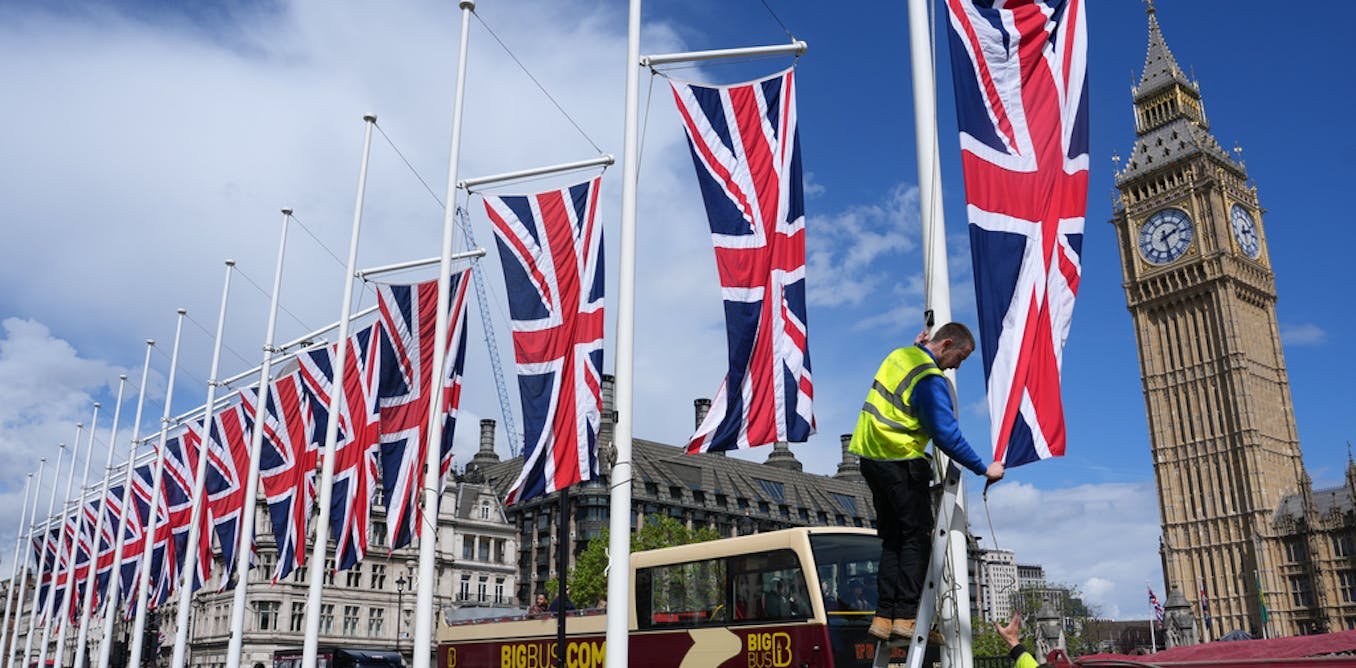
Local elections in Britain on May 7, 2026 – in which the ruling Labour Party suffered deep losses – revealed tectonic shifts.
The two-party system that has been operating there since 1721 has effectively turned into a five-party free-for-all.
Reform U.K., the anti-immigrant right-wing party led by Nigel Farage, won 1,453 seats in local councils, followed by Labour with 1,068, Liberal Democrats 844, the Conservatives 801 and the Greens 587. According to analysis by the BBC, at the national level Reform won 26% of the vote, Greens 18%, Conservatives 17%, Labour 17% and the Liberal Democrats 16%.
If that pattern carried over to the next national election, to take place in no more than three years, the Labour and Conservative parties, which have dominated Westminster Parliament for 100 years, would be all but wiped out. Labour Party leader Keir Starmer, moreover, is deeply unpopular and might soon find himself out of the prime minister job.
Yet the elections are not merely bad news for the parties who have ruled Britain for so many decades. They are also a signpost of the increasing political instability of a country that exists as a political union of four separate nations.
For the first time ever, pro-independence parties now control the devolved parliaments of Wales, Scotland and Northern Ireland. “What people in London like to refer to, rather patronizingly, as the “Celtic fringe” is very much about to become center stage,“ said Scottish First Minister John Swinney.
A story of democratic decline
As an expert on European politics, I have long tracked what many see as the steady decline of British democracy – especially since I started writing the Britain chapter for the Cambridge University Press Comparative Politics textbook in 2000.
Economic stagnation, rising inequality and a decline in public services have eaten away at trust in political institutions. Britain is, of course, not alone: Across Europe, there has been a deficit in trust and support for mainstream political parties. That process has many variables and causes, but accelerated after the 2008 financial crash and has been exacerbated by rising concern over immigration.
The share of foreign-born people in the U.K. doubled from 8% to 16% between 2001 and 2021, according to the nonpartisan Migration Observatory at the University of Oxford. Meanwhile, in the European Union, it rose from 8% to 14%.

Seizing on anti-immigrant sentiment, support surged for right-wing parties which claimed that traditional national cultures were being undermined.
The Brexit story
At the same time, many on the right wing of the Conservative Party were hostile to membership in the European Union. In 2016, the Conservative Prime Minister David Cameron called a referendum on whether to leave the EU, expecting that a negative vote would put the issue to rest.
But U.K. voters narrowly opted for Brexit, and Britain left the EU in January 2020. In Scotland and Northern Ireland, a majority voted for the U.K. remaining in the EU.
Brexit was a major blow to the British economy, and the Conservatives cycled through five prime ministers in eight years, as they negotiated the messy process of leaving the EU.
Due to the vagaries of the first-past-the-post, single-seat electoral system, Labour defeated the Conservatives in the 2024 election, winning a decisive 411 of the 650 seats in U.K. Parliament – but only earned 34% of the votes.
Today, polls show just 30% of Britons think Brexit was the right decision, while 58% think it was a mistake. In Scotland, the anti-Brexit sentiment is even more stark.
The rise of the nationalists
In 1999, Tony Blair’s Labour government introduced independent parliaments in Wales and Scotland – known as devolution – in a bid to reinvigorate British democracy and head off the political challenge from nationalist parties that were eating into Labour’s support base. George Robertson, the Labour spokesman for Scotland, said in 1995 that devolution “would kill nationalism stone dead.”
But the new assemblies provided a platform for pro-independence parties: Plaid Cymru in Wales and the Scottish National Party, or SNP. They pressed for policy concessions to protect the distinct cultural identities and economic interests of their nations.
The public services they provide, moreover, are more generous than those in England. For example, university is free for Scottish students, while students in England have to pay tuition of £9,790 (US$13,250) a year. This is only possible thanks to financial assistance from London: Total annual subsidies now run at $35 billion for Scotland and $30 billion for Wales – or about 12% of the gross domestic product.
The SNP has been the largest party in the Scottish Parliament since 2007. Hoping to put calls for Scottish independence to rest, the Conservative government held a referendum on the issue in 2014. The “no” vote against independence won, by 55% to 45%, with economic anxiety being the main factor swaying the voters against secession. To Westminster, the referendum was framed as a “once-in-a-generation” vote on the issue, but the nationalists’ commitment to independence has only persisted.
On May 7, 2026, the SNP won a plurality of seats in the Scottish Parliament, far ahead of Labour and Reform U.K., followed by the Scottish Greens, Conservatives and Liberal Democrats. The SNP fell short of an absolute majority, but since the Greens also support independence, the SNP argue that it has a mandate for another independence referendum, possibly as early as 2028.
Labour had held a majority of the Westminster Parliamentary seats in Wales since 1922 – the longest winning streak of any political party in the world. But in the local elections, Plaid Cymru won nearly half the seats in the Welsh Parliament, with Reform second and Labour a distant third. Plaid Cymru wants control of rail, justice and the crown estate lands devolved from Westminster, as they are in Scotland. It will be hard for Labour to resist these concessions if it wants to rebuild its support in Wales.
Northern Ireland, which did not vote in the May elections, is a special case. Its economy is closely integrated with the Irish Republic. After Brexit, it was agreed that Northern Ireland would maintain open borders with the South, but that meant customs controls had to be introduced on goods traveling between Northern Ireland and the rest of the U.K., despite being part of the same country.
In 2024, the deputy leader of the Sinn Fein party, Michelle O’Neill, became Northern Ireland’s first nationalist First Minister, a post she holds jointly with the head of the pro-U.K. Democratic Unionist Party under the power sharing introduced by the 1998 Good Friday Agreement.
That agreement stipulated that Northern Ireland could unify with the Republic of Ireland in the future if a referendum produced a majority in favor, on both sides of the border. Support for unity is growing in the North, but polls indicate that it is still less than 40%.
For its part, England remains the strongest U.K. economy, driven by London, where household income is 43% higher than the national average. England’s population of 59 million dwarfs the 5.5 million in Scotland, 3.2 million in Wales and 1.9 million in Northern Ireland.
But English nationalism remains something of a sleeping lion: No party, not even Reform U.K., has tried to stoke English nationalism in opposition to the demands from Scotland and Wales.
Broader implications
Political scientists have long debated whether federalism – creating autonomous units that share sovereignty with the central authorities – satisfies the demands of ethnic minorities, or merely provides them with opportunities to mobilize and escalate their demands.
It is clear that the federal structure of the Soviet Union, Czechoslovakia and Yugoslavia was a key factor in explaining why those socialist systems collapsed in 1991.
But in democratic systems such as Spain, India and Canada, granting autonomy to certain regions has proved a sustainable compromise. Quebec held two referendums on independence from Canada, in 1980 and 1995, which failed to pass. By threatening to leave, however, nationalists can win more concessions from the federal center – without having to bear the costs of actual secession.
We are likely to see that pattern repeated in Britain. If Reform U.K. were to form a government in Westminster after the next election – as polls currently suggest it could – the party may try to roll back some of the political and financial concessions given to Scotland and Wales.
Reform U.K. doesn’t have a clear policy on devolution, but it would be highly likely to resist proposals to devolve authority over immigration to Scotland or Wales.
Whatever the case, the federal dimension is yet another challenge facing the embattled political system of the U.K.