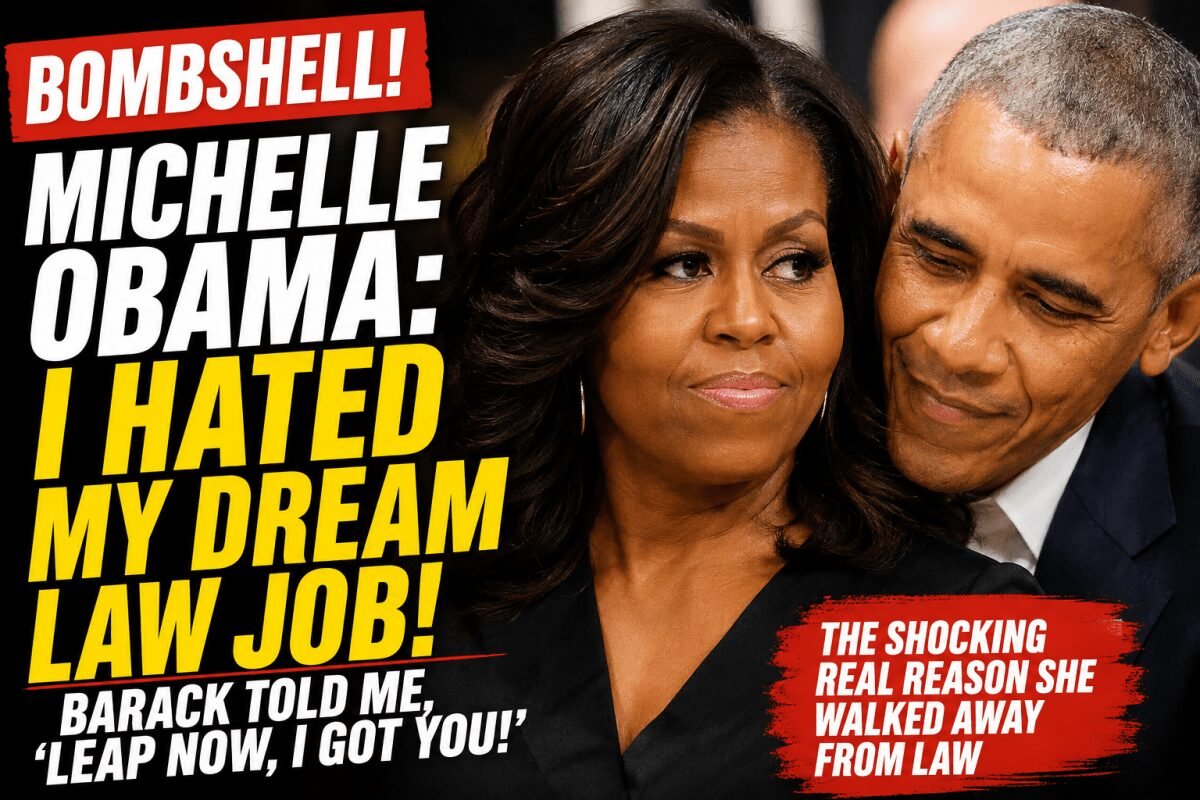
Michelle Obama may have had the résumé, the Ivy League degree and the prestigious Chicago law firm job that looked like a dream on paper — but behind the scenes, she was miserable.
The former first lady has revealed she walked away from her corporate law career after realizing the high-powered profession she had worked so hard to enter was not the life she wanted at all. And according to Michelle, it was her then-boyfriend and future husband, Barack Obama, who gave her the courage to make the shocking pivot.
Michelle, 62, opened up about the life-changing decision during a live appearance at SXSW London, which later aired on her IMO podcast on July 22. In the candid conversation, she admitted she chose law less out of passion and more because it seemed like the right thing to do.
“When I was at Princeton, I had to figure out what to do next,” Michelle recalled. “I was like, ‘I don’t like math. I read. I like to talk a lot, so I’ll apply to law school.’ I mean, that’s how I picked going to law school.”
That choice eventually took her from Princeton University to Harvard Law School, and then to the Chicago office of Sidley & Austin, one of the city’s most elite firms. It was exactly the kind of job a young Harvard Law graduate was expected to want.
But once Michelle got there, reality hit hard.
“But when I got to the law firm and worked at a big corporate firm in Chicago — what you were supposed to do after Harvard Law School — I realized, ‘Oh my God, I don’t like law. I don’t like it at all,’” she said.
Michelle made it clear she was not criticizing attorneys or the legal profession. The problem, she said, was simple: it just was not for her.
“It wasn’t even close,” she added. “And thank you to all the lawyers. No shade, but it just wasn’t for me.”
The confession is striking because Michelle had already achieved what many would consider the perfect career path. She had graduated from Princeton in 1985 with a sociology degree, earned her law degree from Harvard, and landed a job at a major corporate firm.
But looking back, she said she had been following a path that felt safe and impressive, not one that truly fulfilled her.
“I just pursued something that I could do well,” Michelle explained. “I didn’t know anything about passion or purpose. And the truth is, I didn’t know what other careers were out there other than the traditional careers.”
At the time, she said, options like law and medicine seemed like the obvious routes for ambitious students who wanted to succeed. Michelle knew she could excel in law, but excelling at something did not mean she loved it.
Ironically, that same law firm also changed her life in a completely different way. While working as an associate at Sidley & Austin, Michelle met Barack Obama, another Harvard Law School graduate who came into her life with a very different view of success.
Barack had big credentials of his own. He had been president of the Harvard Law Review, a distinction that could have opened doors to elite clerkships and a powerful legal career. But Michelle said he was never interested in following the expected route.
Instead, Barack had already worked as a community organizer and saw law as a tool, not the final destination.
“He had been a community organizer,” Michelle told the audience. “He went back to law not because he wanted to work at a corporate firm, but because he thought it would give him the tools to help the community.”
She added: “He had no interest in Supreme Court clerkships, even though he was president of the Harvard Law Review and that was the expected path.”
That attitude had a major effect on Michelle, especially as she faced personal tragedy.
Michelle said the 1991 death of her father, Fred Robinson, deeply shook her. Around the same time, a close friend died of cancer shortly after being diagnosed. Those losses forced her to confront how short and unpredictable life could be.
“It made me stop and think, ‘Oh my God, life is short. It is unpredictable. Nothing is really guaranteed,’” Michelle said.
Then came the blunt question that changed everything.
“If I were to die tomorrow, is this where I want to be? On the 47th floor of a corporate firm, working for corporate clients?” she remembered asking herself.
The answer was no.
Michelle described Barack as “the master swerver,” meaning someone who was not afraid to make bold turns in life when the expected path no longer fit. While Michelle was struggling with whether to leave the security and prestige of corporate law, Barack encouraged her to trust herself.
According to Michelle, his message was direct and reassuring.
“If you don’t want to do the law, leap now,” Barack told her. “I got you. We’re going to be okay.”
So she leaped.
Michelle left the law firm and went to work for the city of Chicago, becoming an assistant to the mayor before later moving into economic development. The decision marked the beginning of a completely different professional life — one that eventually helped lead her toward public service, advocacy, the White House and a platform of her own.
“With every move, I realized I was walking more into my reality, into my truth,” she said.
For Michelle, the story was not just about quitting a job. It was about realizing that a prestigious career can still feel wrong if it is not connected to purpose.
And for all the power and polish that later surrounded the Obamas, Michelle’s confession offers a surprisingly human glimpse at a young woman who had done everything “right” — only to discover she was standing in the wrong place.
In the end, the job where she realized she hated law was also the job where she met the man who helped convince her to leave it behind.