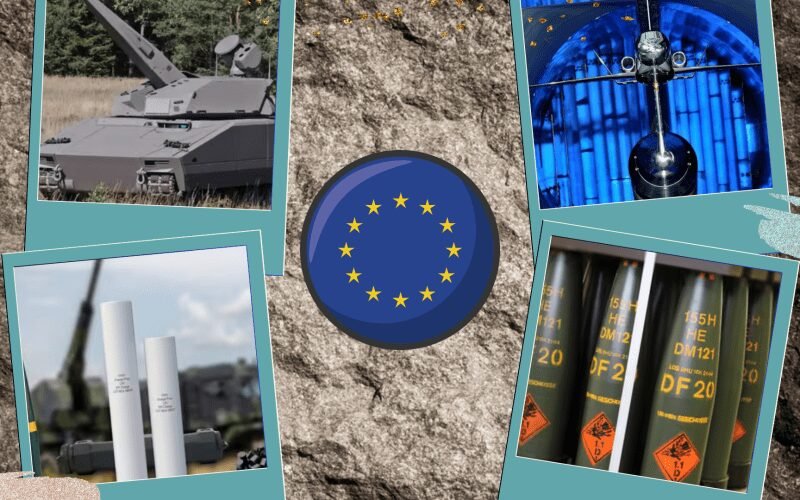
European Parliament committees have backed plans to establish a new EU programme aimed at accelerating defence innovation in response to the changing security environment created by Russia’s war against Ukraine.
On Thursday, the Parliament’s Committee on Industry, Research and Energy (ITRE) and Committee on Security and Defence (SEDE) adopted their position on the proposed Programme for Agile and Rapid Defence Innovation (AGILE).
The proposed programme is intended to speed up innovation cycles and support the deployment of new technologies by EU member states’ armed forces and European defence companies, helping them scale up across Europe. The technologies covered include artificial intelligence, quantum computing, robotics, cyber capabilities, space systems and unmanned autonomous systems.
In amendments to the draft legislation, MEPs called for faster, simpler and more results-oriented support for small and medium-sized enterprises, including innovative start-ups and scale-ups. They proposed that, where possible, funding should be provided as lump-sum grants to allow companies to focus on delivering agreed outcomes.
The committees also proposed stricter rules governing the transfer and ownership of technologies developed under AGILE, requiring any export of exclusive licences to non-associated third countries to be notified and approved.
MEPs further sought to tighten safeguards by preventing EU funding from being awarded to entities from third countries that act against the security and defence interests of the European Union and its member states.
They also proposed that products supported through AGILE should be eligible for procurement by Ukraine through the Ukraine support loan, citing the urgent need to provide Kyiv with innovative technologies developed by Europe’s defence industry.
The programme is designed as a pilot initiative running throughout 2027 under the current 2021-2027 Multiannual Financial Framework, with a budget of €115 million. According to MEPs, the experience gained should help shape the EU’s approach to defence innovation under the next long-term budget, with the European Commission assessing whether the programme should be continued, adapted or expanded.
ITRE rapporteur Ivars Ijabs said Europe could not afford to respond slowly to rapidly evolving threats, describing AGILE as a way to deliver funding more quickly while reducing bureaucracy and supporting innovation.
SEDE rapporteur Tonino Picula said the programme would help move defence technologies more rapidly from innovation to operational deployment by supporting SMEs and start-ups, strengthening resilience against dependencies on third countries, facilitating procurement, including for Ukraine, and ensuring effective oversight.
ITRE Chair Borys Budka said Russia’s war had demonstrated the importance of innovation in modern conflict and argued that AGILE’s target of awarding grants within four months would help innovative SMEs access funding more quickly through lump-sum financing.
SEDE Chair Marie-Agnes Strack-Zimmermann said Parliament’s position sent a clear signal that European defence innovation should be driven by operational needs and deliver capabilities that address Europe’s most urgent defence gaps.
The committees approved the proposed amendments by 76 votes to eight, with seven abstentions. MEPs also voted by 83 votes to eight to open negotiations with the Council of the European Union. Interinstitutional talks are expected to begin under the Irish Presidency of the Council once member states have adopted their own position.







 and Committee on Security and Defence (SEDE) adopted their position on the proposed Programme…)