Cement production alone currently accounts for about 8 percent of global CO2 emissions, so considerable effort is going into lowering that number. Efficiency can be increased, and energy sources can be swapped for cleaner ones, but a stubborn reality remains: The byproduct of turning limestone into lime during cement production releases CO2 gas. These “direct process emissions” are actually slightly larger than the emissions from burning fuel to heat the kilns and drive this process.
A new paper in Communications Sustainability suggests a route to eliminating direct process emissions by removing a bedrock assumption. What if we don’t have to use limestone cement?
Get out of Portland
The material we call “Portland cement” was developed in the 1800s. It simply requires heating limestone (calcium carbonate) and adding something like clay or coal ash. This gives you the calcium oxide (lime) you’re after but also releases the CO2 that results when you pull an oxygen atom from carbonate.
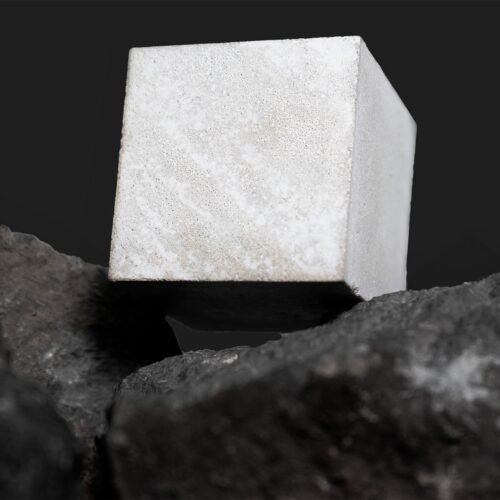
The authors of the new paper include the CEO and an engineer from a company that says it has made Portland cement from silicate rocks like basalt—at the lab scale. Basalt contains a mix of minerals that include calcium, aluminum, iron, magnesium, sodium, silicon, and oxygen. (Note the absence of carbon from that list.) The basic idea is that you don’t need limestone to get calcium oxide.
The process of freeing these components from basalt looks more like a refining or recycling process than the toss-it-in-the-oven simplicity of the limestone process. Acid can be used to leach elements like calcium out, then a chemical or energetic process precipitates that calcium as calcium hydroxide. Toss that in a kiln with additives of your choice, and with less heating than you need for limestone, you’ve got Portland cement, with only water vapor released.
Those steps (along with follow-up reactions to restore the acid or other chemicals to a usable state) obviously add up in terms of cost and energy use. Tallying up the energy to do all this using common techniques, the researchers found that you need to use a little more than double the energy of traditional production from limestone.
The interesting thing is that, according to thermodynamics, the chemical conversion of basalt minerals to calcium oxide only requires around half as much as the conversion from limestone. The problem is that our techniques to facilitate that chemical conversion are quite inefficient, so we don’t get anywhere near what is theoretically possible.
Better options?
The researchers note that there are at least some known lab techniques that could greatly improve our efficiency if they can be applied at scale, but even if we’re stuck with doubled energy usage, producing Portland cement from basalt would significantly reduce CO2 emissions. That’s because the direct liberation of CO2 from limestone is eliminated and because the whole process can run on electricity.
Assuming you use electricity from a fossil-fuel-dominated grid, they estimate that emissions would be cut by almost 30 percent. Using clean electricity would eliminate most of the remaining emissions.
The trade-off, obviously, would be cost, which generally wins out over the sustainability of a livable environment.
But there is another interesting aspect to this idea: The other components of the basalt also have value. Iron, magnesium, and aluminum could also be separated and recovered, and leftover silicate material can serve as the additive for Portland cement instead of something like coal ash. So if these things were done together, the process could become more economically feasible.
That’s a lot of ifs and buts, but this relatively simple analysis can at least point to what would have to happen to make this viable. And given that cement is one of the tougher nuts to crack in the struggle to reduce global greenhouse gas emissions, concrete solutions are welcome.
Communications Sustainability, 2026. DOI: 10.1038/s44458-026-00056-4 (About DOIs).