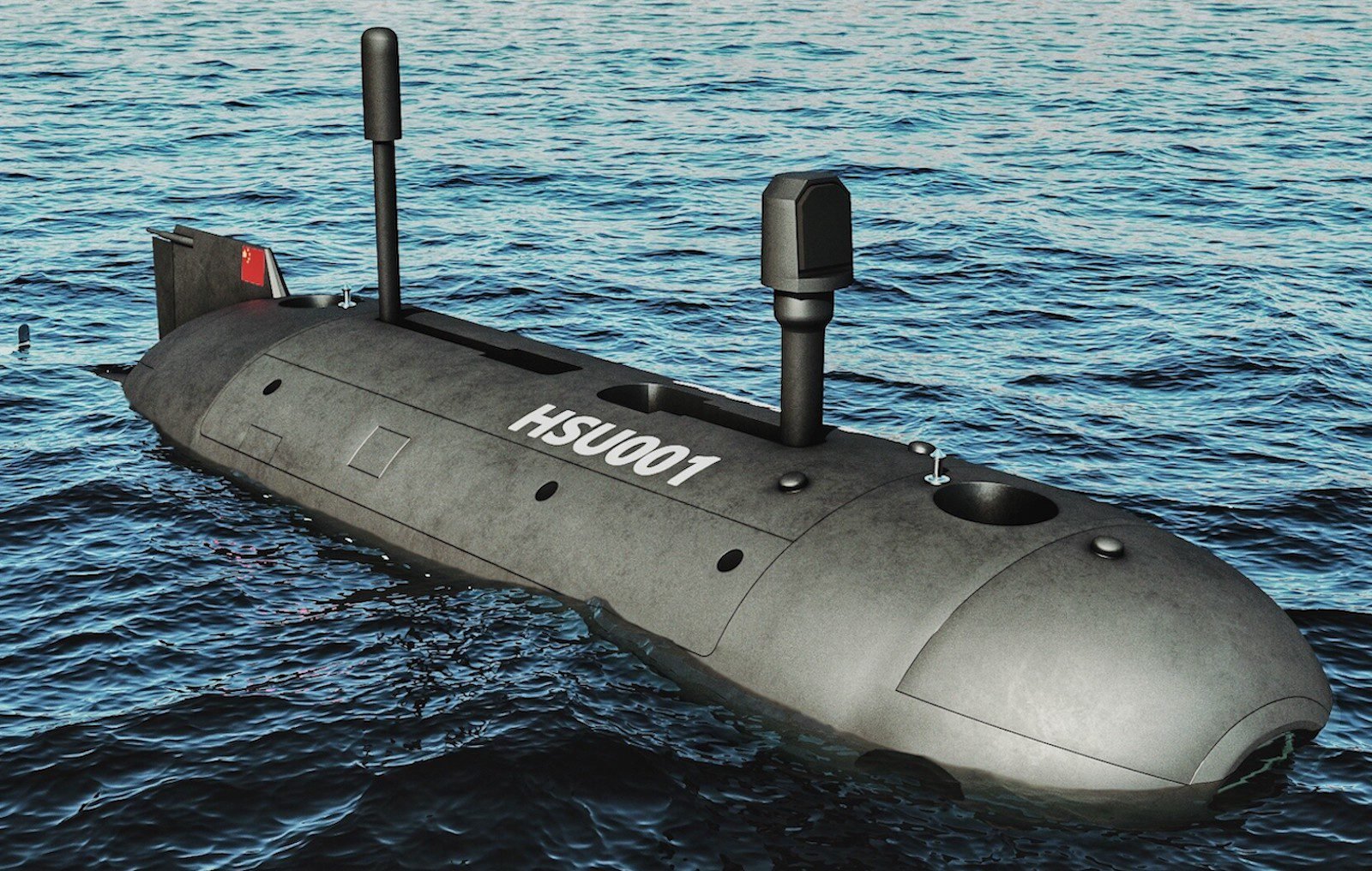
An undersea technological arms race is quietly reshaping the Western Pacific, as Japan prepares to deploy drone-swarmed quantum magnetic sensors to hunt China’s rapidly growing, stealthier submarine fleet.
This month, the South China Morning Post (SCMP) reported that Japan plans to develop drone-mounted quantum magnetic sensors by fiscal 2031 to hunt submarines, according to a defense budget request released in late August, as Japan confronts rising personnel costs and China’s expanding undersea fleet.
The initiative aims to deploy compact, atomic-level sensors aboard low-cost uncrewed aerial vehicles (UAVs) launched from warships and operating near the sea surface, enabling persistent surveillance around vital maritime chokepoints where Chinese vessels must pass into the Pacific.
While the individual detection range of magnetic sensors is limited, deploying them in mass numbers via drones offers a far cheaper, more efficient alternative to crewed patrol aircraft like the P-1.
The push comes amid an escalating Indo-Pacific surveillance race, with China developing its own drone sensors alongside an expansive “Underwater Great Wall” network for a submarine force the US Department of Defense (DoD) projects will reach 80 vessels by 2035.
Meanwhile, the US, Australia, the UK, and Japan are deepening joint investments in uncrewed systems, advanced acoustic communications, and data-processing capabilities to counter China’s growing sea-based nuclear deterrence, forcing both sides to aggressively hunt opposing submarines while shielding their own inside contested regional waters.
How Japan’s prospective leap into quantum-equipped drone swarms actually functions—and why it believes it can tip the undersea balance against China’s modernizing submarine fleet—rests on a confluence of emerging physics, swarm tactics, high-stakes geography, and technological competition.
In a September 2024 scientific conference paper, Donna Kocak and other authors note that traditional magnetic sensors have limited sensitivity, require calibration, are susceptible to background noise, and are bulky. In contrast, Kocak and others say that quantum magnetic sensors offer higher sensitivity, fast response times, and higher resolution.
Detailing the operational physics of anti-submarine quantum magnetic sensors, Benjamin Nathan notes in a March 2023 scientific conference paper that they measure subtle external magnetic fields using the spin properties of subatomic particles.
Nathan explains that exposure to an external magnetic field alters particle spins within sensor materials, thereby revealing the presence of a target. He emphasizes that nitrogen-vacancy diamond and silicon carbide magnetometers rely on atomic vacancies whose photoluminescent spins emit light frequencies that precisely track applied magnetic fields.
Alternatively, he outlines how superconducting quantum interference devices use superconducting Josephson junctions to identify submarines through distinct current shifts induced by external magnetic fields. Nathan observes that such tech, when deployed in sensor networks on uncrewed platforms, delivers accurate vector coordinates to track underwater threats.
In a December 2024 article in the peer-reviewed journal Drones, Yongzhao Yan and others note that these anti-submarine UAVs would initially launch from patrol aircraft, with the UAV swarm dividing an expansive maritime sector into sub-areas using geometric path planning to conduct low-altitude searches for geomagnetic anomalies generated by metallic submarine hulls.
Yan and his team state that once an individual UAV detects a target signal, the cluster activates a decentralized, distributed optimization protocol. They add that the remaining drones dynamically adjust trajectories to converge within a preset timeframe, forming an encircling formation that precisely pinpoints, tracks, and traps the maneuvering submarine.
In Japan’s operational context, such capabilities may be deployed in the Miyako Strait. The 250-kilometer channel serves as China’s primary deep-water gateway between coastal ports and the Pacific Ocean.
As the Miyako Strait has the deepest waters in the Ryukyu archipelago, it provides Chinese surface fleets and submerged submarines essential transit into distant seas. By controlling the waterway, Japan aims to constrain China’s naval maneuvering and bottle up or attrit its North and East Sea Fleets during a conflict.
A Chinese breakout into the open Pacific threatens to sever Japan’s sea lanes of communication (SLOCs), cutting it off from critical energy supplies and trade and possibly posing an existential threat to Japan.
Multiple PLAN carrier strike group (CSG) deployments through the Miyako Strait highlight its strategic significance for China’s navy in a potential conflict over Taiwan. Although public documentation showing submarines participating in those formations is scarce, those assets are nevertheless most likely involved in such operations.
As Daniel Rice highlights in a July 2024 China Maritime Studies Institute (CMSI) report, submarines serve as a primary offensive and defensive shield in the PLAN’s CSG battle groups, operating within the carrier’s Outer Defense Zone extending 185 to 400 kilometers away.
Drawing from Chinese media analysis, Rice concludes that submarines employ an “offense to enhance defense” strategy within this perimeter. He notes that submarines use stealth and maneuverability to conduct maritime surveillance, track opposing formations, and launch surprise strikes against enemy surface vessels. He adds that they also gather tactical intelligence and provide essential anti-submarine screening, coordinated directly from the carrier’s centralized command post.
Andrew Erickson highlights in a June 2026 Korea Institute for Maritime Strategy (KIMS) report that China has made qualitative and quantitative improvements to its submarine force, overcoming persistent acoustic deficiencies to achieve major advances in quieting across successive nuclear-powered generations.
Looking ahead to third-generation platforms, Erickson states that future Type 095 attack and Type 096 ballistic missile submarines are projected to integrate advanced pump-jet propulsion, low-speed reactor natural circulation, and horizontal floating raft isolation systems to approach Russian Akula-class stealth levels.
He notes that these design advancements, paired with expanded hull diameters, will allow Chinese nuclear platforms to substantially suppress mechanical vibration and low-frequency flow noise, significantly complicating sub-surface detection across deep-water patrol zones.
Those qualitative improvements are matched by significant submarine fleet growth in a relatively short time.
In a March 2026 testimony before the US Congress, Rear Admiral Mike Brookes mentioned that the PLAN currently operates over 60 submarines—including six attack, at least two guided-missile, six ballistic missile, and more than 50 diesel-electric submarines- and is executing a major expansion and strategic transition of its submarine force toward an all-nuclear fleet.
Brookes notes that shipyard investments have tripled construction hall capacity, bolstering the submarine force buildup; the fleet is projected to reach roughly 70 submarines by 2027 and up to 80 by 2035, with nuclear-powered hulls comprising about half the force to support blue-water missions beyond the First Island Chain.
Ultimately, the question is whether Japan’s move into autonomous quantum hunting will mature fast enough to make an impact, or if China’s expanding, quieter submarine fleet will overwhelm allied chokepoints before the technology scales up.