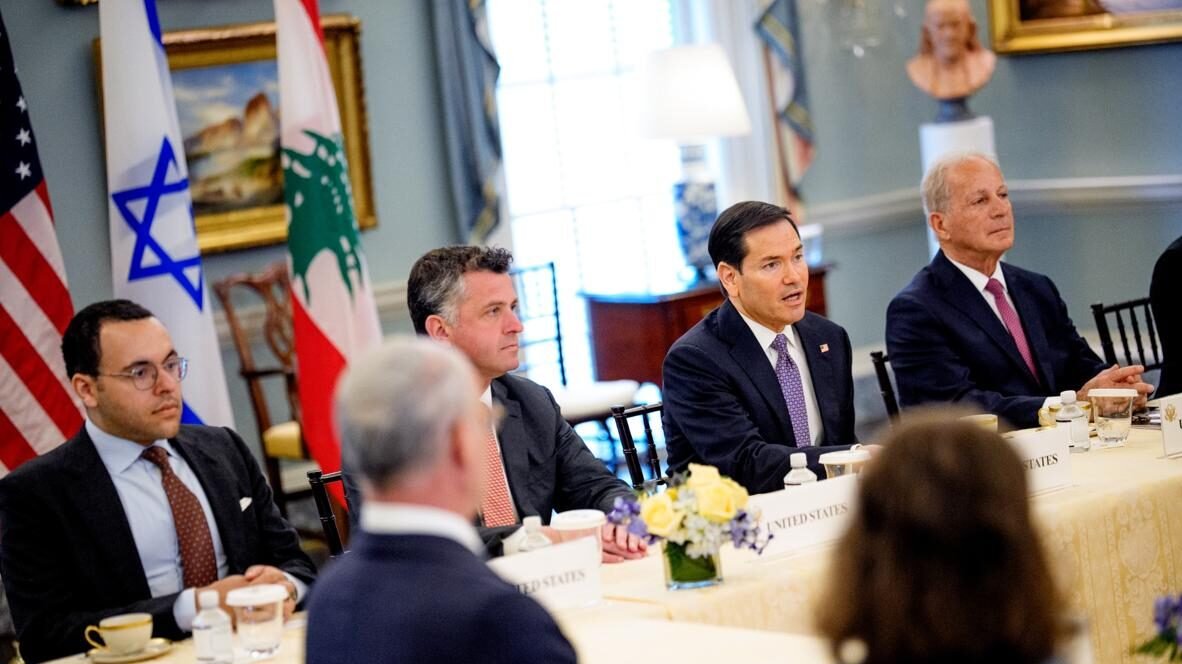
Israeli Ambassador to the US Yechiel Leiter said Tuesday that Israel and Lebanon found common ground during their first direct diplomatic talks since 1993, describing the outcome as a shared position against Hezbollah.
“We discovered today that we’re on the same side of the equation. That’s the most positive thing we could have come away with,” Leiter said after the meeting in Washington. “We are both united in liberating Lebanon from an occupation power dominated by Iran called Hezbollah.”
The talks, mediated by the United States, began at 11 a.m. EDT and lasted for two hours. US Secretary of State Marco Rubio took part alongside Leiter and Lebanese Ambassador to the US Nada Hamadeh Moawad.
Ahead of the meeting, Rubio cautioned against expecting immediate results. He described the effort as a “process, not an event” and said, “This is a historic opportunity,” while noting that “we’re working against decades of history and complexities” that will not be quickly resolved. Rubio added the Trump administration is “very happy” to be facilitating the discussions.
Israel has ruled out a ceasefire prior to talks, stating its objective is Hezbollah’s disarmament and the possibility of a peace agreement with Lebanon. Foreign Minister Gideon Saar said Tuesday that Israel does not have a dispute with Lebanon itself, adding that “the problem is Hezbollah.”
Leiter said Israel expects Lebanon to “completely” separate from Iran and Hezbollah, adding that “the Lebanese government made it very clear that they will no longer be occupied by Hezbollah and Iran has been weakened; Hezbollah is dramatically weakened.” He described the situation as “an opportunity.”
Prior to the talks, Lebanon called for a truce as a precondition. President Joseph Aoun said Monday, “Israel’s destruction of Lebanese territories is not the solution, nor will it yield any results,” adding that “Diplomatic solutions have consistently proven to be the most effective means of resolving armed conflicts globally.”
Hezbollah opposed the talks and was not represented. Wafiq Safa said the group would not abide by any agreements reached, while Secretary-General Naim Kassem called for a return to a 2024 framework of indirect talks mediated by the US, France, and the United Nations peacekeeping mission.