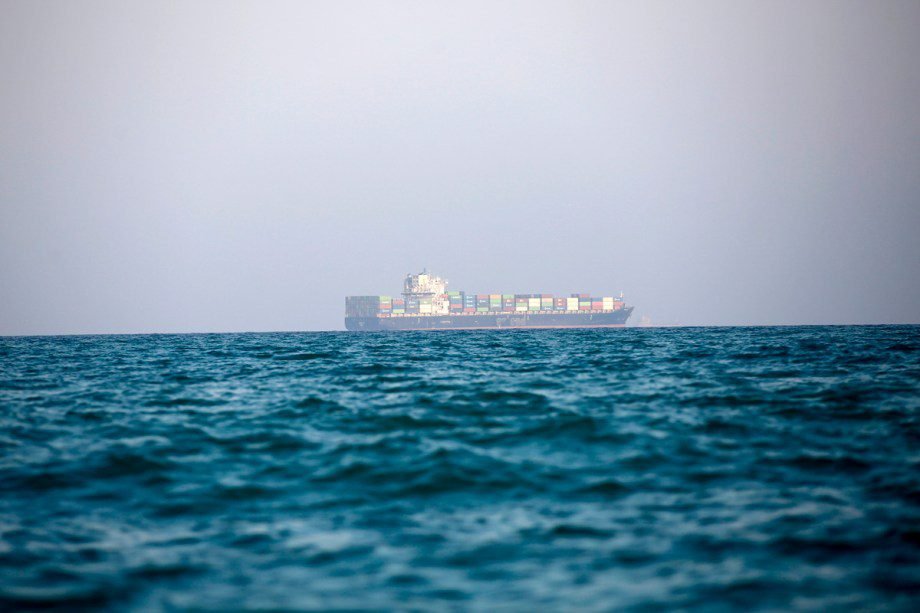
Iran’s Islamic Revolutionary Guard Corps (IRGC) Navy said Wednesday that a ship carrying more than 2,500 containers sank after striking a naval mine while attempting to cross the Strait of Hormuz through “an unauthorized” route, Anadolu reports.
In a statement carried by Iranian state broadcaster IRIB, the IRGC Navy said the vessel struck a mine and caught fire while attempting to navigate “a dangerous and unauthorized” passage through the strategic waterway.
The ship sank in waters south of the Strait of Hormuz on Wednesday morning after the fire intensified, the statement said.
The IRGC Navy urged local vessels and fishermen to exercise extreme caution when navigating the area, warning that containers from the sunken ship were floating on the water’s surface.
The statement did not identify the vessel, its flag or operator, or provide details on the fate of its crew.
String of maritime incidents
The reported sinking came amid a series of maritime incidents in the Strait of Hormuz, where Iran has imposed restrictions on commercial shipping, including designated transit routes and requirements for prior authorization from the IRGC Navy.
READ: Iran’s IRGC Navy threatens to sink US warships approaching Strait of Hormuz
The UK Maritime Trade Operations (UKMTO) reported on Wednesday two incidents from the previous day in which container ships were struck by unidentified projectiles in the Strait of Hormuz.
It said in a statement that a 50,000-ton vessel conducting an inbound transit, was struck at 1640UTC, while the other, a 19,000-ton vessel conducting an outbound transit, was hit at 1700UTC.
Both vessels reported minor damage and no casualties and were able to continue their passages, according to the agency.
Earlier this week, the IRGC Navy reported that several oil tankers had struck naval mines or come under attack while attempting to navigate unauthorized routes through the waterway.
Since April, Iran has imposed restrictions on maritime traffic through the Strait of Hormuz, including designated transit routes and a requirement for prior coordination with the Islamic Revolutionary Guard Corps Navy.
On May 30, Tehran announced that vessels passing through the strait would be required to obtain prior authorization from the IRGC Navy, warning that transit without permission would constitute a “security threat.”
The developments come amid continued tensions between Iran and the US over navigation through the Strait of Hormuz, one of the world’s most important strategic routes for energy and commodity supplies and a key issue in negotiations between the two sides.
The war began with US and Israeli attacks on Iran on Feb. 28, before a ceasefire was reached in April. Clashes between Washington and Tehran later resumed as negotiations stalled despite the two sides signing a framework agreement in June.