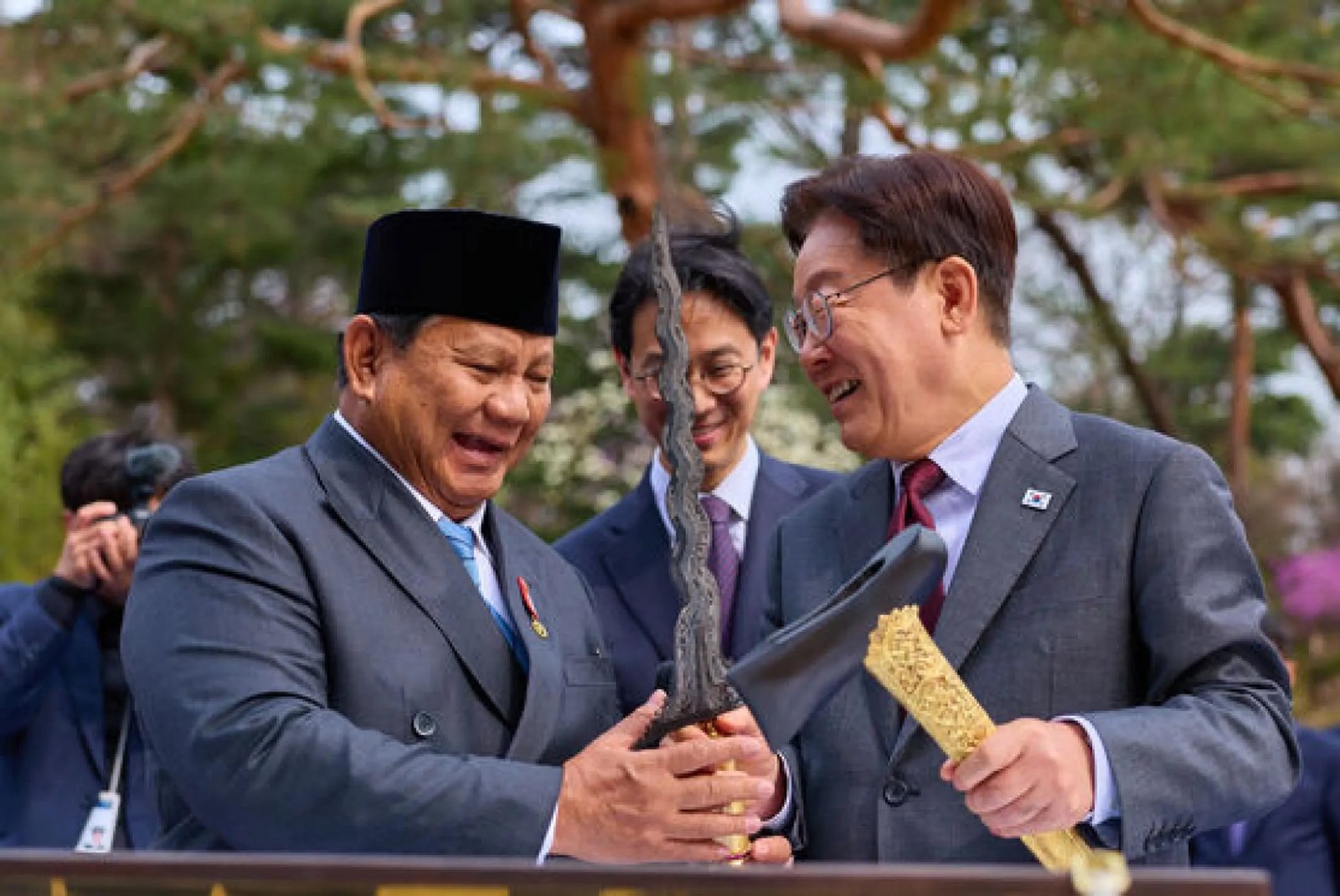
South Korea and Indonesia this year have been working on elevating their relationship.
Both countries are vulnerable to the changing geopolitical currents of our times. From a security perspective their situations are different: Korea has long maintained a close treaty alliance with the US while managing deep economic relations with China, whereas Indonesia pursues an independent and active (bebas aktif), non-bloc foreign policy. Recent shifts in US policy, including sharper burden-sharing demands and a more transactional approach to alliances and partnerships, have nevertheless created uncertainty across the region about future expectations and policy continuity. This does not diminish the importance of the ROK-US alliance, but it strengthens the case for Seoul and Jakarta to broaden their strategic options and invest in additional reliable partnerships.
China presents a different combination of opportunities and constraints. It is an indispensable economic partner for both the ROK and Indonesia and a central actor in regional growth and supply chains. At the same time, the expansion of Chinese strategic influence, continuing maritime disputes, and the risks of excessive economic dependence create incentives for regional countries to diversify relationships and preserve policy space. For both Seoul and Jakarta, the challenge is therefore not to choose against China, but to maintain mutually beneficial relations with Beijing while safeguarding sovereign interests, strengthening resilience, and supporting international law and regional stability.
The 2026 US defense-policy debate also reflects a more transactional emphasis on burden-sharing, military capability, and measurable contributions from allies and partners. In an August 2026 speech in Manila, US Under Secretary of Defense for Policy Elbridge Colby cautioned against “middle power alliances designed to exclude America.” Yet he also stressed that the US seeks “partnerships, not dependencies,” encouraged stronger indigenous defense-industrial capacity, and described pragmatism in Southeast Asia positively.
The tension between these messages matters: countries such as the ROK and Indonesia may welcome stronger capabilities and cooperation with the US while still seeking sufficient strategic room to define their own priorities and partnerships.
The broader point is not that the United States has ceased to matter – far from it. Rather, policy volatility, tariff pressures, burden-sharing debates, and conflicts beyond Asia have reinforced the incentives for regional states to diversify their external relationships and strengthen sovereign capabilities. For Indonesia, this is consistent with its free and active foreign policy and its preference to maintain constructive relations with all major powers. For the ROK, it means complementing its alliance commitments with a wider network of dependable partnerships. In both cases, diversification should be understood as adding strategic options, not replacing one dependency with another.
South Korea has experienced this policy volatility directly. In August 2026, the ROK and US cut short the annual Ulchi Freedom Shield exercise after President Trump directed that the drills be substantially reduced; the decision generated debate in Seoul about consultation, readiness, and its implications for preparations related to wartime operational control (OPCON) transition.
Such an episode does not negate the value of the ROK-US alliance, but it illustrates why Seoul has an interest in strengthening its own capabilities and widening the network of countries with which it can cooperate. Indonesia, as a major regional partner with substantial defense-industrial, maritime, economic, and technological complementarities, should be part of that wider network.
Making the relationship ‘comprehensive’
On April 1, the Republic of Korea’s President Lee Jae Myung and Indonesia’s President Prabowo Subianto held a bilateral summit meeting at the Blue House in Seoul. In bureaucratic terms, the two leaders agreed to upgrade the relationship from a “special strategic partnership” by adding the term comprehensive to make it a “special comprehensive strategic partnership.” They gave the relationship its own initials, SCSP.
Accordingly, the two countries concluded 16 memoranda of understanding across political and security cooperation, economic partnership, advanced technology, health, energy and other fields. Separately, Indonesia reported approximately US$10.26 billion in South Korean business commitments associated with the visit.
The implementation of the upgrade will not be automatic, given the two countries’ geographic separation, different strategic environments, and significant economic and cultural differences. Against this background, on 27 July 27 a hybrid (“track 1.5”) diplomatic meeting was held, mixing official government representatives with unofficial experts, such as academics, think tank researchers and business leaders.
The discussion addressed three interconnected issues: how much strategic autonomy is realistically possible for the ROK and Indonesia amid shifts in US foreign and security policy; whether closer ROK-Indonesia cooperation can help both countries navigate intensifying US-China rivalry; and whether middle-power cooperation can help preserve policy space while supporting international law and effective multilateralism.
The dialogue did not produce a finished implementation roadmap, but it exposed a real challenge: how to translate broad strategic convergence into clear, concrete objectives in areas such as energy and critical minerals, defense-industrial cooperation, data and digital coordination, maritime cooperation and supply-chain resilience. The next step should therefore be to move beyond institutionalizing existing ties and identify practical projects, responsible agencies, timelines and measurable outcomes.
More importantly, despite differences in emphasis and perspective, there was a broad shared understanding among the participants that the ROK and Indonesia need one another as reliable and complementary partners in an increasingly uncertain environment, and that both sides should do all they practically can to strengthen and operationalize their partnership. That common ground may be the most important starting point for the SCSP: not complete agreement on every geopolitical question, but a determination to deepen cooperation because each country can help the other become more resilient, capable, and prosperous.
So what can be expected from the SCSP? Although the joint statement does not formally define the ROK and Indonesia as a “middle-power partnership,” the two countries can reasonably be viewed as complementary regional powers seeking greater resilience and policy space amid great-power polarization.
Indonesia is central to global nickel supply and an important producer of other critical minerals needed by Korea’s advanced manufacturing and battery industries. The SCSP can help stabilize and diversify critical-mineral supply chains. In return, Korean capital, technology, and industrial capabilities can contribute to Indonesia’s digital development, artificial intelligence and information and communication technology cooperation, digital healthcare, high-performance computing, human-capital development, advanced manufacturing, and energy transition.
Beyond this exchange of resources, technology, and investment, there are geopolitical ramifications. As important regional actors, the ROK and Indonesia share an interest in avoiding a rigid, zero-sum “US vs. China” either-or choice. A denser bilateral partnership can increase strategic autonomy, but strategic autonomy should not mean equidistance from every major power or collective resistance to Washington or Beijing. It should mean greater capacity to make sovereign choices: more diversified supply chains, stronger national industries, broader diplomatic options and greater resilience against external shocks or pressure from any source.
The SCSP is also an opportunity for the ROK and Indonesia to deepen diplomatic, security, and defense cooperation as the regional environment changes. Both countries are modernizing their defense capabilities, creating opportunities for complementary defense-industrial cooperation. The April 2026 joint statement describes this cooperation as a symbol of high strategic trust and emphasizes capacity-building, research and development and joint production.
The KF-21/IF-X program remains the flagship example, alongside cooperation on trainer aircraft, anti-tank guided missile systems, ammunition and expanding opportunities in shipbuilding and maritime industries. The strategic value lies in building stronger domestic capabilities and mutually beneficial co-development – not in defining the partnership against US, European, or other defense partners.
The two great powers of our times will continue to exert enormous influence over the Indo-Pacific, which means that complete strategic autonomy is unrealistic for either the ROK or Indonesia in an interdependent world. The more practical objective is greater strategic room for maneuver.
The SCSP can advance the economic and security interests of both countries without becoming an exclusive middle-power bloc: Indonesia can continue its bebas aktif approach and maintain constructive relations with the US, China, and other partners, while the ROK can preserve its alliance with the US and simultaneously broaden its regional partnerships. If the SCSP reaches the potential outlined by the two presidents in Seoul, the ROK and Indonesia could become important contributors to an open, inclusive, and ASEAN-centered regional architecture.
For the present, ambitions should remain practical. The SCSP is valuable not because it enables either country to resist or exclude other partners, but because it can make both countries more capable, resilient, and useful to one another. The most durable measure of success will be whether the two sides translate political trust into concrete cooperation–in critical minerals, advanced technology, defense co-development, shipbuilding and maritime industries, energy transition, human capital, and people-to-people ties–while preserving sovereign choices and constructive relations with all major partners. In that sense, the strategic logic is simple: Indonesia and the ROK need each other, and both should do all they reasonably can to make this partnership work over the long term.
Sukjoon Yoon is a retired ROK Navy captain affiliated with the Korea Institute for Military Affairs.