On Monday, US President Donald Trump threatened to expand his administration’s boat-bombing spree to Iranian vessels that “come anywhere close” to the US naval blockade of the Strait of Hormuz that the president had ordered over the weekend.
Trump wrote on social media that Iranian vessels seen approaching the blockade “will be immediately ELIMINATED, using the same system of kill that we use against the drug dealers on boats at Sea.”
“It is quick and brutal,” the president added.
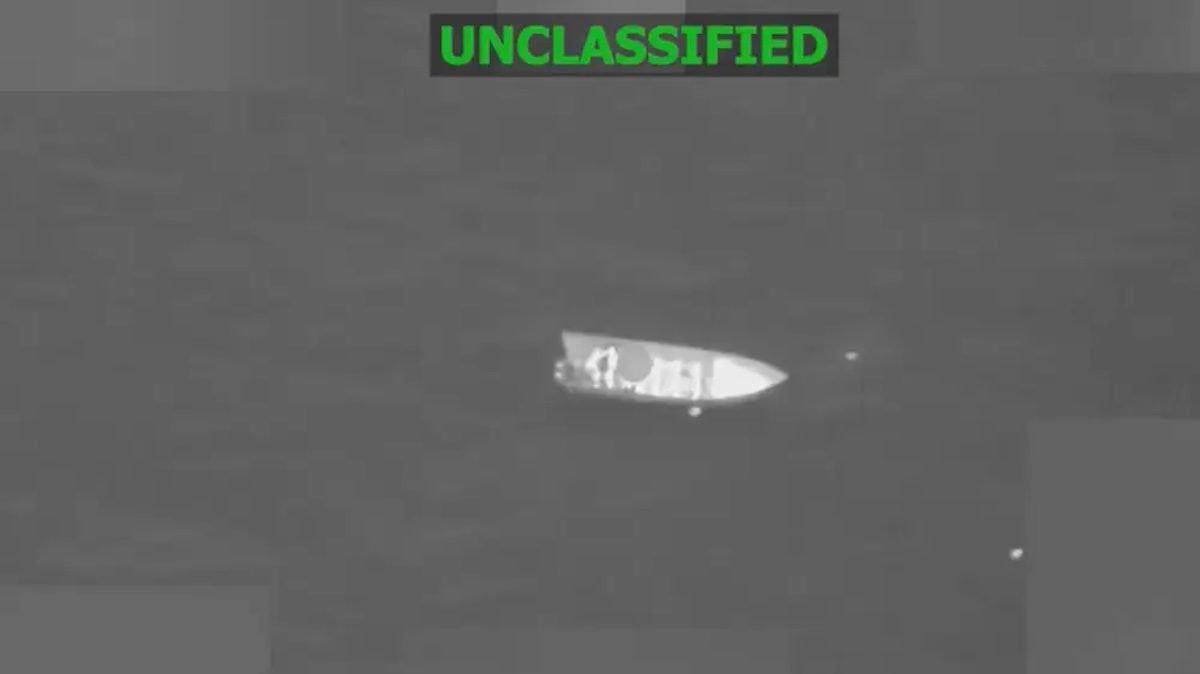
The US military demonstrated on Monday, attacking a vessel in the eastern Pacific that was accused, without reported evidence, of engaging in “narco-trafficking operations.” The strike killed at least two people and brought the known death toll from the Trump administration’s boat-bombing spree in international waters to more than 170.
Mutual threats
Meanwhile, as the US on Monday was beginning its naval blockade of Hormuz, a spokesperson for Islamic Revolutionary Guard Corps issued Iran’s own warning to the US.
“If the war continues, we will unveil capacities that the enemy has no idea about,” said Sardar Mohibi, according to the IRGC-affiliated Tasnim News Agency. “We will unveil warfare methods that the enemy will have little ability to counter.”
As Iran’s Press TV reported, Iranian Lt. Col. Ebrahim Zolfaqari also commented on the blockade, which began at 10:00 am US Eastern time Monday, stressing that “enemy-affiliated vessels do not and will not have the right to pass through the Strait of Hormuz.”
“Other vessels will be allowed to transit the strait in compliance with the regulations of the Armed Forces of the Islamic Republic of Iran,” Zolfaqari said. “If the security of ports of the Islamic Republic of Iran is threatened, no port in the Persian Gulf or the Sea of Oman will remain safe,
Iran closed the Strait of Hormuz to many ships after the US and Iran launched an illegal war six weeks ago. The waterway between the Persian Gulf and the Gulf of Oman is a crucial trade route, including for fossil fuels from the region, and has become a key negotiating point as the death toll across the Middle East has mounted.
After talks led by Vice President JD Vance broke down, Trump wrote Sunday on his Truth Social platform that “the United States Navy, the Finest in the World, will begin the process of BLOCKADING any and all Ships trying to enter, or leave, the Strait of Hormuz. At some point, we will reach an ‘ALL BEING ALLOWED TO GO IN, ALL BEING ALLOWED TO GO OUT’ basis, but Iran has not allowed that to happen by merely saying, ‘There may be a mine out there somewhere,’ that nobody knows about but them.”
“THIS IS WORLD EXTORTION, and Leaders of Countries, especially the United States of America, will never be extorted,” Trump continued. “I have also instructed our Navy to seek and interdict every vessel in International Waters that has paid a toll to Iran. No one who pays an illegal toll will have safe passage on the high seas. We will also begin destroying the mines the Iranians laid in the Straits. Any Iranian who fires at us, or at peaceful vessels, will be BLOWN TO HELL!”
The president on Monday again threatened any Iranian vessels that “come anywhere close to our BLOCKADE,” and also said that “34 Ships went through the Strait of Hormuz yesterday, which is by far the highest number since this foolish closure began.”
As North Atlantic Treaty Organization member countries on Monday made clear they did not plan to join Trump’s blockade, China’s defense minister, Dong Jun, said: “Our ships are moving in and out of the waters of the Strait of Hormuz. We have trade and energy agreements with Iran. We will respect and honor them and expect others not to meddle in our affairs. Iran controls the Strait of Hormuz, and it is open for us.”
Summarizing an interview with Salvatore Mercogliano, maritime historian at Campbell University in North Carolina, Al Jazeera reported Monday that the scholar “expected the US Navy to turn around ships that come out of the strait while keeping at a distance from the range of Iran’s missiles and drones.”
It’s possible the US action could result in “two competing blockades,” Mercogliano said. “This has the potential to freeze shipping in and out the Strait of Hormuz entirely.”
The ‘narco-boat’ example
As has been its custom since the boat bombings began last September, US Southern Command posted an unclassified video clip of Monday’s eastern Pacific attack on social media. SOUTHCOM described the bombing as “a lethal kinetic strike on a vessel operated by Designated Terrorist Organizations,” but did not provide any evidence against the boat’s operators.
Monday’s deadly strike came days after the April 11 US bombings of two other boats in the eastern Pacific, attacks that killed at least five people. United Nations experts and human rights organizations have condemned the bombings in international waters as extrajudicial killings and murder – and argued that those ordering and carrying out the attacks should be prosecuted for homicide.
“More murder,” The Intercept’s Nick Turse wrote in response to Monday’s boat bombing.
Hours before SOUTHCOM announced the latest strike, Turse reported that the Trump administration is “waging a pressure campaign against the leading inter-American human rights watchdog to squash a potential investigation into illegal US attacks on boats in the Caribbean Sea and the Pacific Ocean.”
Brian Finucane, a senior adviser to the US Program at the International Crisis Group, said Monday that it is “funny how the Trump administration is very happy to continue to post snuff films of these lawless killings but not defend the legal merits of these strikes.”
Last month, the Inter-American Commission on Human Rights held a hearing during which experts testified to the illegality of the boat strikes.
“The administration’s desire to play imperial superpower in the region cannot be a reason to completely displace the foundations of international law,” Angelo Guisado, senior staff attorney at the Center for Constitutional Rights, told the commission.