The tiny remains of the Laurentide Ice Sheet began getting somewhat less tiny.
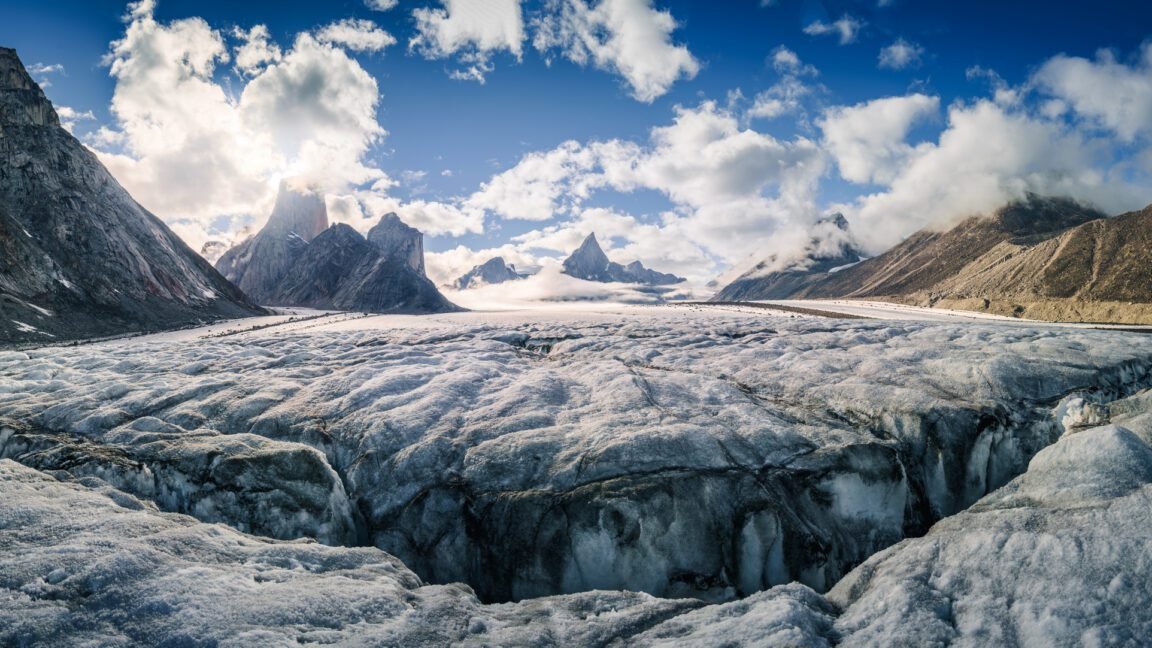
Baffin Island is a good location for ice sheets to spend their retirement. Credit: Posnov
Barnes Ice Cap sits on the central plateau of Baffin Island, in the Canadian Arctic. It is the last surviving fragment of the Laurentide Ice Sheet, the largest of the Pleistocene ice sheets, which at its peak buried most of Canada under two miles of ice and locked away around 80 meters of sea level. That remnant has now yielded direct physical evidence that ice sheets might have reversed their retreat and started to grow again thousands of years ago.
In a recent Science study, researchers show that the Laurentide reached its smallest size about 3,600 years ago, then started re-expanding roughly 2,000 years ago, which the team interprets as the opening move of the next glaciation. Apparently, this brand-new ice age was on its way until about 1960, when human-caused climate warming reversed it.
Frozen to the bed
“Barnes is the last remaining piece of one of the domes of the Laurentide Ice Sheet,” says Nicolás Young, a geologist at Columbia University’s Lamont-Doherty Earth Observatory and lead author of the study. As that enormous dome thinned through the Holocene, its margin withdrew up onto Baffin Island, and what’s left today is the deflated core of something that was once two miles thick. The reason Barnes can testify about its own history, Young explains, comes down to the temperature at its base.
Most glaciers are warm-based, meaning meltwater at the bed lets them slide, and sliding ice grinds up everything beneath it, erasing the record. Barnes is cold-based, and thus frozen directly onto the bedrock beneath it, which prevents it from sliding.
“If there is an ice event where you live and you have to go and scrape off your windshield, that ice that’s plastered to the windshield of your car, that’s a good example of how cold-based ice operates. It’s sort of just stuck to what it’s on,” Young says.
This stuck ice preserves what’s beneath instead of eroding it. As the Laurentide retreated across the plateau, tundra plants colonized the newly bare ground. When the ice came back later, it simply smothered them in place and held them there, intact, for two millennia. To pinpoint the exact moment of this turnaround, Young’s team used two independent dating methods.
Rocks and plants
The first method measures beryllium-10, an isotope that accumulates in the top few centimeters of rock that is exposed to the sky. By sampling a boulder’s upper surface and counting the beryllium, researchers could learn how long it has been uncovered. That technique put a date on the ice sheet’s retreat. It turned out the Laurentide had withdrawn to within today’s ice margin by 3,600 years ago, probably shrinking further by around 3,000.
The second dating method looked at the dead plants. “There were all these plants growing, just like today. And included in that are mosses, these little mosses that are rooted in the ground,” Young says. “So they’re there, they’re living their life, and eventually the Laurentide Ice Sheet starts to re-expand. And when that ice margin covers the moss, it literally kills it.”
By radiocarbon dating the remnants of the moss, the team could pinpoint the moment it died, yielding what glaciologists call a kill date—the moment the ice arrived at that spot. By stringing multiple kill dates of moss samples taken from different spots, scientists reconstructed a map of an advancing ice margin.
About 70 percent of the team’s radiocarbon dates cluster around 1800 CE, at the culmination of the Little Ice Age. “It’s all sort of the same thing,” he says. The Little Ice Age marks the point where Northern Hemisphere glaciers were at their most extensive in recent millennia. At Barnes, Young argues, it was just one late pulse within an advance that had been running for two thousand years.
The most important plants for Young’s team, however, are still hidden under ice. Barnes’ margin has retreated 200 to 800 meters since 1960, exposing mosses killed from about 1000 CE onward. Anything older remains buried. To pinpoint the exact moment the ice started advancing, the team had to look at Barnes’ neighbors.
Pinning down the turn
Scattered across the same plateau are other small ice caps, close enough to share the same climate. Earlier studies collected nearly 200 kill dates from beneath them—not one is older than 2,000 years. “What that means is that all of those ice caps up there didn’t start advancing or re-expanding until about 2,000 years ago,” Young says. “Since the Barnes Ice Cap is right next door, it’s probably a good bet that it also started expanding 2,000 years ago.”
Young argues that continued retreat of the Barnes Ice Cap should eventually reveal the decisive samples. “If we went back there in 20 years or something, as the ice margin has retreated a little more, we actually might be able to sample those 2,000-year-old plants,” he says.
According to the study, the ice started re-expanding at this precise moment because two global forces were pulling it in opposite directions, and one of them eventually won.
A tug of war
Solar energy reaching high northern latitudes peaked about 10,000 to 11,000 years ago and has declined ever since, pushing the planet toward the next ice age. Meanwhile, atmospheric carbon dioxide crept up by roughly 20 parts per million between 8,000 and 2,000 years ago, increasing the greenhouse effect that was heating the atmosphere up. “That drop in insolation and temperatures actually overwhelmed the small temperature forcing the little bit of carbon dioxide rise over the same time span,” Young explains.
Eventually, 2,000 years ago, temperatures dropped far enough due to lower sunlight in the high latitudes, and the effects of carbon dioxide weren’t high enough, so ice sheets started to re-expand. This happened despite the fact that calculations of orbital forcings, together with modeling of how carbon dioxide interferes with glacial inception, have suggested the next ice age was postponed by tens of thousands of years. Young argues there’s really no contradiction between these models and the evidence his team collected in the field.
“A lot of people have defined glacial inception as glaciers and ice sheets needing to be of a certain size—big enough that we’ll say, ah, yes, we are into the next ice age,” Young says. “And that’s perfectly reasonable, because until now there’s been no way to actually pinpoint when an ice sheet first turns around and starts to expand.” But a few geological moments after the Laurentide sheet started re-expanding, humanity entered the chat.
Greenhouse gases had risen by about 12 ppm between 1750 and 1850, another 50 ppm by 1960, and a further 138 ppm by 2024. “Once we hit the Industrial Revolution, we’re now pumping way more carbon dioxide at a magnitude that has never occurred in the geologic record,” Young says. By 1960, Barnes’ mass balance went negative and its advance ended.
Today, Barnes Ice Cap is dying. In the 1960s and ’70s, roughly 35 percent of its surface sat above the area’s snow line. By the early 2000s, about 3 percent did. Today, none of it does. “This means in the summer, it’s all melting. There’s no more accumulation zone. There’s no more new ice forming,” Young says. “An ice cap or glacier cannot survive if it does not have an accumulation zone.” According to his models, under any plausible emissions scenario, Barnes will disappear within a few centuries.
So did we actually dodge the bullet by warming the climate so quickly?
Canceled ice age
“Frankly, in modern times, no one wants to live in an ice age climate. Things would be quite hard and quite different,” Young says. He argues, though, that we did not exactly do ourselves a favor here. To get to a true, full ice age climate with big ice sheets, it would have taken several tens of thousands of years. “I would argue that the pumping of greenhouse gases into the atmosphere hasn’t really saved us from anything,” Young claims. What we have done instead is interrupt a cycle that was very old and very regular.
“The pacing of ice ages over the last 2.5 million years has been one of the most consistent cycles in the Earth system that we have,” Young says. “We have evidence now that humans, and specifically greenhouse gases, have actually terminated one of the most consistent cycles on Earth.”
The study is published in Science: https://doi.org/10.1126/science.aed3379

Jacek Krywko is a freelance science and technology writer who covers space exploration, artificial intelligence research, computer science, and all sorts of engineering wizardry.