 Safia Southey is an international lawyer and writer who focuses on how societies reckon with wartime abuses.
The Hidden Backstory of the Blue Wave
Students at Columbia University set up tents on the lawn at the center of campus in April 2024 and said they would stay until the university divested from Israel’s war on Gaza. Within weeks, encampments had spread to campuses across the country, and soon around the world.
I was a law student at Columbia that spring and spent much of it in the encampment. I remember the cold nights and the teach-ins on the grass, the food that kept arriving from strangers, a Passover seder held on the lawn, and students praying in rows beside the tents.
Young people were told that their objection was a luxury the country could not afford.
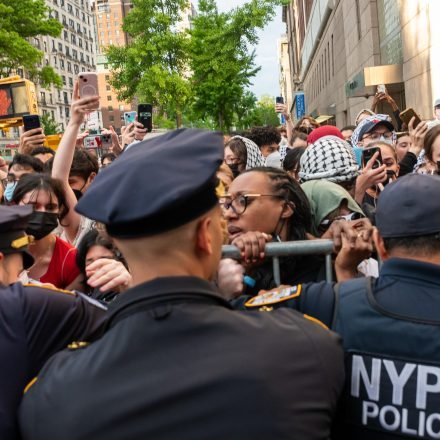
Those who watched from a distance may remember a different set of images: riot police dragging students across their own campuses, an Emory economics professor thrown to the ground by officers, and a spring in which more than 2,000 people were arrested at protests nationwide. By the summer, the tents were gone. The bombing of Gaza continued.
In the 2024 presidential race, these same young people who had spent the spring organizing were asked to support a ticket that would not break with the policy they had protested. They were told that their objection was a luxury the country could not afford. Months before the encampments, more than 100,000 Michigan Democrats had voted “uncommitted” to warn the party about Israel’s onslaught, but the warning went largely unheeded. Many of us voted that November with dread, and some could not bring themselves to vote at all.
Donald Trump won the presidency, and within only a few months, federal immigration agents had detained Mahmoud Khalil (who had negotiated on the encampment’s behalf), and Columbia had agreed to pay more than $200 million to the administration that was punishing its students. By then, much of the commentary class had decided the protests had alienated voters and might even have helped elect Trump.
The midterm election results told a very different story. Darializa Avila Chevalier, who was arrested alongside students at Columbia’s encampment in 2024, won the congressional seat that includes the university, after unseating a five-term incumbent in June’s primary. In Michigan, Abdul El-Sayed, who ran openly against his own party’s position on Gaza, won a seat in the Senate. Democrats took back both the House and the Senate, and they did it by winning in places the party had stopped imagining it could compete: Texas, South Carolina, Kansas, to name a few, while also flipping Senate seats in Ohio and Maine. When Zohran Mamdani was elected mayor of New York City a year ago, plenty of commentators treated it as a local story, one that could only happen there; the midterm results show they were wrong.
This election was enormous, and the encampments belong at the center of the story of how it happened. Gaza was the source of the anger: For two years, a generation watched the genocide on their phones in real time, while the people they had been raised to trust explained why nothing could be done. The encampments and the wider student movement gave that anger somewhere to go, taught people how to organize, and even more importantly, showed them the institutions meant to protect them simply would not. If young people wanted to be represented, we realized we would have to build that representation ourselves.
Learning From the Encampments
Many of the students who joined the encampments had never organized anything before. Within days — especially after the original organizers were arrested — they were running a small town: rotating security shifts, feeding hundreds of people, coordinating legal observers and jail support, holding meetings late into the night to decide by consensus what to do next, and negotiating with administrators who had far more power than they did.
Students learned how to bring a demand to an institution, how to build a coalition across groups that did not always agree, and how to keep people together after arrests and suspensions. Jewish, Muslim, Arab, Black, and Latino students, graduate workers, faculty, and neighbors from Harlem and Morningside Heights in New York City learned to work beside one another. Political campaigns run on those same skills, and plenty of people who staffed jail-support lines in 2024 were staffing phone banks two years later.
Socialist organizers were part of that education from the start. Members of the Young Democratic Socialists of America helped set up encampments from the University of California, Berkeley to New York City’s Hunter College, and the culture there — with mass meetings, shared labor, and decisions made together — already resembled the organizing that the Democratic Socialists of America had been practicing in tenant unions and on picket lines for years.
The students also learned what their universities would do when tested. Columbia presented itself as a place for open debate and then called the police on its own students, suspended and expelled them, and later settled with the federal government to restore its funding while one of the encampment’s negotiators sat in immigration detention. Students who had been taught that their schools existed to protect free inquiry watched those schools choose their endowments and their relationships with power instead. Many of them had already watched law firms withdraw job offers from students who had signed statements about Gaza in the fall of 2023. The lesson was harsh and clarifying: No institution was coming to save them.
The Democratic Party gave them no reason to think otherwise. Even after Biden withdrew and Kamala Harris became the nominee, the policy stayed where it was, and at the party’s convention that August, organizers rejected the Uncommitted delegates’ request to have a Palestinian American speak on the main stage.
For a generation already disillusioned with their universities, this confirmed that if Gen Z wanted their voices heard in the halls of power, they would need to knock on the doors, recruit the candidates, raise the money through small donations, and build the organizations themselves.
From the Lawn to the Ballot
Mamdani’s mayoral campaign was the first clear sign that they had started that work. He grew out of that energy, and his campaign gave it a direction. His primary victory in June 2025 rested on years of organizing by tenants, socialists, workers, and Palestine solidarity groups, and much of it ran through New York City DSA, whose electoral organizers described the coalition behind him as young New Yorkers becoming politically active, tenants, and voters drawn to both his affordability agenda and his support for Palestinian rights.
Sociologist Heba Gowayed traced the protest movement’s contribution to his win within days of the result. More than 50,000 people signed up to volunteer during that primary. Many of them were young people who had never knocked on a door for a candidate before, and they learned to canvass the way they had learned to run an encampment: quickly, from one another, and because no one else was going to do it for them. A campaign that talked about both affordability and Palestinian rights gave them a reason to give up their evenings and weekends. When he won the general election, more than 2 million New Yorkers had voted, the most in a mayoral race since 1969.
Mamdani’s victory changed what seemed possible for everyone watching. Candidates who had been warned that criticizing Israel would end their careers could now point to New York. Reps. Rashida Tlaib and Alexandria Ocasio-Cortez, currently the only members of DSA in Congress, will be joined by a record number of DSA-endorsed candidates, at least six. Claire Valdez, a state assembly member who had joined protests calling for an arms embargo on Israel, won the open seat in New York’s 7th Congressional District. In Colorado, Melat Kiros, a 29-year-old lawyer who lost her job after refusing to take down a social media post criticizing law firms over their positions on Israel and Palestine, unseated Rep. Diana DeGette, who had held the seat for three decades.
Avila Chevalier remains the clearest line from the lawn to the Capitol. She is a Columbia alumna who stood with students through arrests and threats of expulsion, and who had spent years in immigrant rights and community organizing before that spring. She ran with the backing of the same democratic socialists who had helped elect Mamdani. After her primary, Maryam Alwan, who protested at Columbia in 2024 (and with whom I am proud to have studied at Sciences Po Menton in France), told Al Jazeera what it meant to see “Darializa, a former leader and organiser of the encampment, represent the school that arrested her.” Gowayed, the sociologist, put the connection more bluntly: “This does not happen if those students don’t encamp; it just doesn’t happen.”
In Michigan, the state where the uncommitted vote first registered the party’s Gaza problem, Seed the Vote organized Jewish, Muslim, and Arab volunteers to knock doors for El-Sayed together, alongside IfNotNow and Bend the Arc. El-Sayed spoke directly to voters’ anger over the party’s position on Gaza and asked them to elect someone who shared it.
For anyone who had been in the encampments, those canvasses would have looked familiar. Khalil, who was released from detention in June 2025 and is still facing deportation, pointed to El-Sayed and Mamdani a week before the election as evidence that politics was shifting. “The American public is finally changing, is finally looking at the Palestinian as an equal human,” he said.
Anger at Trump, the cost of living, and organizations with decades of history all helped produce the blue tsunami, and no election return can isolate the share owed to the encampments. For people who had already concluded that their leaders were willing to fund devastation in Gaza while claiming there was no money for housing or healthcare at home, the war with Iran confirmed the judgment.
By October, polls compiled by Responsible Statecraft found voters were more worried about the war than about immigration or crime, and 6 in 10 opposed U.S. military action against Iran. The candidates who won on Election Day week treated rent, healthcare, and war as one argument about whose lives the government is willing to sacrifice, and young voters answered them.
Lessons for Serbia and India
Americans were not the only ones to see a student movement reach the ballot this fall. In November 2024, the canopy of the Novi Sad railway station collapsed and killed 16 people, and Serbian students, blaming the corruption they believed had made the disaster possible, blockaded their faculties and demanded accountability. Inside the blockades, they ran themselves through plenums and open assemblies with no leaders; every decision went to a vote. In March 2025, they invited the rest of the country to do the same, and within 10 days, citizens had formed their own assemblies, called zborovi, in neighborhoods and towns from Niš to Novi Sad. That same month, roughly 300,000 people filled Belgrade for the largest protest in Serbia’s history, but a moment of silence for the victims ended in panic when the crowd scattered from what protesters and analysts said was a sonic weapon; the government denied using one.
In May 2025, the students began calling for snap parliamentary elections. Serbian opposition politics had long concentrated on the cities and left smaller towns and villages to the ruling party, so the students went there, knocking on doors in places where the state media had branded them terrorists. On October 25, almost two years after the collapse, the Students’ List group won 140 of Parliament’s 250 seats and ended Aleksandar Vučić’s party’s hold on government. The plenums had taught them how to make decisions together, keep thousands of people moving in the same direction, and earn trust one conversation at a time — skills they carried over into election campaigning. Few people would have predicted that outcome during the first winter of the blockades, when the students were being dismissed as naïve.
In India, young people organized under the banner of the Cockroach Janta Party have been in the streets since September, together with student groups and opposition parties, protesting a revision of the voter rolls that has removed more than 130 million names. Police have detained thousands of them, and it would be easy to judge that movement by what it wins this month. Two years from now, we may have a better sense of what it set in motion.
What Comes Next
Nothing that happened on Election Day can repair what was done to Gaza, and the encampments’ original demands remain unmet. The students were protesting the killing of Palestinians and their own institutions’ complicity in it, and electing a former organizer to Congress will not change American policy toward Israel on its own. The organizations that carried these candidates into office will need to stay independent enough to press them once they arrive, and the voters who returned to the Democratic Party this year came back on conditions. Officials who forget this should expect the same organizers to come for their seats.
For those of us who felt crushed in 2024, though, the midterm victories deserve to be fully absorbed and celebrated. We were told that the protests had failed, that we had cost the party an election, that our anger was a liability. The people who had every reason to give up kept meeting instead. They recruited friends, built campaigns, found candidates they could believe in, and spent two years knocking on doors in neighborhoods where no one expected them.
While the news cycle may measure movements in weeks, it wrote this one off before most of its participants had graduated. The verdict came on Election Day, two years late, and it was written by the same people who had been dismissed. We did it, or at least we started to. The work ahead is harder, and it will take longer than anyone would like, but it starts now, with the wind at our backs.
Source: Iwpost.com