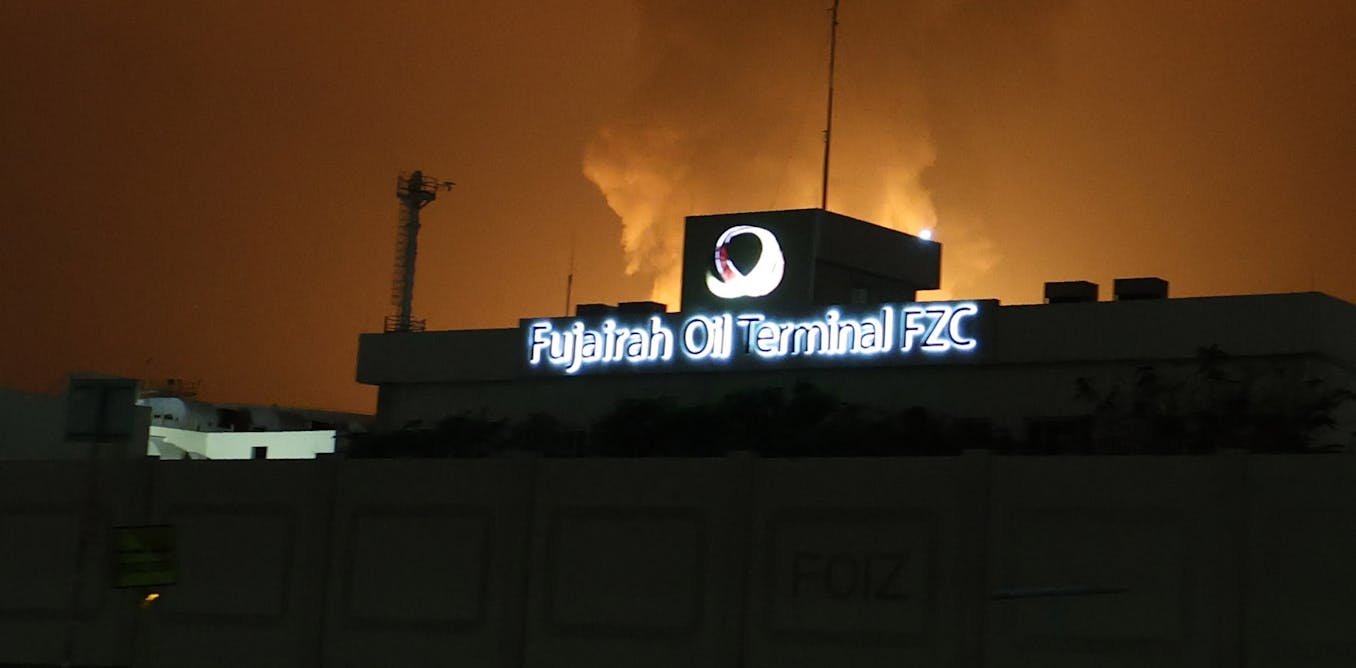
Iran immediately responded to US-Israeli strikes on February 28 by launching coordinated missile and drone attacks against US military installations in the Gulf region. Since then, its targeting has expanded to airports, seaports, hotels and oil refineries. The debris from missile interceptions has produced several casualties.
The first official statements from governments in the Gulf, with the exception of Oman, refrained from condemning the US-Israeli strikes. Those strikes killed Iran’s supreme leader, Ayatollah Ali Khamenei, along with several senior Iranian officials and nearly 180 civilians. Many of these were schoolgirls killed in an attack on a school in southern Iran.
This lack of condemnation did not go unnoticed. Across social media, a wave of debate broke out, with many Gulf citizens asking how governments that style themselves as voices of measured multilateralism could fail to register the illegality of the US-Israeli aggression against Iran.
However, as the barrage continued and many Gulf citizens and residents found themselves stuck indoors, the initial sympathy for Iran’s position began to give way. For most Gulf citizens, the sound of explosions and aerial interceptions is new. The exception is Kuwait, whose population carries the memory of Iraq’s 1990 invasion and occupation.
Like many anxiously watching from a distance, I have been calling family and friends in the Gulf every day. They send voice notes offering insights on the conflict that rarely make it into official Gulf channels.
Those who had been through war before knew what to do. An Emirati friend described a message from her Lebanese colleague, who had lived through multiple cycles of conflict and passed along a piece of practical advice: “Keep your windows and doors slightly ajar, so that pressure from nearby explosions does not drive the glass to shatter inward.”
She went on to recount how a Serbian woman in Dubai, who had survived two wars and believed she had exhausted her capacity to do so again, had told her she found the sounds so triggering that she spent the night sleeping in her car in the basement of her apartment building.
The sight of a long queue outside an Emirates airline office in a Dubai mall offended at least one Emirati observer. Expatriates rerouting their lives away from a conflict that had not yet become catastrophic, by any measure, was something this person found “cowardly”, she told me in an indignant voice note.
A Qatari friend put the asymmetry differently. Western governments, she remarked, could be relied on to extract their nationals from the consequences of foreign policy decisions they had supported. In contrast, Gulf populations would be left to absorb them – including rising food prices that could strain household budgets if traffic through the strait of Hormuz remains disrupted.
To date, the casualty figures in the Gulf are relatively low. Three people have died in Kuwait, three in the United Arab Emirates (UAE), three in Oman and one in Bahrain. None were Gulf citizens. Two of those killed in Kuwait were members of the Bidoon, a stateless community that has existed in Kuwait for generations without formal legal recognition.
For now, the absence of citizen casualties has softened the psychological impact of the conflict, exposing the racial hierarchies that have long plagued Gulf societies. But it is possible the Gulf governments are managing disclosure carefully, wary of provoking panic.
The information environment there is tightly controlled. The UAE has warned the public against filming or sharing footage of strikes and interceptions, with violations carrying a fine of 100,000 UAE dirhams (roughly £20,000) and potential imprisonment.
Saudi Arabia, Kuwait, Bahrain and Qatar have also issued directives urging citizens and residents to rely only on official sources.
Regional security questions
The conversation has taken on a different register among Gulf scholars and commentators. Despite the narrow space for debate, the war has opened an unexpected aperture for introspective commentary.
Conspicuously absent have been Emirati voices. Scholars and commentators in the UAE operate under tighter constraints than their Gulf counterparts. Views that interrogate state policy also rarely find their way into public circulation.
Saudi analyst Sulaiman al-Oqaily, speaking on Al Jazeera on February 28, gave voice to a frustration that has also appeared in local media. He argued that the US, nominally a security partner to the Gulf, had revealed itself as focused overwhelmingly on Israeli security, with scant regard for the Gulf states.
Omani scholar Abdullah Baabood put it plainly in a social media post on March 3: “The Iran-US war is not the Gulf’s war, yet Gulf states have become sitting ducks – exposed by geography, constrained by alliances, and vulnerable to escalation they neither chose nor control.”
Qatari commentator Abdulrahman Al-Marri offered a more layered analysis. Also in a post on social media, he insisted any serious engagement with the crisis must begin from its most basic fact: this is a war of choice, manufactured by the US and Israel. But he was equally insistent that this should not obscure the Gulf’s own reckoning with Iran.
The US and Israel and also Iran, in Al-Marri’s framing, are respectively engaged in forms of “state terrorism” and “counter-state terrorism” that have cost the region dearly. Iran’s conduct is not absolved by US-Israeli aggression, he writes. Its support for armed proxies and interventions in Iraq and Syria have left a residue of enmity and distrust that are etched in collective memory across the Gulf.
Yet on one point, the commentary has converged: the Gulf states must stay out of the war. Restraint and diplomacy have been the consistent recommendations.
Alongside this, Al-Marri and others have pointed out that US military bases in the Gulf, long presented as guarantors of security, have revealed themselves as liabilities. They have made Gulf territories a target in a confrontation they did not initiate.
Fifty years after independence, the Gulf region has yet to build a security framework that does not depend on outsourcing its defence to external partners whose interests, as this war has shown, do not reliably align with its own.