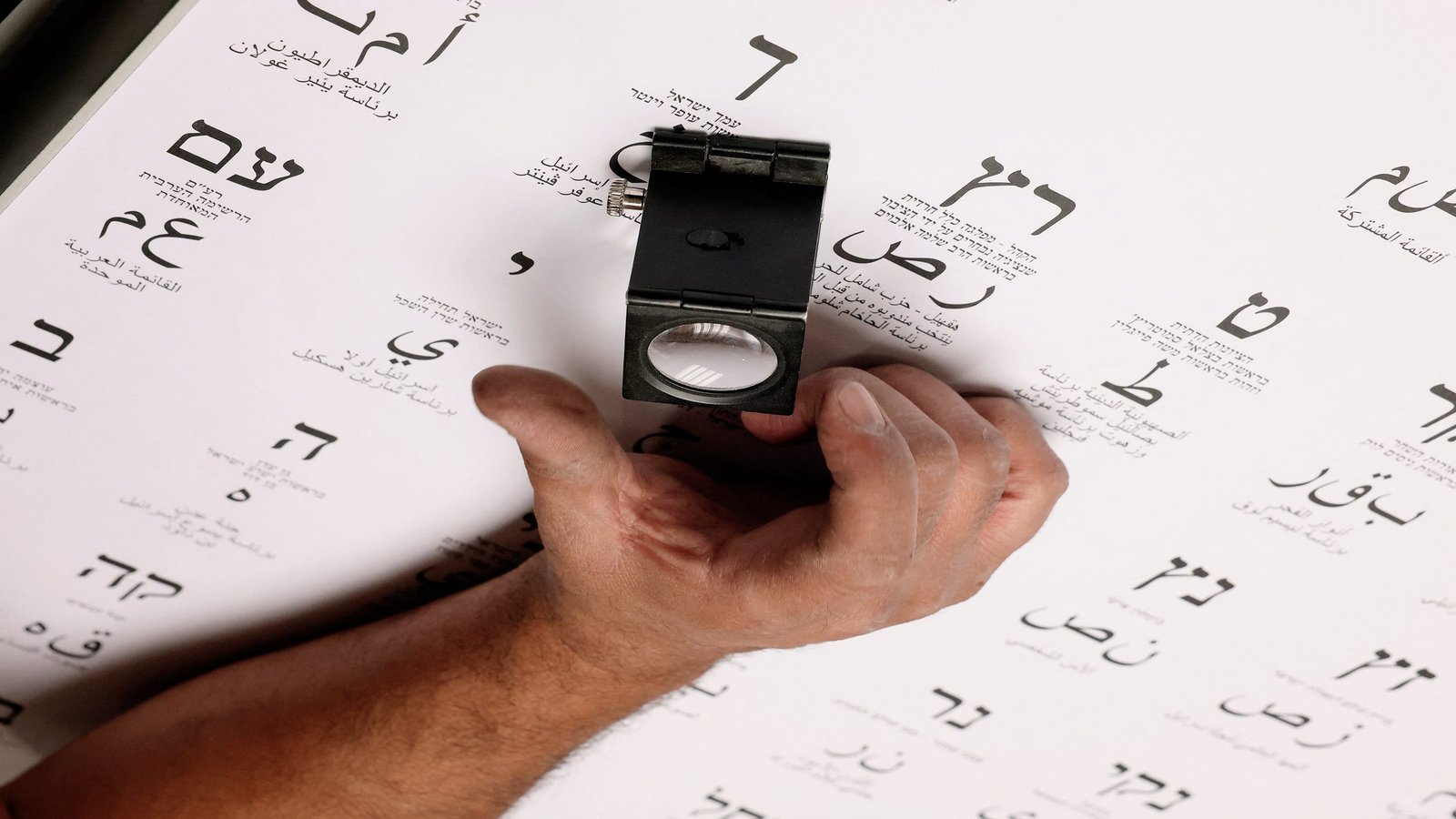
Israelis vote for party lists rather than individual lawmakers or a prime minister. A proportional electoral system, mathematical seat-allocation rules, and coalition negotiations determine who governs.
In Israel, voters do not directly elect their prime minister or individual members of parliament. Instead, each voter chooses a single list of candidates, usually representing a political party or an alliance of parties. The votes determine how the 120 seats in the Knesset, Israel’s parliament, are distributed.
What happens after the election can be just as important as the vote itself. Parties negotiate alliances, agree on policies, and divide government responsibilities. The leader of the largest party does not automatically become prime minister, and a smaller party can sometimes determine who governs.
Israel uses a system called proportional representation, which helps explain its many political parties, complicated coalition negotiations, and frequent early elections.
Why Does Israel Have So Many Political Parties?
Unlike the United States, where two major parties dominate national elections, Israel has a multiparty system. Its parties represent a broad range of political, religious, ethnic, and social interests.
Some focus on security, diplomacy, and economic policy. Others represent particular communities, including ultra-Orthodox Jews, religious Zionists, and Arab citizens of Israel. Parties also differ over relations with the Palestinians, religion’s role in public life, and the balance between government authority and judicial power.
The Knesset has 120 seats, a number inspired by the Great Assembly, a council of Jewish religious leaders and sages traditionally associated with the period following the return from the Babylonian exile in the fifth century BCE.
Unlike the US Congress, the Knesset has only one chamber. The entire country is treated as a single electoral district, meaning there are no separate parliamentary constituencies for Jerusalem, Tel Aviv, or other cities. Parties win seats according to their share of the nationwide vote, provided they receive enough votes to qualify.
How Do Israelis Vote?
Israeli citizens who are at least 18 years old are generally eligible to vote. Citizens can run for the Knesset beginning at age 21, although certain restrictions apply. The president, judges, the state comptroller, the military chief of staff, the two chief rabbis, and certain senior civil servants, military officers, police officers, and prison officials cannot run while holding their positions. Depending on their position, some must resign well before an election. Certain criminal convictions can also disqualify candidates.
Knesset terms are legally set at four years, but the interval between elections can be longer. Regular elections are scheduled for a Tuesday in the Hebrew month of Heshvan, which falls in October or November. The precise Tuesday depends on whether the preceding Hebrew year was a leap year. Following an early election, the next regular election is scheduled for Heshvan after four years have elapsed, potentially extending the interval beyond four years. Early elections are also common, and the Knesset can postpone elections in exceptional circumstances with the support of at least 80 of its 120 members.
At polling stations, voters select a paper slip bearing the name and identifying letters of their preferred electoral list, printed in Hebrew and sometimes also in Arabic, place it in an official envelope, and deposit it in a ballot box.
Each voter chooses one list. There is no separate vote for prime minister, no vote for a local representative, and no ranking of individual candidates.
Every list presents its candidates in a predetermined order. If a list wins 15 seats, its first 15 candidates enter the Knesset. Parties use different methods to select and rank candidates, including primary elections, party committees, and decisions by party leaders.
A list can represent one party or several parties running together. Voters selecting a joint list vote for the combined slate, not its individual components.
What Is the Electoral Threshold?
To enter the Knesset, an electoral list must receive at least 3.25% of all valid votes cast nationwide. This is known as the electoral threshold.
If 4 million valid votes are cast, for example, a list needs at least 130,000 votes to qualify. A list receiving 3.24% wins nothing, while one receiving 3.25% would ordinarily receive about four seats, depending on the overall results.
The threshold was originally 1%, increased to 1.5% before the 1992 election, rose to 2% in 2004, and reached 3.25% in 2014. The increases were intended to reduce parliamentary fragmentation and encourage smaller parties to run together.
Votes cast for lists that fail to cross the threshold are excluded when distributing the 120 seats.
Suppose three parties each receive 3% of the vote. Together, they attract 9% of voters, but none enters the Knesset because each ran separately and fell below the threshold.
Their votes are not transferred to any other party. Instead, all 120 seats are divided among the qualifying lists, increasing those parties’ proportional shares.
This can alter the balance of power between political blocs and helps explain why parties with similar positions sometimes run on joint lists.
How Are Knesset Seats Distributed?
After excluding votes for lists that fail to cross the threshold, election officials add the votes received by all qualifying lists and divide the total by 120. The result is an initial electoral quota representing the approximate number of votes needed for one seat.
Each list’s vote total is divided by this quota, with the whole-number result determining its initial allocation.
For example, if qualifying lists receive 3.6 million votes altogether, the quota is 30,000 votes per seat. A list with 310,000 votes initially receives 10 seats, with 10,000 votes left over.
Because this calculation normally leaves some seats unassigned, Israel uses a mathematical formula known as the Bader-Ofer method, named after former Knesset members Yohanan Bader and Avraham Ofer, to distribute the remaining seats.
Rather than simply awarding these seats to parties with the largest number of leftover votes, the formula divides each list’s vote total by the number of seats it has already received, plus one. The list with the highest resulting figure receives the next seat, and the calculation is repeated until all 120 seats have been assigned.
Suppose Party A receives 310,000 votes and has 10 seats. Its figure for an 11th seat is 310,000 divided by 11, or approximately 28,182.
Party B receives 205,000 votes and has six seats. Its figure for a seventh seat is 205,000 divided by seven, or approximately 29,286.
Party B would have priority for the next seat, despite receiving fewer votes overall.
The complete calculation also accounts for agreements between parties over their excess votes.
What Are Excess-Vote Agreements?
Before an election, two lists can sign an excess-vote agreement, sometimes called a surplus-vote agreement. This allows their votes to be combined when calculating eligibility for the remaining seats under the Bader-Ofer method.
If their combined votes qualify them for an additional seat, a further calculation determines which partner receives it.
The agreement can improve the chances of one partner gaining another seat, although it does not guarantee one.
Both lists must independently cross the 3.25% electoral threshold for the agreement to take effect. If either fails, the agreement cannot save its votes or transfer them to its partner.
These arrangements differ from joint electoral lists. Parties running together on one list combine their votes before the threshold is applied. Parties signing an excess-vote agreement remain separate, appear independently on the ballot, and receive their own Knesset seats.
An excess-vote agreement also does not require its participants to cooperate in forming a government. Its immediate purpose is mathematical, not political.
Why Doesn’t the Largest Party Automatically Form the Government?
Once the seats have been allocated, the next challenge is forming a government.
A party needs 61 of the Knesset’s 120 seats to hold an outright parliamentary majority. No single party or electoral list has ever won that many seats in an Israeli election, so every Israeli government has been formed through a coalition of several parties.
A coalition is an agreement among parties to govern together, usually involving compromises over policy, government ministries, budgets, and legislation.
Consider an election in which Party A wins 35 seats, Party B wins 30, Party C wins 18, Party D wins 15, Party E wins 12, and Party F wins 10.
Although Party A is the largest, Parties B, C, and D could form a coalition with 63 seats, giving them a majority.
This also gives smaller parties considerable bargaining power. A party holding just five or six seats can sometimes determine whether a prospective coalition reaches the 61-seat mark. In exchange for joining, it may demand cabinet positions or commitments on policies important to its voters.
However, coalition partners must also make compromises, and disagreements can eventually threaten the government’s survival.
Relatively small shifts in voting can dramatically change the outcome of an Israeli election. The balance between right-wing and center-left blocs may come down to just a handful of Knesset seats. A party gaining or losing one or two seats, or narrowly crossing or missing the electoral threshold, can determine which bloc has enough support to form a government.
The outcome also depends on parties that do not fit neatly into either bloc. Some centrist, religious, or other parties may be willing to join coalitions led by different political camps, depending on their priorities and the agreements they can negotiate. As a result, even when the overall vote changes only slightly, the composition of the next government can be very different.
What Does Israel’s President Do After the Election?
Israel’s president is the head of state, with mainly ceremonial and representative responsibilities, while the prime minister leads the government.
After an election, the president plays a central role in deciding who gets the first opportunity to form a government.
Once the official results are published, the president consults representatives of the newly elected parliamentary factions. Each can recommend a Knesset member to form a government.
The president considers these recommendations and assigns the task to a willing Knesset member, generally choosing someone who appears capable of assembling sufficient parliamentary support.
The president is not legally required to choose the leader of the largest party or even the candidate receiving the most recommendations.
The assignment must be made within seven days of the official publication of the election results.
How Is a Government Formed?
The candidate selected by the president receives 28 days to negotiate a governing coalition. The president may grant extensions totaling up to 14 additional days, allowing a maximum of 42 days.
Negotiations typically cover coalition policies, government ministries, budgets, legislation, and arrangements for resolving disputes.
Once an agreement is reached, the candidate informs the president and the Knesset speaker that a government has been formed.
The proposed government is presented to the Knesset, including its policy guidelines, ministers, and their responsibilities. Lawmakers then vote on whether to express confidence in it.
Although a coalition normally seeks the support of at least 61 members, an initial confidence vote requires a majority of those voting, not necessarily 61 affirmative votes.
This means Israel can have a minority government if enough lawmakers outside the coalition support it or abstain. Such governments, however, can have difficulty passing budgets and legislation.
If the confidence vote succeeds, the new government takes office, and the person who formed it becomes prime minister.
What Happens if the First Candidate Fails?
If the first candidate cannot form a government within the allotted time, or the proposed government fails to win the Knesset’s confidence, another election does not automatically follow.
Within three days, the president can assign the task to another willing Knesset member, who receives 28 days without an extension. Alternatively, the president can inform the Knesset speaker that there appears to be no possibility of forming a government.
If the second attempt fails, or the president has declared that no government appears possible, Knesset members have 21 days to propose their own solution.
During that period, at least 61 lawmakers can submit a written request asking the president to assign the task to a particular willing Knesset member. That candidate then receives 14 days to form a government.
If no candidate receives 61 signatures during the 21-day period, or the final candidate fails, the Knesset is considered dissolved, and new elections must be held within 90 days.
The outgoing government remains in office until a new one takes over.
Can a Government Fall Before the Next Election?
Yes. Coalition partners can withdraw their support, a prime minister can resign, or the Knesset can dissolve itself and call early elections.
Israel also uses a system known as constructive no-confidence. Rather than simply voting to remove a government, at least 61 Knesset members must vote to express confidence in a specific alternative government that is ready to take office.
This prevents lawmakers from dismissing a government through a no-confidence vote without agreeing on its replacement.
A failure to pass the state budget within the legally required period can also trigger early elections.
Between April 2019 and November 2022, Israel held five general elections, largely because of repeated difficulties forming and maintaining governing coalitions.
The combination of proportional representation, multiple parties, and coalition politics means election night rarely settles every question about who will govern.
Voters determine which parties enter the Knesset and how many seats they receive. The government that emerges depends on which parties can assemble enough parliamentary support to take office and remain there.