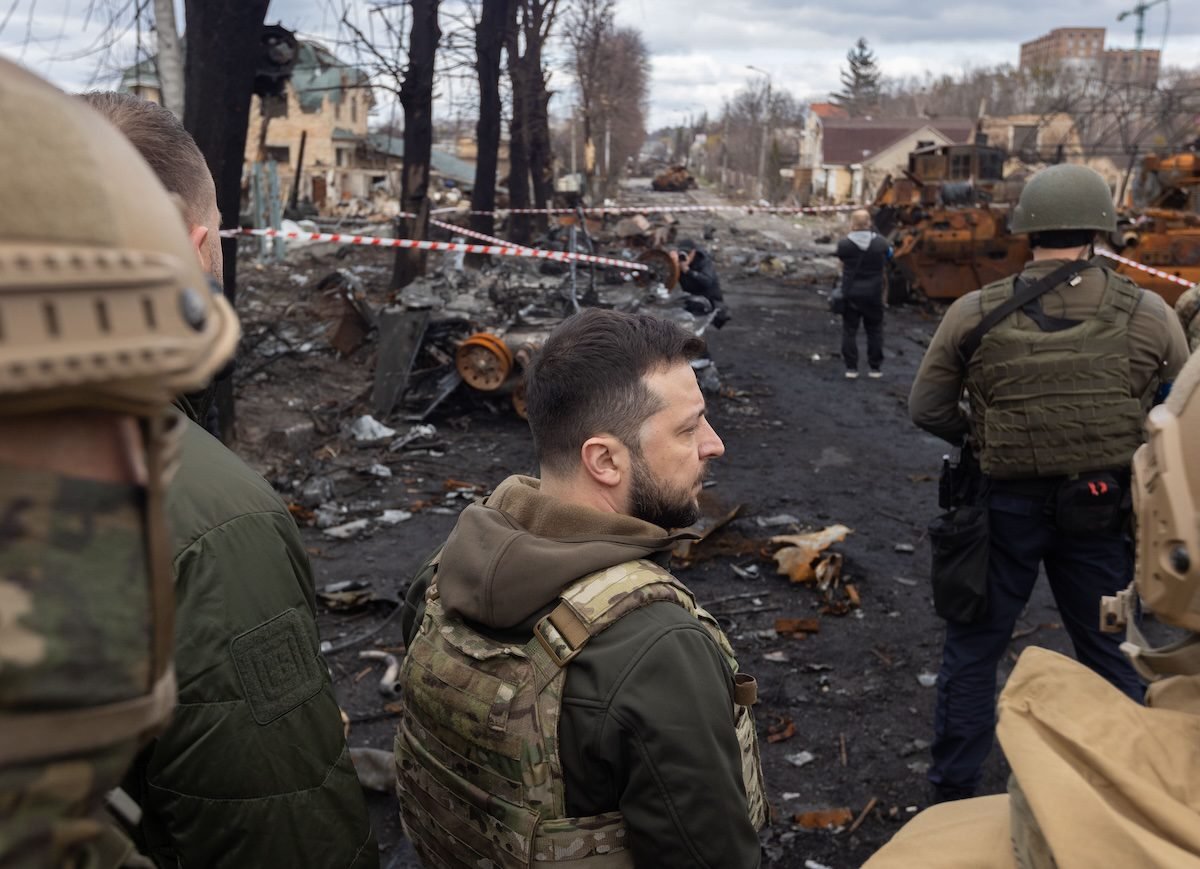

The background on Russia’s so-called informal ban on killing Zelensky traces to a meeting in Moscow in March, 2022.
At the request of Ukrainian President Volodymyr Zelensky, then Israeli prime minister Naftali Bennett flew to Moscow. Even though Bennett is an orthodox Jew who observes the Sabbath (Shomer Shabbat), he left Israel on Saturday, March 5th, 2022 on an urgent mission. Jewish Halakhah (Jewish religious law) allows that the Sabbath can be violated to save a life (called in Hebrew Pikuach Nefesh). The Bennett mission was to convince Russian President Putin not to kill Zelensky.
Bennett remembered the dialogue between himself and Putin this way:
- Bennett: “What’s with this? Are you planning to kill Zelensky?”
- Putin: “I won’t kill Zelensky.”
- Bennett: “I have to understand that you’re giving me your word that you won’t kill Zelensky.”
- Putin: “I’m not going to kill Zelensky.”

On leaving Moscow Bennett phoned Zelensky. According to Bennett, Zelensky asked, “Are you sure?” to which Bennett replied, “One hundred percent. He won’t kill you.”
Reports this past week from Moscow and from Ukraine say that the Russian Security Council, meeting with Putin, announced that the ban on assassinating Zelensky was no longer in effect and that Russia could attack the Ukrainian leader and other political and military leaders in Ukraine.

The news on lifting the ban was carried by Moskovsky Komsomolets (MK), a Moscow-based daily newspaper with a circulation between one and two million, covering general news. On November 14, 2026, MK carried the key article entitled “The Taboo is Lifted: A Decision to Eliminate Zelensky Was Made at a Closed Security Council Meeting.” It is noteworthy that MK (and other outlets repeating the MK story) referred to unnamed “sources” and various Russian military-political Telegram channels (such as Akademiya), rather than official Kremlin statements or documentary evidence.

The story ran that Ukrainian drone and missile attacks on the critical Baltic oil export hub at the port of Ust-Luga along with the huge cost of shooting down Ukrainian drones had stretched Russia to an economic breaking point. The Security Council, according to the news story, decided the time had come to essentially decapitate Ukraine’s political and military leaders. The Security Council proposed attacking bunkers and motorcades using heavy hypersonic weapons, Iskander ballistic missiles, and three-ton FAB-3000 glide bombs.

Volodymyr Zelenskyy’s wartime command has relied heavily on a deep, Soviet-era subterranean complex beneath Kyiv’s government quarter. The underground complex started out as a Cold War nuclear fallout shelter – identified in defense reporting as part of the ChZ-417 subterranean network. Built to sustain a rump government during a nuclear strike, the concrete warren connects via deep vertical shafts and underground tunnels to the Cabinet of Ministers, the Verkhovna Rada (parliament), and the Kyiv Metro system. The facility features autonomous life-support, water, diesel power, and secure communications infrastructure.

During the course of the war the Russians have not bombed the Kiev underground complex. Whether conventional Russian weapons can damage or destroy the complex isn’t known. Unlike the United States, Russia does not have specialized bunker busters such as the US Air Force’s 13-ton GBU-57 Massive Ordnance Penetrator that was used in Iran as part of Operation Midnight Hammer.
The most effective Russian penetrator weapon is the FAB-3000 M-54 (with UMPK Glide Kit). This is a 3-ton Soviet-era gravity/glide bomb repurposed in recent conflicts to deliver devastating blast overpressures against large industrial and fortified city blocks. The UMPK Glide Kit turns the FAB “iron bomb” into a semi-precision glide weapon with a release range of 40 to 60 km. There is no publicly verified confirmation of a 3-ton FAB-3000 with a UMPK glide kit specifically being shot down, though Ukrainian forces have claimed over 100 interceptions of smaller UMPK-equipped glide bombs.
Ukrainian operations against military and political figures in Russia stepped up just before the Security Council meeting in Moscow, part of a continuing series of covert strikes.
On November 12th in St. Petersburg Russian Air Force Colonel Dmitry Lobodin was killed in a car bomb attack attributed to the Ukrainians. On the morning of November 13, 2026, a car bomb exploded on Kirovogradskaya Street in southern Moscow, severely injuring 72-year-old Sergei Zavorotniy. Zavorotniy survived the blast but was placed in an induced coma after losing his left arm and suffering a concussion, fractured ribs, and shrapnel wounds. Zavorotniy previously served as a spokesperson and senior aide to exiled pro-Russian former Ukrainian Prime Minister Mykola Azarov before fleeing to Moscow in 2014.
Ukraine has an active campaign against Russian military and political figures and has sponsored attacks inside Russia, in the Russian occupied zone in Ukraine and possibly elsewhere.
The Russians have been less proactive against major Ukrainian leaders, although they did launch an attempt to hit the headquarters of Kyrylo Budanov, head of Ukrainian military intelligence (HUR) and now top aide to Zelensky.
If the Russian Security Council had lifted the ban on killing Zelensky one would have expected complaints from Israel and the United States. Bennett remains a major Israeli political figure and a factor in the ongoing coalition negotiations there. Bennett has not made a comment so far about the MK report. Likewise there is no comment from the White House or the State Department. The Europeans have not said anything either.
The MK report, therefore, and its echoes among Russian and Ukrainian bloggers, may be more of a threat than a changed policy. It remains to be seen what happens next.
Stephen Bryen is a former US deputy under secretary of defense. You can find this article and many more on his newsletter Weapons and Strategy, from which it is republished with permission.
Source: Iwpost.com