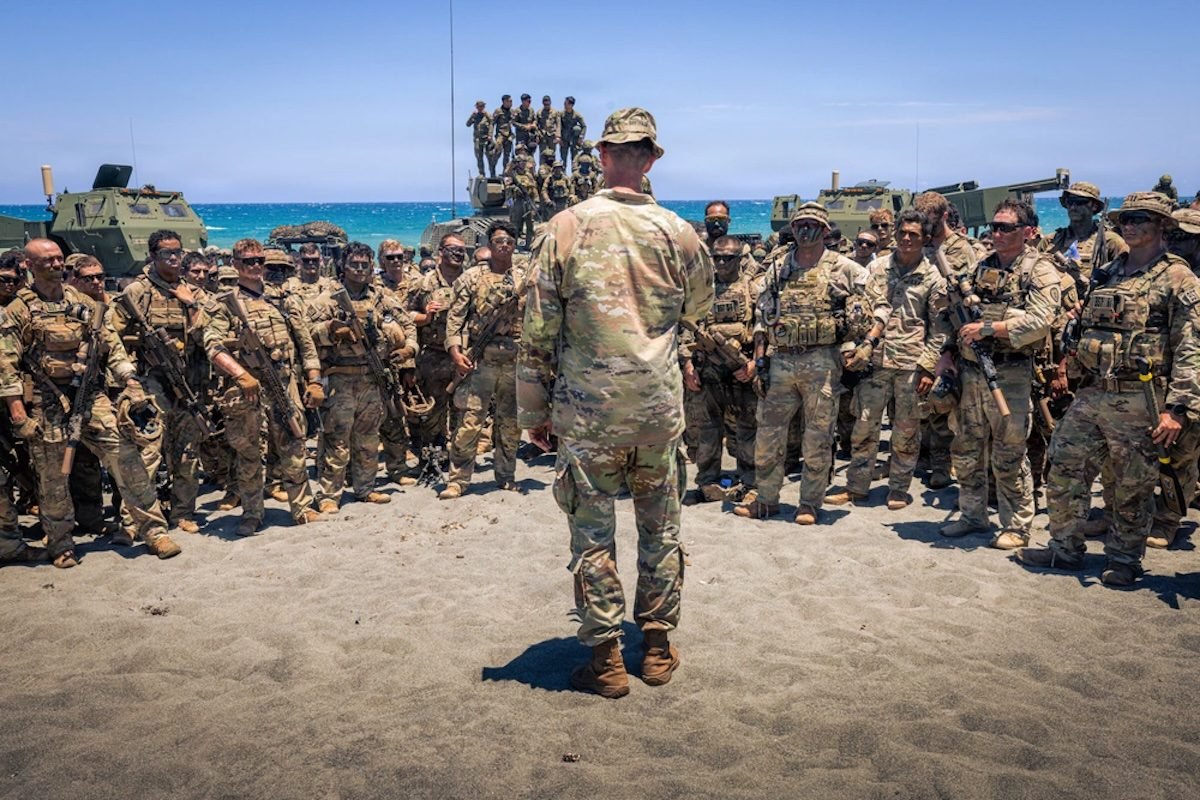

In the Balikatan military exercise, taking place in the Philippines, troops from the Philippines, US, Japan, Australia, New Zealand, Canada, and France have been getting real combat training – and a lot of it.
It’s conducted with China in mind – even if nobody will say so. That’s the etiquette.
Furthermore, the forces are training in the area that would be part of the “operational area” in the event the People’s Liberation Army moves against Taiwan.
This includes the northern Philippines facing the South China Sea and the Luzon Strait, also known as the Bashi Channel, between Taiwan and the Philippines. The PLA would need to move through this channel to protect its right flank or to conduct operations on the east side of Taiwan.
It’s always best to train where you’ll fight and militaries improve just the way sports teams do. Training with partners is even more helpful – so that you’re not strangers when the time comes to fight for real.
But beyond the operational benefits that come from Balikatan-type exercises, there are psychological and political benefits that are sometimes overlooked.
When militaries exercise together they tend to view each other differently – not least as more equal partners. Along with enhanced confidence in their own and partner capabilities, it tends to thicken political alliances.
Overly imbalanced defense relationships are risky. One side eventually feels put upon and restrained. The other comes to think it’s doing too much – for an ungrateful partner. This weakens a relationship and, if unchecked, can destroy it.
The Japan Self-Defense Force (JSDF) sent a large contingent to join this year’s Balikatan combat exercises for the first time, and is otherwise rapidly improving its capabilities. It’s a good reminder of how improved operational capabilities brings along psychological and political advantages.
Not long ago the Japan-US defense relationship was dangerously imbalanced – with Japan pathologically dependent on the US military for protection.
When Japan’s amphibious force got its start in late 2011 with a small group of US and Japanese officers quietly pushing things forward, the idea was partly to give Japan a necessary capability.
An island nation with vast maritime territory must be able to conduct amphibious operations along the littorals. Such operations are necessary both for disaster relief and for fighting an enemy invader.
And the effort was also a way to address a fundamental JSDF weakness: the unwillingness and inability of the three JSDF services to operate together. Amphibious capability was a forcing function to get ground and naval forces to cooperate – and, eventually, to work in the Air Self-Defense Force.
But there was more intended than just filling a missing operational capability. All of this built confidence in JSDF – which sometimes seemed to have an inferiority complex towards the US forces. Even Japan’s political class had for years belittled the JSDF and its capabilities.
The American officers also wanted the American military to take Japan seriously. Other than the US Navy, the basic thinking in too many parts of the US military was that the Americans would take care of things and the Japanese could go sit in the corner.
This was causing resentment in JSDF – and contributing to Japan’s political class’s lassitude, if not antagonism about defense.
When the JSDF became able to conduct complex, if rudimentary, amphibious operations, within a couple years its confidence increased. And the political class also saw Japan as able to play a more active role in the nation’s defense – and also alliance operations.
Japan also became less gratingly deferential to the US.
The US side in turn saw Japan as a more useful, and more equal (or at least less unequal) ally.
All in all this led to a political strengthening of the bilateral relationship. Which made it harder for China to split the two politically, for example by China sending “white lobbyists” to Capitol Hill or the Sunday Talk Shows claiming that “Japan expects you Americans to do all the hard work and go die for them.” That would resonate widely.
And it would not be a vote getter in DC.
Conversely, and as importantly, consider the psychological effect of getting things right on one’s adversaries – such as China. A more militarily capable target nation is bad enough. China hates it when its intended victims are better able to defend themselves, and it’s even more irked when intended victims get together to defend themselves. There’s a reason Xi Jinping complains about ‘blocs.’
So from Balikatan and similar exercises, the free nations are enhancing their ability to resist Chinese aggression, but, as importantly, are coming to recognize that they can resist such aggression, and need not submit to inevitable Chinese domination. Maybe next year, Taiwan can be invited.
Colonel Grant Newsham (US Marines – Ret.) is the author of When China Attacks: A Warning to America.