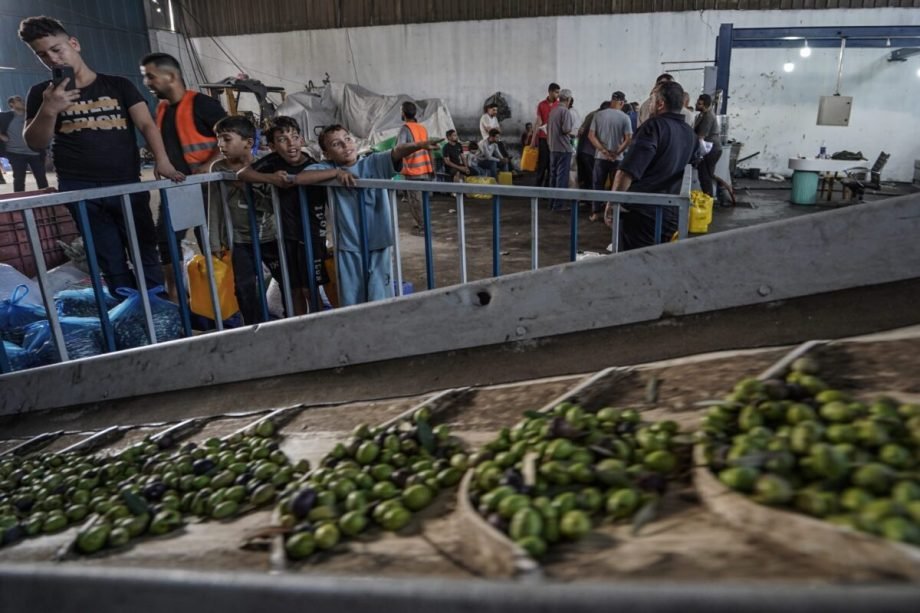
Palestinian farmers in Gaza are facing a difficult olive harvest this year as production declines, large areas of agricultural land remain damaged and many groves are inaccessible because they lie in areas controlled by the Israeli army or beyond the so-called “yellow line,” Anadolu reports.
On accessible farmland, farmers continue picking olives and separating them from leaves and branches despite shortages of fertilizer, irrigation water and agricultural supplies, as well as higher labor, transportation and pressing costs.
The pressures have left many families unable to store their usual annual supplies of olive oil and olives.
On July 13, Gaza’s Agriculture Ministry estimated losses to the agricultural sector from Israel’s genocidal war, which began on Oct. 8, 2023, at more than $3 billion, including $1.49 billion in direct damage and $1.59 billion in indirect losses.
Kamel Baraka, a farmer from Deir al-Balah in central Gaza, said olive tree yields had fallen significantly.
“A tree that produced around 100 kilograms (220.4 pounds) of olives before the war now produces no more than 20 (44 pounds) to 30 kilograms (66 pounds),” Baraka told Anadolu.
That represents a decline of around 70% to 80%, he added.
“A season that once provided an important source of income for farmers, traders and workers now barely meets the needs of some families because of current conditions and shortages of essential agricultural supplies,” Baraka said.
“Olive cultivation requires constant care, fertilizer, irrigation and other inputs that have become increasingly difficult to obtain,” he added.
-Massive damage
Damage to farmland and restrictions on access have also directly reduced the harvest.
“Large areas of olive groves in eastern parts of central Gaza lie in zones farmers cannot reach, particularly east of Salah al-Din Street and around the ‘yellow line,’” Baraka said.
The “yellow line” is a notional line inside the Gaza Strip to which the Israeli army withdrew under the first phase of US President Donald Trump’s plan to end the war, under which a ceasefire took effect on Oct. 10, 2025. It separates areas in eastern Gaza that remain under Israeli army control from areas west of the line where Palestinians are allowed to move.
“Farmers in Deir al-Balah, Bureij and Maghazi face difficulty reaching agricultural land that had been a major source of olive production,” Baraka said.
He said available farmland west of Salah al-Din Street is insufficient to meet residents’ needs for olive oil and olives.
Before the war, preparations for the harvest began about a month in advance, with farmers arranging workers and preparing equipment for picking and transport, while families stored olives and oil for the year ahead.
Those preparations have declined as production falls and costs rise, with some farmers now collecting only enough olives for household consumption and limited quantities for sale.
-Costs triple
Farmers are also struggling with sharply higher transportation and pressing costs, as well as shortages of containers needed to store olive oil.
“The cost of pressing olives has risen to around three times what it was before the war,” Baraka said, adding that the increase has placed further pressure on farmers whose incomes have already fallen because of lower production.
“Before the war, olive press owners often transported harvests from farms to pressing facilities, while farmers now struggle to find transportation even for small quantities,” he added.
Higher costs for pumping water and irrigating trees, combined with shortages of fertilizer, labor and storage containers, have made preserving the harvest and storing oil increasingly difficult, particularly for families that depend on farming for their food needs.
“The olive season, once an opportunity for farmers to improve their livelihoods and secure food supplies for the year, has become an exhausting season that provides many of them with only a fraction of what they need,” Baraka said.
Since Israel’s genocidal war began on Oct. 8, 2023, Gaza’s agricultural sector has sustained widespread damage, according to the Agriculture Ministry.
The ministry said 158,909 dunams (39,267 acres) of agricultural land have been damaged out of a total 182,247 dunams (45,033 acres), or around 87%, sharply reducing crop production and the capacity to provide food.
The war also has killed more than 74,000 Palestinians and injured over 175,000 others, according to Palestinian figures, also destroying about 90% of the enclave’s infrastructure.