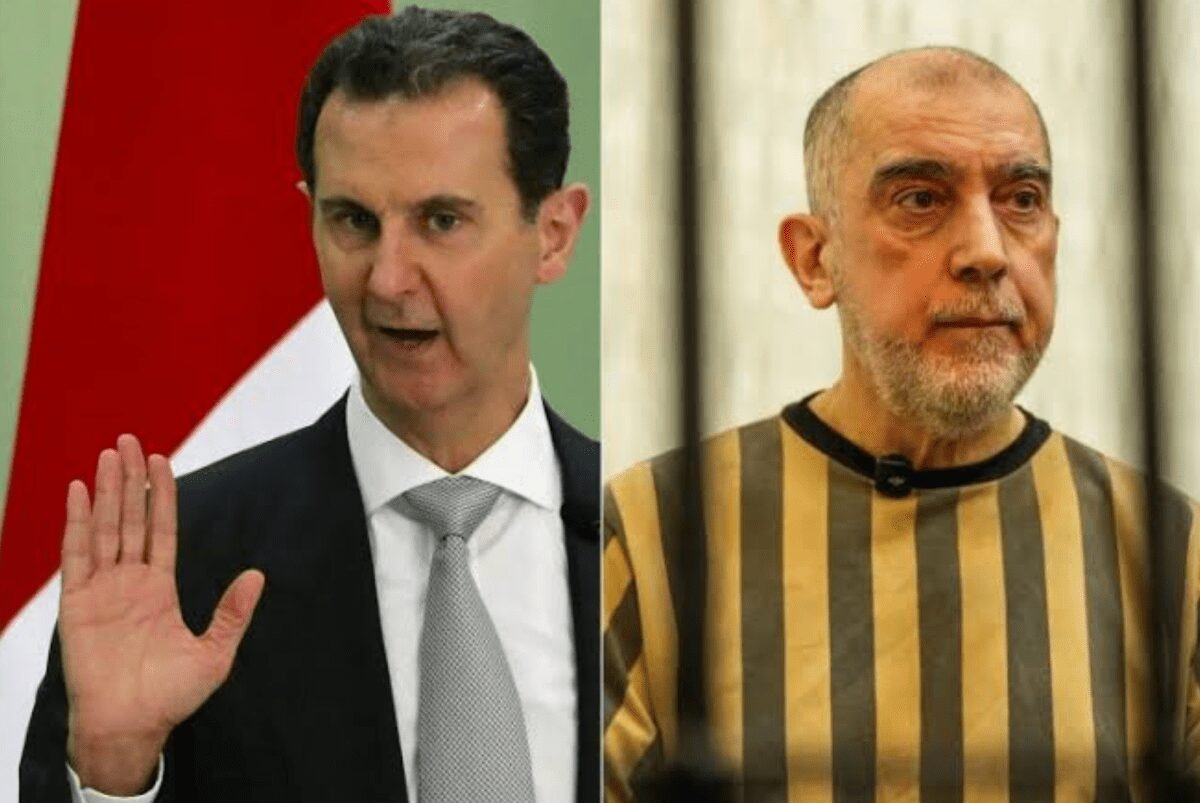
Former Syrian dictator Bashar al-Assad has been sentenced to death, nearly two years after his government collapsed and he fled the country for the safety of Moscow.
A court in Damascus handed Assad the death sentence Tuesday after convicting the ousted leader in absentia of war crimes and crimes against humanity committed during Syria’s devastating civil war.
Assad, who ruled Syria with an iron grip for more than two decades, fled to Russia with his wife, Asma, and their children after rebel forces toppled his government in December 2024.
Now, while Assad remains beyond the reach of Syrian authorities, a court in the capital has delivered one of the most dramatic judgments yet against the former regime.
Judge Fakhr al-Din al-Aryan convicted Assad of a series of crimes that included premeditated murder, the killing of children under the age of 15, torture resulting in death and unlawful imprisonment.
Assad’s younger brother, Maher al-Assad, was also sentenced to death in absentia. Maher commanded Syria’s powerful Fourth Division and was widely regarded as one of the most feared figures inside his brother’s government.
Several other former military and security officials received death sentences as well, including former Defense Minister Fahd al-Freij.
Most of the defendants were nowhere near the courtroom when the sentences were announced.
Former security official Atif Najib, Assad’s cousin, was the notable exception.
Najib was in custody and appeared in court before receiving his own death sentence over his role in the brutal crackdown on protesters in the southern city of Daraa in 2011.
The events in Daraa helped ignite the uprising that would eventually explode into Syria’s catastrophic civil war.
Pro-democracy demonstrations began spreading across the country in 2011 as part of the wider Arab Spring movement. Assad’s security forces responded with arrests and deadly force, helping transform the unrest into a sprawling conflict that lasted nearly 14 years.
By the time Assad’s government finally collapsed in December 2024, roughly half a million people had been killed, millions had been forced from their homes and countless families were still searching for relatives who vanished during the fighting.
Assad had repeatedly denied responsibility for atrocities attributed to his government, portraying his opponents as extremists and foreign-backed forces.
But his regime became internationally notorious for allegations of mass torture, executions, sieges and chemical weapons attacks. International investigations have attributed multiple chemical attacks involving sarin or chlorine to Syrian government forces.
Tuesday’s ruling marks an extraordinary reversal for a man who once appeared nearly impossible to remove from power.
Assad became president in 2000 following the death of his father, Hafez al-Assad, continuing a family dynasty that controlled Syria for more than five decades.
That dynasty came crashing down in late 2024 when rebel fighters rapidly swept across the country and captured Damascus, sending Assad fleeing to Russia.
He now remains in exile while Syria attempts to reckon with the enormous human toll left behind by his government.
The death sentence is largely symbolic as long as Assad remains outside the country and protected in Russia.
Still, for Syrians who spent years demanding accountability for the bloodshed, Tuesday’s verdict represents a remarkable moment: the former ruler who once commanded Syria’s sprawling military and security apparatus is now a convicted war criminal facing a death sentence in the very capital he once controlled.