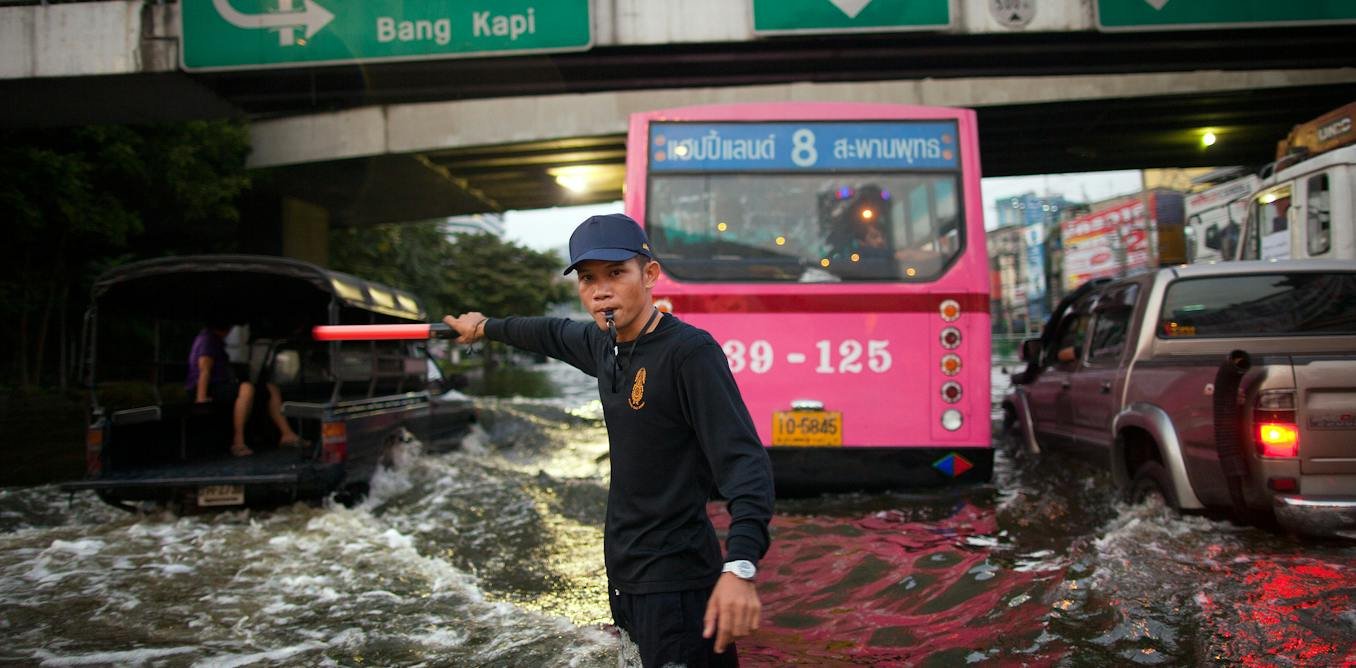
Making that decision increasingly means thinking about risks, like whether surrounding roads will flood, worker safety will be compromised by extreme heat in the summer, and clean water will be available.
As climate change increases the frequency and intensity of extreme weather events around the world, these effects can be especially severe in poorer countries that lack the resources to prepare for disasters or recover quickly after they hit.
I study how political and environmental risks affect international business. In my new book, “Multinational Corporations and Climate Change: Risks, Responsibilities, and Resilience,” I explore how disaster risk is affecting the ways global companies see these climate-vulnerable markets, and how those views are leading some foreign investors to avoid these developing nations altogether.
Low- and middle-income countries aren’t the only ones that suffer when multinational corporations pass them by. The companies themselves also stand to lose out on business opportunities in emerging markets if they pull away.
How climate risk affects foreign investment
Evidence from several studies suggests that multinationals are systematically avoiding investing in the most climate-vulnerable countries. These include my own analysis of 159 countries. Although these studies focus on different samples, they identify the same trend: Countries characterized by greater climate vulnerability received less foreign investment.
The results are not trivial. My book identifies a 12% reduction in foreign direct investment for each 1-point rise in climate vulnerability on a 100-point scale, while holding other relevant factors constant. This vulnerability data measures countries’ exposure to climate hazards as well as their capacity to adapt.
Companies rarely say why they’re avoiding a particular location, but their climate-related concerns occasionally become visible.
For example, Google halted plans to build a US$200 million data center in Chile after an environmental court revoked its construction permit over the likely effects on water supplies and the environment. Similarly, a $1 billion data center proposed in Kenya by Microsoft and the Abu Dhabi-based artificial intelligence company G42 was delayed and ultimately suspended amid concerns about water stress in the area.
Companies have reason to be cautious about climate risks.
One analysis of 71 large publicly traded companies found that firms reporting major flood losses experienced a 5% average decline in shareholder value over the following year, after accounting for broader market movements.
In Vietnam, typhoons and floods caused an estimated $475 million in damage to energy and transportation infrastructure in 2022. Unreliable infrastructure cost companies there about $280 million.

Severe flooding in Thailand in 2011 forced several companies, including Toyota, Nissan and Honda, to temporarily suspend production as factories flooded, shutting down production of parts or vehicles made there.
Costs like those shape where companies choose to invest next.
While climate risk does not stop all investment in climate-vulnerable markets, it does make projects in these nations relatively more expensive, less attractive and more difficult to finance than less risky locations.
Who loses from investor avoidance?
For developing countries, less foreign investment means fewer jobs are created. These countries also have fewer opportunities to benefit from exposure to the new technologies that multinationals bring when they invest abroad.
Those results highlight another way climate change is deepening global inequality. It reduces the economic activity that could support future development, while simultaneously damaging physical infrastructure and threatening human health and well-being.
Developing countries are especially vulnerable to the effects of rising global temperatures, whether for their dependence on agricultural markets, geography or relatively fragile infrastructure. A report from the Climate Impact Lab at the University of Chicago projects that 90% of heat-related deaths in the coming decades will take place in low- and middle-income countries. Similarly, a 2022 study found that around 90% of people exposed to flooding live in developing nations.
Yet poor countries have contributed only a tiny fraction of the emissions that are causing climate change, even as they face the brunt of the damage. For example, African countries are responsible for less than 4% of greenhouse gas emissions globally. But they stand to experience the greatest negative effects of climate change.
Lost opportunities for multinational companies
When a company avoids investing in climate-vulnerable countries, that may reduce its exposure to floods, droughts or extreme heat, but the decision also carries potential costs for the company.
Many of these countries have growing consumer markets, energy resources or critical minerals that multinationals need. Companies that dismiss them as too risky may lose out on promising opportunities.
For example, the Democratic Republic of Congo supplies most of the world’s cobalt, while Indonesia has become the dominant producer of nickel. These countries are highly vulnerable to climate change, which is likely scaring some companies away.
Yet companies with a greater tolerance for risk have established strong positions in those countries’ mineral industries. Thus, more cautious firms may reduce their risk exposure, but they are also surrendering access to important resources and growing markets.
Reducing investor avoidance
There are ways to help companies overcome their climate-risk avoidance so more investment can pour into these countries:
-
Foreign aid from wealthy countries can help developing countries shore up their roads, ports, electrical grids and water systems before extreme storms or droughts occur. My 2025 study found that climate-vulnerable countries that received more aid for climate adaptation also received more foreign direct investment than those receiving less aid. The result suggests the funding may reassure companies that climate risks are being addressed.
-
International development banks can share some of the risks by providing climate risk insurance to multinationals. This would offer a safety net to absorb some of the losses if a covered disruption prevents a project from operating as intended. The World Bank already offers similar coverage against political risk incidents, which has given companies confidence to invest in countries such as Kenya, Mozambique and Nigeria.
-
Better data can give companies more precise information about climate risks. Many risk scores label entire nations as vulnerable or not, even though exposure varies from one city or project site to another. More detailed information about local flood exposure, water availability, heat, infrastructure and adaptation capabilities would allow companies to limit their avoidance to the riskiest areas, instead of bypassing those countries altogether.
Understanding the local risk, insuring companies against risk and helping countries make their infrastructure more resilient to storms, droughts and heat can help boost investment in ways that benefit the companies and spur economic growth and development in climate-vulnerable countries at the same time.
Source: Iwpost.com