The key to working at a place like Ars Technica is solid news judgment. I’m talking about the kind of news judgment that knows whether a pet peeve is merely a pet peeve or whether it is, instead, a meaningful example of the Ways that Technology is Changing our World.
The difference between the two is one of degree: A pet peeve may drive me nuts but does not appear to impact anyone else. A Ways that Technology is Changing our World story must be about something that drives a lot of people nuts.
“But where is the threshold?” I hear you asking plaintively. “It’s extremely important that I know when something crosses the line from pet peeve to important, chin-stroking journalism topic!”
Fortunately, the answer is simple. The threshold has been breached when your local public transit agency puts up a sign about the behavior in question.
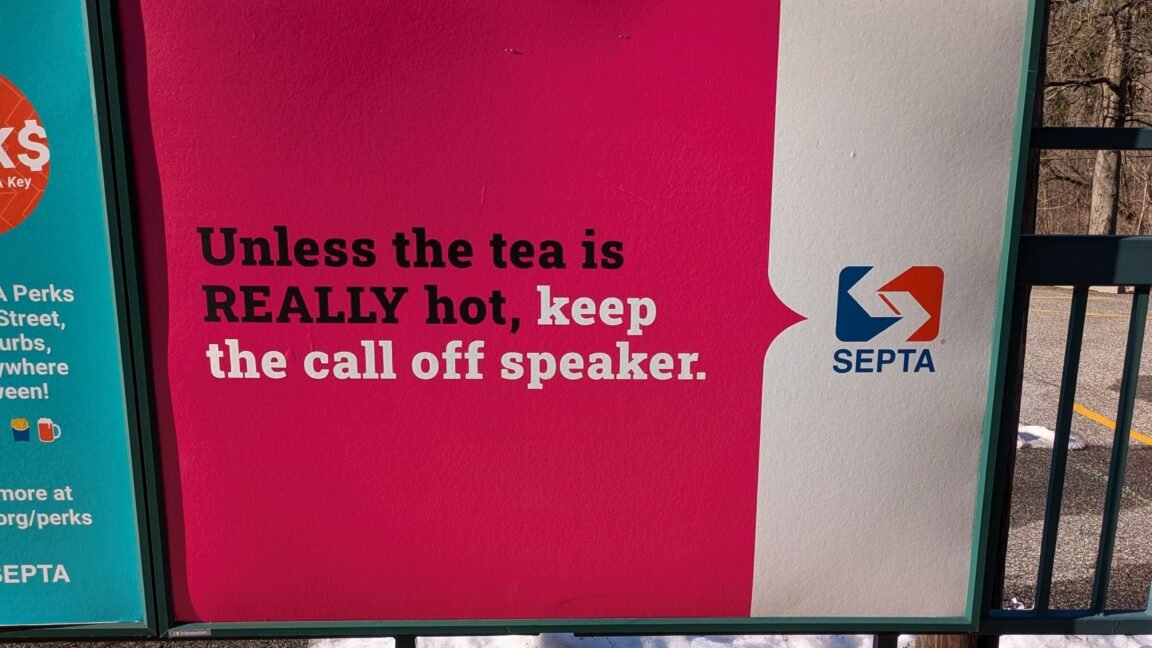
Which brings me to the sign I saw yesterday in Philadelphia.
“Unless the tea is REALLY hot, keep the call off speaker,” it said.
(For those not in the US, “tea” in this context means gossip or news.)
SEPTA, the local transit agency, runs the buses and commuter rail in Philadelphia, and you can tell from the light-hearted-but-seriously-don’t-do-this tone of the message that speakerphone-wielding passengers are now widely complained about by their fellow riders.
I share their disdain, but for me, the dark and judgmental thoughts I have when I see this behavior are also paired with confusion. Why is it happening? Do these people not know that it is actually more work to hold your phone out in front of you than up to your ear? Do they have no common decency, manners, or taste? Do they genuinely not care if everyone in the frozen foods aisle overhears them talking about Aunt Kathy’s diagnosis? It’s bizarre.
At least when it comes to something like TikTok or Spotify, there’s a certain logic. Perhaps you have no headphones but need to unwind after a long day, and you just can’t imagine anyone who might not enjoy the soothing sounds of [Harry Styles/Cannibal Corpse/Wu-Tang Clan]?
But phone calls? People—are you aware that we can hear you and the person speaking to you?
Our long national nightmare
Ever since people began emerging from their pandemic isolation, I’ve seen a shocking amount of public speakerphone usage. Especially—of all places—in the grocery store. I can only assume that picking out spicy hummus and chicken tikka masala at Trader Joe’s is so boring for many people that they would rather have completely unrelated conversations, on speaker, in public, as a form of distraction.
It’s not just grocery stores and SEPTA trains, of course. Just yesterday, shortly after seeing the sign, I saw a woman walking along the sidewalk talking loudly into a phone held out in front of her. When will our long national nightmare finally end?
Not soon, if we can judge by that bastion of cultural reporting, the New York Post, which claimed in 2025 that speakerphone use on New York City public transit was “an unspoken act of aggression backed by the threat of violence—and everyone nearby knows it.” But New Yorkers weren’t going to do anything about it because people are “too scared of nasty blowback if they so much as look at the offender wrong.”
Londoners aren’t going to act, either, as My London noted in 2023. “Londoners being Londoners,” the outlet said, “they are unlikely to approach anyone directly and ask them politely to turn the volume down, but they will spend hours and hours online discussing other ways to deal with the problem, including spending £350 on Sony noise-cancelling headphones.”
I mentioned my frustrations to a friend from Chicago this week. Maybe Chicago has the answer? My friend had just encountered obnoxious speakerphone use at his local Starbucks, he said, where a couple had placed a phone on the table between them with the volume apparently on max. My friend could hear this quite clearly from two tables away, and he could not resist making his feelings known. So he marched over and told the couple that they were being loud, obnoxious, and inconsiderate… and then immediately shimmied his way out the door.
Frustrated members of the public have taken to social media to vent about the issue, hoping for good advice. But what they usually get is a warning, such as, “You think these guys don’t know they’re being obnoxious? Of course they do: they just don’t give a sh— about you or anyone else on the train. Unless you’re 6’2” and 250 pounds of anger and muscle and willing to risk eating a box cutter, put your AirPods or whatever in and ignore it like everyone else.”
You might think that Philly, of all places, would be a natural spot for the public to speak up—this is the city that memorably threw snowballs at Santa, an event so famous it has its own Wikipedia entry.
But I’ve never seen it happen, and frankly, I don’t do it either. I’m not scared of “eating a box cutter,” because despite what the post above implied, most of the people I’ve seen on speakerphone don’t seem aggressive or purposely obnoxious. Many are middle-aged, and their basic affect is just… oblivious.
Indeed, this was the explanation that USA Today came up with in 2024. People have just become (I am paraphrasing here) unconsciously self-centered jerk faces who don’t even think about how annoying their behavior might be in public spaces. Perhaps the pandemic is to blame, or the solipsism of the smartphone.
Maybe. I’m not fully sold on those explanations, which appear to have no real data behind them. On the other hand, it’s hard for me to think of a good reason for doing this, so who knows. Whatever the reason for it, though, people are not generally receptive to public criticism from strangers—and I’m not sure they ever were.
The search for answers
Ars readers are some of the smartest on Earth and so, when I saw the SEPTA sign validating my long-running disdain for public speakerphones, I wondered if our readers might not have scientific answers to my long-gestating questions:
- Is public speakerphone use increasing?
- If so, why? (WHY, I SAY!)
- And—most importantly—how do we spread the good word about public spaces, private conversations, and the fact that phones still work when pressed to your ear?