A recent report put out by a relatively obscure Washington think tank, Defense Priorities, is getting an unusual amount of attention.
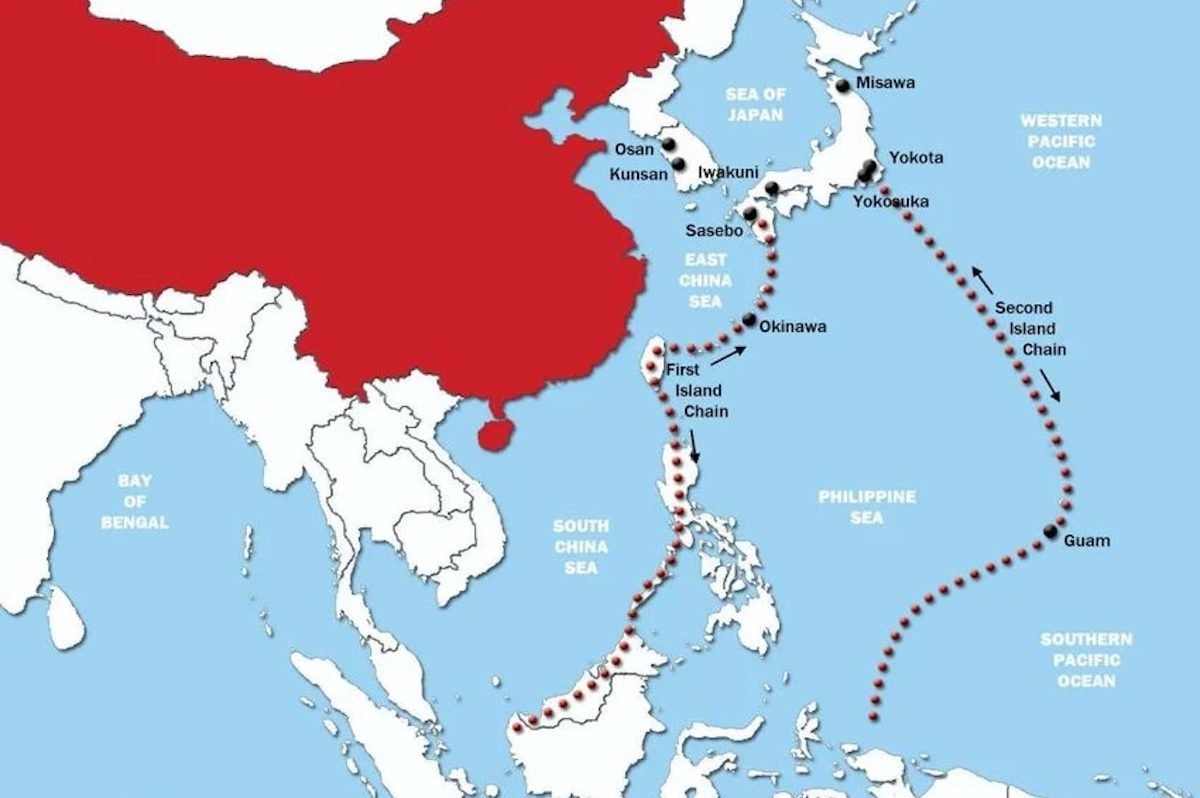
In simple terms, the report written by the shop’s military analysis director Jennifer Kavanagh and entitled “A Second Island Chain Strategy for Asia” looks at current US security policy in the Asia-Pacific region and calls for doing the opposite.
DC think tanks put out reports all the time. Very few get the amplification seen with this one. With all of the attention, it has triggered deep confusion – and, in some cases, concern – across the region.
So, it’s worth answering some of the questions the report has raised and see if its assertions stand up to scrutiny.
The report says that moving troops from the first island chain to the second island chain and ending any strategic ambiguity over a defense commitment to Taiwan would reduce risk of war with China. How might China view this move, and what might the Chinese reaction to such a move possibly be?
When setting defense strategy at any level – from strategic to tactical – it’s good to ask
- “What would my enemy think about this?”
- “What would he least/most want me to do?”
The Defense Priorities report’s call for ending US alliances, pulling back to the so-called Second Island Chain, effectively declaring that the US will not defend Taiwan (by stating a ‘non-intervention policy) and eventually pulling most US forces out of the region entirely could have been drafted by the PRC.
For People’s Liberation Army planners, it’s a wishlist.
In short order we would see full-bore Chinese political warfare amplifying the idea that “the Americans are unreliable, in retreat, and leaving you Asia-Pacific nations on your own. So you had better submit – and now, since we won’t be so nice later on.”
To signal this, the PLA (navy and air force in particular) would be out and about in more places, more often and asserting presence and dominance – to include violence and kinetic moves.
China has always been very clear about its intentions. Recall a Chinese officer telling Admiral Timothy Keating (then US PACOM commander) in 2008: “why don’t we reach an agreement, you and I? You take Hawaii east. We’ll take Hawaii west.”
He was serious.
And look at Chinese behavior toward the Philippines and Japan over the last decade-plus, and toward Taiwan in recent years.
That gives you a taste of what would spread across the region if this report’s recommendations were followed.
The report identifies the United States’ key interests in Asia as “supporting a regional balance of power in East Asia that does not leave China decisively dominant and defending access to key regional trade routes and maritime passageways as a hedge against physical interdiction.” Will the report’s recommendations accomplish this?
The report seems to be paraphrasing the latest US National Defense Strategy (NDS).
The key point is that the author argues that removing US forces from the Western Pacific (and eventually all the Pacific) and telling free nations with which we have formal alliances (and implicitly telling every other Asian nation that does not want Chinese domination) “You’re on your own” will not cause any real problems.
How wrong can somebody be? Remove the only force that currently prevents Chinese domination and it creates a vacuum. Vacuums get filled. Forget about having any sort of balance of power in Asia and the Western Pacific.
Protecting trade routes and free flow of commerce would be similarly impossible before too long.
The report notes that the US Navy can escort commercial ships to ensure trade flows if necessary. To put it mildly, this is insane.
Does shifting US military focus to the Second Island Chain adequately defend those interests, as this report suggests?
No. It undercuts the entire basis – military, political, psychological – for protecting US national interests, as well as the entire idea of free sovereign nations in the region.
Defending from the Second Island Chain with a token force? The author never makes the case how that would work in practice, and does not seem to be familiar at all with military operations – or very familiar with the Second Island Chain itself, either the geography or the people.
For example, current attempts by the Department of War to put around $2 billion worth of infrastructure in Yap, on the Second Island Chain, are entangled in difficult negotiations and, according to PACOM, may even be moved to another location, resulting in serious delays.
Moving troops and military facilities is not like changing a seating chart for a dinner party.
How would Japan, South Korea, the Philippines and Australia react to the end of mutual defense alliances with the US? Would they be willing to negotiate security partnerships instead, as this report suggests?
They would panic, though some might hide the panic better than others. None of these countries has the ability to take on China alone. Nor is there any combination that could do so.
“Arm themselves to the teeth” as the author suggests? She needs to explain what that means, how they would do it, and how it would counter an aggressive China. She doesn’t.
As for separate security partnerships with the US, there may not be much interest in doing so with a United States that has just sold out Taiwan and otherwise appears in retreat and not committed to the region – including potentially putting Americans in US territories like Guam, Northern Mariana Islands and American Samoa at risk.
Deterring China was arguably made the United States’ second priority in its 2026 National Defense Strategy, after years as the number one defense priority. Given that change in focus, does this make it more likely that the Pentagon will take any of these suggestions to heart?
I’m not so sure deterring China is the second priority – even though those who think that’s the case note correctly that the language regarding China isn’t as specific or obvious as in previous defense strategy documents. In any case, the NDS does stress first-island chain defense and also having allies do more defense-wise. Arguably, this is a part of homeland defense. Not only is a forward defense sound military strategy, the US is a Pacific nation and its defenses (and territory) start in the Western Pacific – not just off the California coast.
China is still considered the major threat that needs to be defended against – even if pundits call it the ‘second’ priority.
Will the administration pay any attention to the report’s suggestions?
I hope not. Unless we want to hand the Asia-Pacific over to the Chinese Communists and entirely discredit ourselves worldwide as a nation in decline, lacking the power or will to challenge an expansionist enemy and protect our trade routes – and whose promises mean nothing.
What else is missing?
I’m surprised this report was not commissioned by China’s Global Times newspaper. It is exactly what the PRC wants America to do. And even some of the specific recommendations are almost word for word Chinese talking points. For example:
- First thing to do: remove US trainers / advisors from Taiwan.
- Remove Typhon missile systems from the Philippines.
- Remove US forces from Okinawa.
The report makes many stark, controversial assertions and does not adequately defend them.
Nor does it discuss Chinese objectives, observed behaviors and avowed strategies.
It ignores empirical evidence.
It also shows cold bloodedness in calling for 23 million Taiwanese to accept Communist Chinese enslavement.
The report doesn’t account for psychological and political effects (on friends and foes of its proposed recommendations) and instead only touches on “military” aspects.
And the author does not consider current or future Chinese political warfare at all – instead focusing almost exclusively on “military” parts of a larger equation. This is a huge omission.
Meanwhile, I don’t see any sign that locals – Japanese, Koreans, Taiwanese, Filipinos, Pacific Islanders, Australians, et al – were considered in all of this. The author ought to have run the draft report by them and also by some good military experts.
Some, if not most, of the ideas in this report are fantastical. They don’t make any sense from a military operational perspective. And, as noted, the writer does not appear knowledgeable or familiar with the Second Island Chain – its people and geography.
It brings to mind moving pieces of paper around on a map without thought for on-the-ground realities or feasibility or effects of such moves.
Finally, one wonders why this report is getting amplified now. Think tanks produce all sorts of reports, but this one came out just before Xi visited Washington and is getting more attention than most. That’s curious timing.
At the same time, beyond the US policy crowd, there are people in the Pacific and Asia who will use this report as ammunition to argue China’s case – and to call for removing the US military from the Pacific.
One may hope that nobody in the Trump administration takes this report seriously. However, I gather there are some people not far removed from the administration who might agree with the ideas expressed in the report. And maybe a few actually inside the administration. How they got hired is anybody’s guess.
Grant Newsham is a retired US Marine officer, a former US diplomat and business executive with many years experience in the Asia-Pacific region – to include serving as head of intelligence for Marine Forces Pacific and as an advisor to the Japan Self Defense Force. He is the author of When China Attacks: A Warning To America. Follow on X @NewshamGrant