<
article id=”post-952678″>
Having taken control of both houses of the US Congress, the Democrats are likely to push back against Trump’s war on Iran, brutal immigration and customs enforcement (ICE) and attacks on the environment, but they are just as protectionist as the Republicans and just as likely to put Europe and the Middle East ahead of East Asia when it comes to defense.
On Wednesday, Japan’s Chief Cabinet Secretary Minoru Kihara told the Japanese media that the alliance with the US “remains the cornerstone of Japan’s foreign and security policy” and is key to “maximizing its national interests,” regardless of the outcome of the US midterm elections, adding that the government will monitor financial markets “with a high sense of urgency.”
What is new here? Not the evident case of nerves. It is Trump’s war on Iran that has driven up energy costs and Trump’s approach to China and North Korea that has put the Japanese government on edge.
The US has a history of dealing with China behind Japan’s back dating back to Nixon and Kissinger, and Trump has been talking about reviving his special relationship with North Korean leader Kim Jong Un.
In August, Trump said he expected to meet with Kim by year’s end. “The fact that I get along with him, that’s a very good thing. Not a bad thing,” particularly because North Korea has “57 very powerful nuclear weapons.”
In October, while speaking at a campaign rally in Ohio, Trump said. “I get along great with Kim Jong Un. You know who that is? When people have 112 nuclear missiles, it’s nice to get along.”
So far, no progress toward a meeting has been reported. Still, a senior Japanese official told the Yomiuri newspaper: “We don’t want them [the United States and North Korea] bypassing us to make deals.” But they might. The same goes for China and Russia, which the government of Prime Minister Sanae Takaichi continues to alienate despite China’s importance as a trade partner and Russia’s as a key supplier of oil and gas.
A delegation of about 200 Japanese business leaders from the Japan-China Economic Association, including senior representatives of Keidanren (Japan Business Federation), had planned to visit China last January.
However, they were forced to cancel the trip due to the blowback following Takaichi’s remark that a Chinese blockade of Taiwan could be seen as a “survival-threatening situation” for Japan, justifying a military response. The Japanese business organizations found that they simply could not arrange meetings with Chinese officials.
The Japan-China Economic Association tried to reschedule in November, but that also fell through, so it is now aiming for March. Instead, about 20 Japanese business leaders will reportedly attend the APEC summit in Shenzhen on November 18 and 19.
As for the situation on the Korean Peninsula, it has been more than two decades since Prime Minister Junichiro Koizumi met with Kim Jong-il (Kim Jong-un’s father) in 2002. According to Japan’s Ministry of Foreign Affairs:
(i) The aim of this visit was, through a frank discussion between the two leaders, (a) to achieve a breakthrough of the situation towards a resolution of the various issues between the two countries, including the abduction issue, by eliciting the political will of Chairman Kim Jong-Il, and
(b) to firmly urge North Korea to act as a responsible member of the international community to dispel international concern about security issues such as nuclear and missile problems and to resolve such issues through the promotion of dialogue with the United States, the Republic of Korea and other concerned countries in order to ease the tension on the Korean Peninsula.
(vi) The summit meeting did not resolve all of the issues outstanding between Japan and North Korea, and they continued to remain grave concerns. However, it was judged that there was a prospect that the resolution of pending issues would be advanced in a comprehensive manner. As such, Prime Minister Koizumi decided to resume the normalization talks in order to move further towards the resolution of the issues.
In fact, the Koizumi–Kim Jong-il summit did not resolve any of the outstanding issues between Japan and North Korea, which only grew more serious. Trump met with Kim Jong Un three times during his first term, but failed to achieve a breakthrough, although Kim and Ambassador Extraordinaire Dennis Rodman did share a love of basketball.
President Biden reverted to containment, which led to the Comprehensive Strategic Partnership between North Korea and the Russian Federation and the economic revival of North Korea (GDP growth above 3% per annum since 2022, according to the Bank of Korea). South Korea now faces North Korean troops battle-hardened in Ukraine, and a larger and more sophisticated North Korean weapons industry.
With this in mind, many South Koreans were alarmed when Lieutenant General Joe Hilbert, commander of the US Eighth Army in South Korea, told the South China Morning Post that it would be “irresponsible to focus myopically” on threats on the Korean peninsula or to “suggest that we cannot do other things simply because we are in Korea.”
The US 2026 National Defense Strategy calls for South Korea to take primary responsibility for deterring North Korea, while US forces focus on defending the first island chain, which runs from Japan to Taiwan and the Philippines. US Forces Korea Commander General Xavier Brunson went further a year ago, when he showed off his “East-Up Map” of the Western Pacific, stating that:
When the same region is viewed with east orientation toward the top, the strategic picture transforms dramatically. The first island chain, a cornerstone of Indo-Pacific strategy, takes on new meaning. Forces already positioned on the Korean Peninsula are revealed not as distant assets requiring reinforcement, but as troops already positioned inside the bubble perimeter that the US would need to penetrate in the event of crisis or contingency.
This shift in perspective illuminates Korea’s role as a natural strategic pivot. Distance analysis reveals the Camp Humphreys’ proximity to potential threats: approximately 158 miles from Pyongyang, 612 miles from Beijing and approximately 500 miles from Vladivostok. Korea is positioned to address northern threats from Russia while simultaneously providing western reach against Chinese activities in the waters between Korea and China.
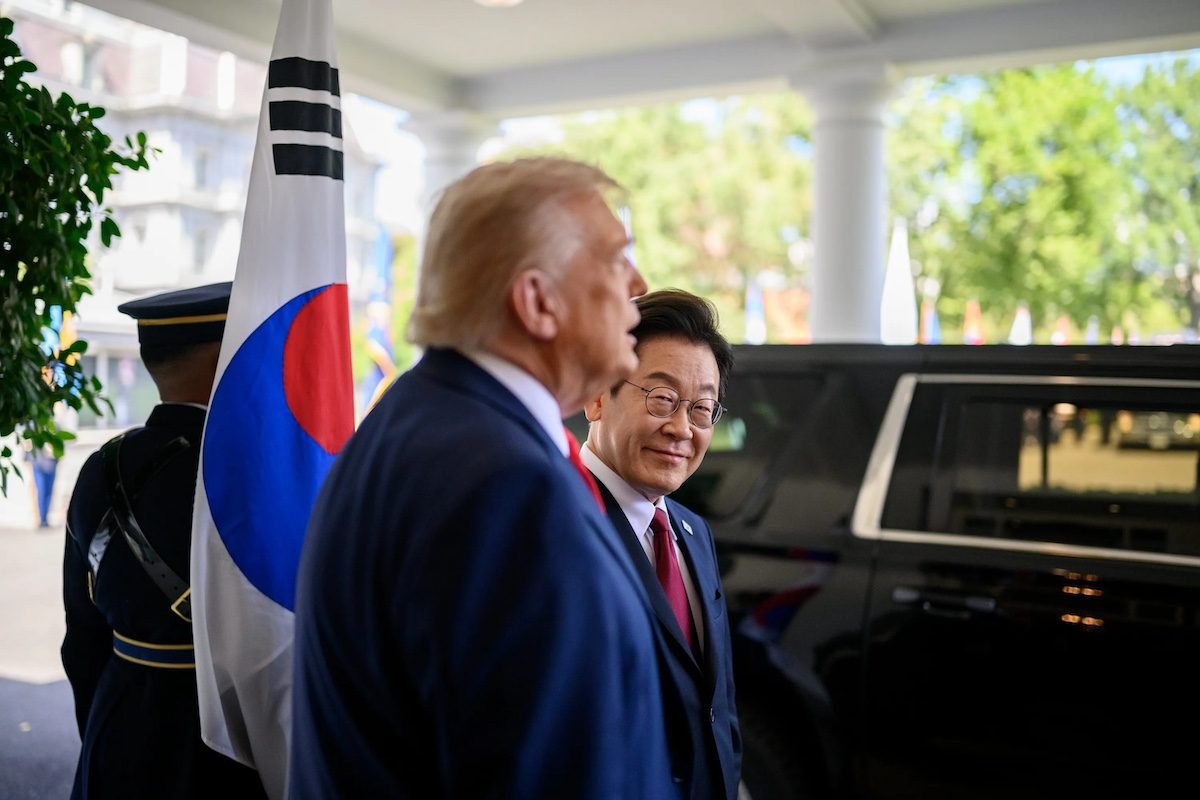
The US is also pushing back against South Korean President Lee Jae-myung’s attempt to have wartime operational control (OPCON) of US forces in South Korea transferred to South Korean military commanders.
Lee wants it done before the end of his term in 2030, but Brunson said in October that the changing security environment (e.g., North Korea launching more ballistic missiles) has created “new standards” that require the transfer to be “conditions-based” rather than determined by politics. As reported by Air & Space Forces Magazine, the South Korean Minister of Defense and National Security Advisor see this as “moving the goalposts.”
Speaking at the Indo-Pacific Summit hosted by the Gold Institute for International Strategy in Washington, DC, Brunson said:
Because the conditions have changed, because we’ve changed our plan, we have new standards which we have to uphold. We don’t have the benefit of changing the conditions to time. Time, in and of itself, is a condition. We’re talking about critical capabilities. We’re talking about the ability to be fully mission-capable to do all the things you’re counting on me to do right now.
The intent seems to be to move the goalposts as far out as possible, perhaps to never. There is precedent: The plan to relocate the US Marine Corps’ Futenma Air Station in Okinawa was first announced in 1996, to be done “within five to seven years.” Now it is expected to take place in the mid-2030s. A city has grown up around the Futenma Air Station since 1945 (conditions have changed), increasing the risk of accidents and complaints about noise.
It is for good reason that South Koreans see a growing risk of being dragged into a US war with China over Taiwan, or another regional conflict. Speaking at Seoul National University’s Institute for Future Strategy on October 21, Professor Emeritus Moon Chung-in of Yonsei said, “Personally, I see the alliance as a curse rather than a blessing for us. As long as we remain in an alliance, we cannot escape the security dilemma.”
President Lee Jae-myung, who is trying to improve diplomatic and trade relations with both Beijing and Moscow, finds himself between a rock and a hard place. He also favors the revival of dialogue between Trump and Kim Jong Un. In September, Lee told the Associated Press that “The two leaders should build trust and work together to identify a common ground, face-to-face.”
At the same time, South Korea is capitalizing on the US effort to rebuild its naval shipbuilding capacity. On November 1, South Korea’s Hanwha Defense USA signed a US $269 million contract to build a Medium Landing Ship for the US Navy and Marine Corps at the Hanwha Philly Shipyard in Philadelphia, which it acquired in December 2024. On October 23, HD Hyundai (formerly Hyundai Heavy Industries) said it had signed an agreement with US engineering and construction company Kiewit to build a new shipyard in the US.
The Japanese used to talk about an all-directions foreign policy. South Korea actually has one.
Follow this writer on X: @ScottFo83517667
Source: Iwpost.com