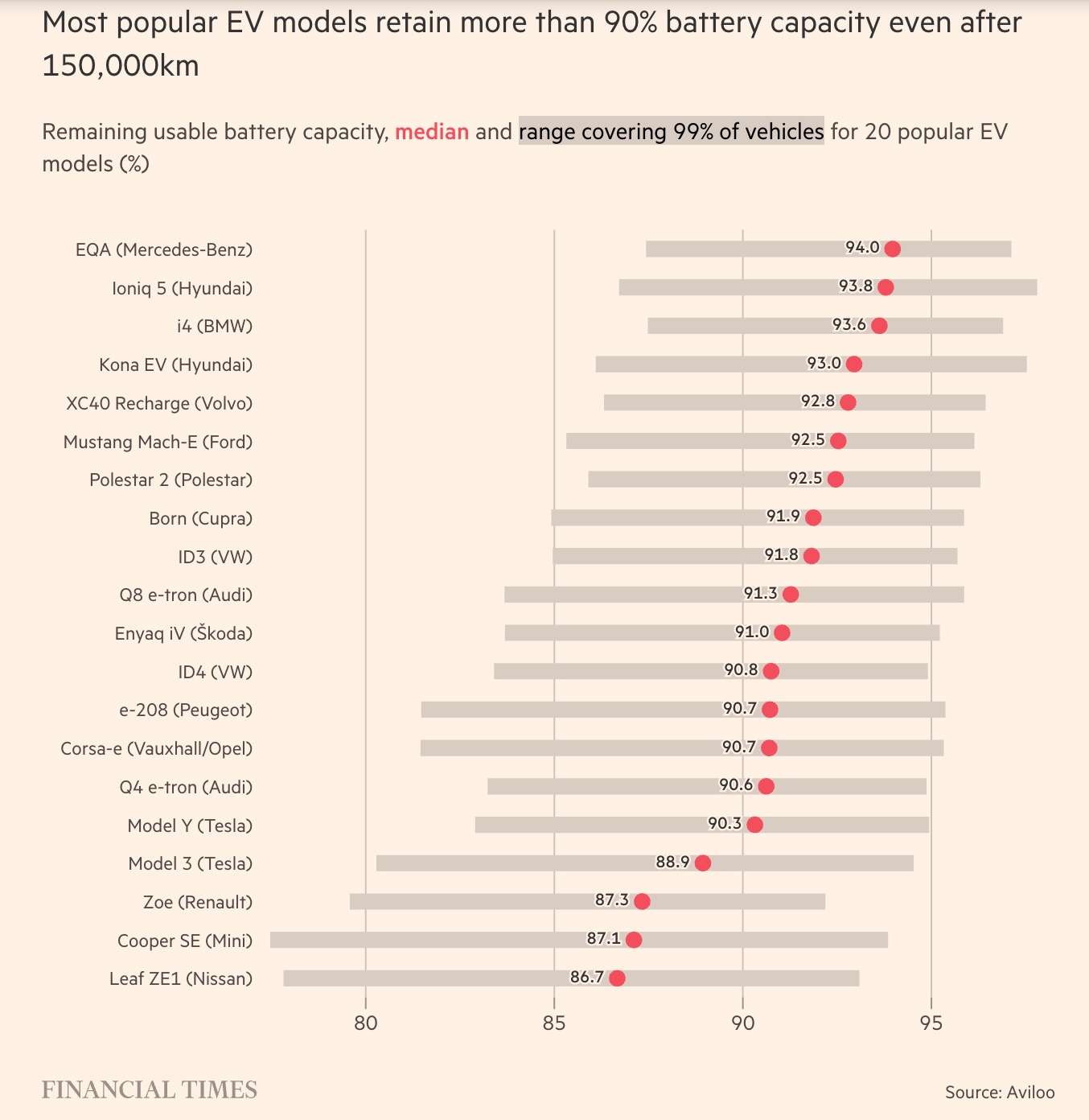
Electric vehicle batteries are lasting longer than previously feared by drivers, with most used EVs able to retain about 90 percent of their original usable battery capacity after 150,000 kilometers, a new study has shown.
Despite a surge in global EV sales on the back of rising fuel prices, long-term battery durability continues to be one of the key concerns for drivers when they consider switching from a petrol model to an electric car.
EV battery warranties typically cover eight years or 100,000 miles (160,000km) with car manufacturers required under the warranty to provide a replacement battery if capacity falls below 70 per cent.
According to the latest study published by Aviloo, an Austria-based group that analyzes battery health, the median state of health (SoH)—which represents the remaining percentage of a battery’s original usable capacity—for 20 popular EV models stood between 87 percent and 94 percent after 150,000 km.
The median SoH was between 91 and 97 percent after 50,000 km, and 88 and 95 percent after 100,000 km. The study was based on more than 500,000 tests Aviloo carried out globally on the 20 EV models including Tesla’s Model Y and Volkswagen’s ID.4 between 2022 and 2026.
The Aviloo study, which did not include Chinese models due to lack of data, also showed that the speed of battery degradation varied significantly even within the same EV model depending on climate conditions, battery size, and driver habits, such as parking.
“In contrast to a combustion engine car, where age and mileage would more or less carry the value of the car and technical condition, that’s not the case for an EV,” said Marcus Berger, chief executive of Aviloo. “The car might look the same—same age, same mileage—and you don’t know how it has been treated.”
For Nissan’s Leaf ZE1 model, which requires more frequent charging to cover the same distance than other EV models due to the smaller size of its battery, the median SoH at 150,000 km varied by as much as 13.5 percentage points—equivalent to about 29 km of real-world range per charge and the largest spread among the 20 EV models covered by the study.
Aviloo said the spread between the individual cars could vary by up to 11 percentage points for Tesla’s Model Y, 11 and 12 points for VW’s ID.4, and more than 12 points for Hyundai’s Ioniq 5.
Berger said batteries of EVs in hotter climates degraded faster, while another key factor was how much the batteries were charged when the EVs were parked. “What very few consumers know is: don’t park your cars with 100, 90 or 80 percent state of charge. It’s just harming the battery,” he said, adding that the ideal level was between 30 and 70 percent.
Aviloo’s study came as three of the UK’s largest EV organizations recently called on the government to introduce mandatory battery health certifications to boost confidence for buyers and reward owners who have properly maintained their vehicles.
“We see the customer demand for confidence in battery health,” said James Strong, used-car sales and delivery manager at Tesla UK, adding that “a nationally recognized battery state of health standards” would strengthen confidence in the used EV market and improve transparency for consumers.