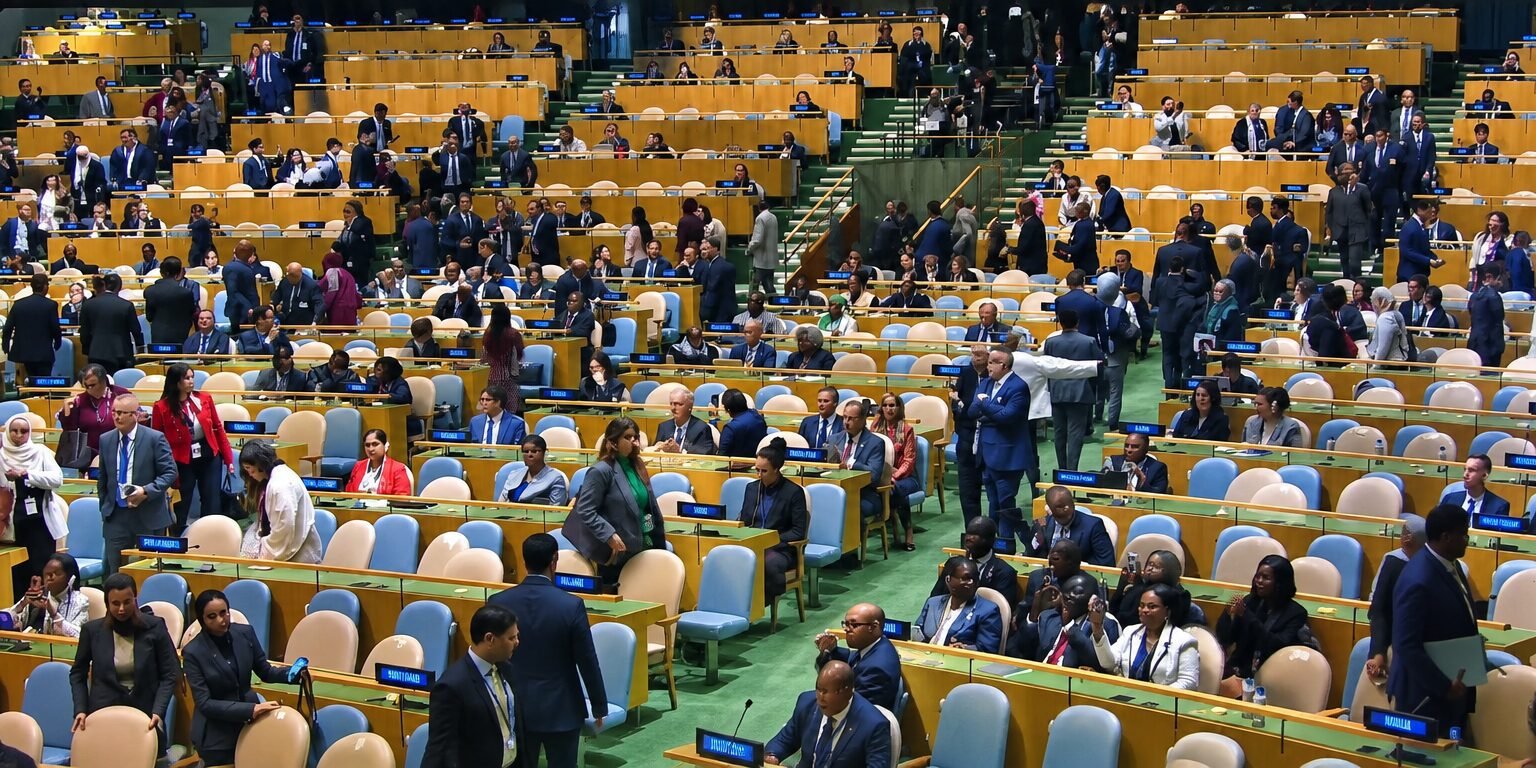
Dozens of delegates walked out of the United Nations General Assembly as Israeli Prime Minister Benjamin Netanyahu began his address in New York on Thursday, Sept. 24, while others remained in the chamber despite sharp international divisions over Israel’s conduct in Gaza and elsewhere in the region.
Reuters reported that “dozens of delegates” left the General Assembly hall as Netanyahu began speaking. Anadolu Agency, reviewing footage from the session, said representatives of roughly 70 countries either walked out or did not attend the speech.
Among the delegations Anadolu identified as participating in the protest were Turkey, the Palestinian delegation, Tunisia, Syria, Algeria, Yemen, Egypt, Iraq, Saudi Arabia, Jordan, Iran, Qatar, Lebanon, Malaysia, Kuwait, Indonesia, Sudan, Spain, Brazil and Peru.
The same review found that a number of countries previously reported as joining the walkout actually remained represented in the chamber. They included Colombia, Slovenia, Ireland, Uganda and Kenya, as well as the United Arab Emirates, Bahrain, Germany, Argentina, Hungary, the United Kingdom, France and China. Al-Monitor separately reported from New York that Bahrain, China and Colombia remained during Netanyahu’s address.
Colombia’s presence was particularly noteworthy because Vice President José Manuel Restrepo, representing President Abelardo De La Espriella, delivered Colombia’s General Assembly speech immediately before Netanyahu took the podium. Netanyahu was also scheduled to meet Restrepo during his brief visit to New York, according to the Israeli Prime Minister’s Office.
Relations between Colombia and Israel have improved under De La Espriella after deteriorating under his predecessor, and reports that the Colombian delegation walked out Thursday are contradicted by both Al-Monitor and Anadolu’s review of the session.
Slovenia also remained represented, according to Anadolu. Prime Minister Janez Janša met Netanyahu on the sidelines of the General Assembly the same day, with both governments describing a strengthening of bilateral relations. Israel opened its first resident embassy in Ljubljana earlier in September.
As delegates left the chamber, Netanyahu responded from the podium: “If there are any other moral cowards who haven’t left this hall, please do so now.”
Netanyahu used the speech to defend Israel’s military campaigns in Gaza and against Iran and to reject accusations that Israel has committed genocide in Gaza. “Israel didn’t commit genocide. Israel prevented genocide,” he said, calling the allegation “the greatest lie of the century.”
He also attacked Turkish President Recep Tayyip Erdoğan, calling him a “tyrant” and accusing him of supporting Hamas, repressing journalists and seeking influence over Jerusalem. “He says he will be the ruler of Jerusalem,” Netanyahu said. “No, sir, you won’t. It is our city.”
Turkey rejected the remarks. Turkish presidency Communications Director Burhanettin Duran said Netanyahu’s use of the UN podium to make what he called “baseless accusations” against Turkey and Erdoğan was incompatible with the UN’s “ideals of peace, law and dialogue.”
Duran also said Netanyahu’s statements could not “make his massacres, the humanitarian catastrophe in Gaza and the proceedings before international law invisible.”
Netanyahu also criticized Qatar, accusing Doha of financing American universities and Al Jazeera in an effort to “brainwash young minds to hate Israel, hate America, hate the West,” and pointing to Qatar’s hosting of Hamas officials.
Qatari Deputy Ambassador to the United States Hamad Al-Muftah responded that Netanyahu was “speaking to a half-empty room,” which he said “says plenty about the support for this message.”
Al-Muftah rejected Netanyahu’s characterization of Qatari funding for American universities, saying much of it supported US university campuses in Doha’s Education City. He also defended Qatar’s contacts with Hamas as part of its role as a mediator in negotiations involving Israel, Hamas, the United States and Egypt.