Political analyst Abdul Salam Mohammed told TML that continued Houthi pressure could compel Saudi Arabia to provide full backing to Yemeni government forces for a decisive ground offensive toward Sanaa, with direct US support
[SANAA] As tensions in the region escalate, including a renewal of fighting between the Houthis and Saudi Arabia, analysts question whether the Houthis’ capabilities and regional alliances can sustain a prolonged conflict on multiple fronts.
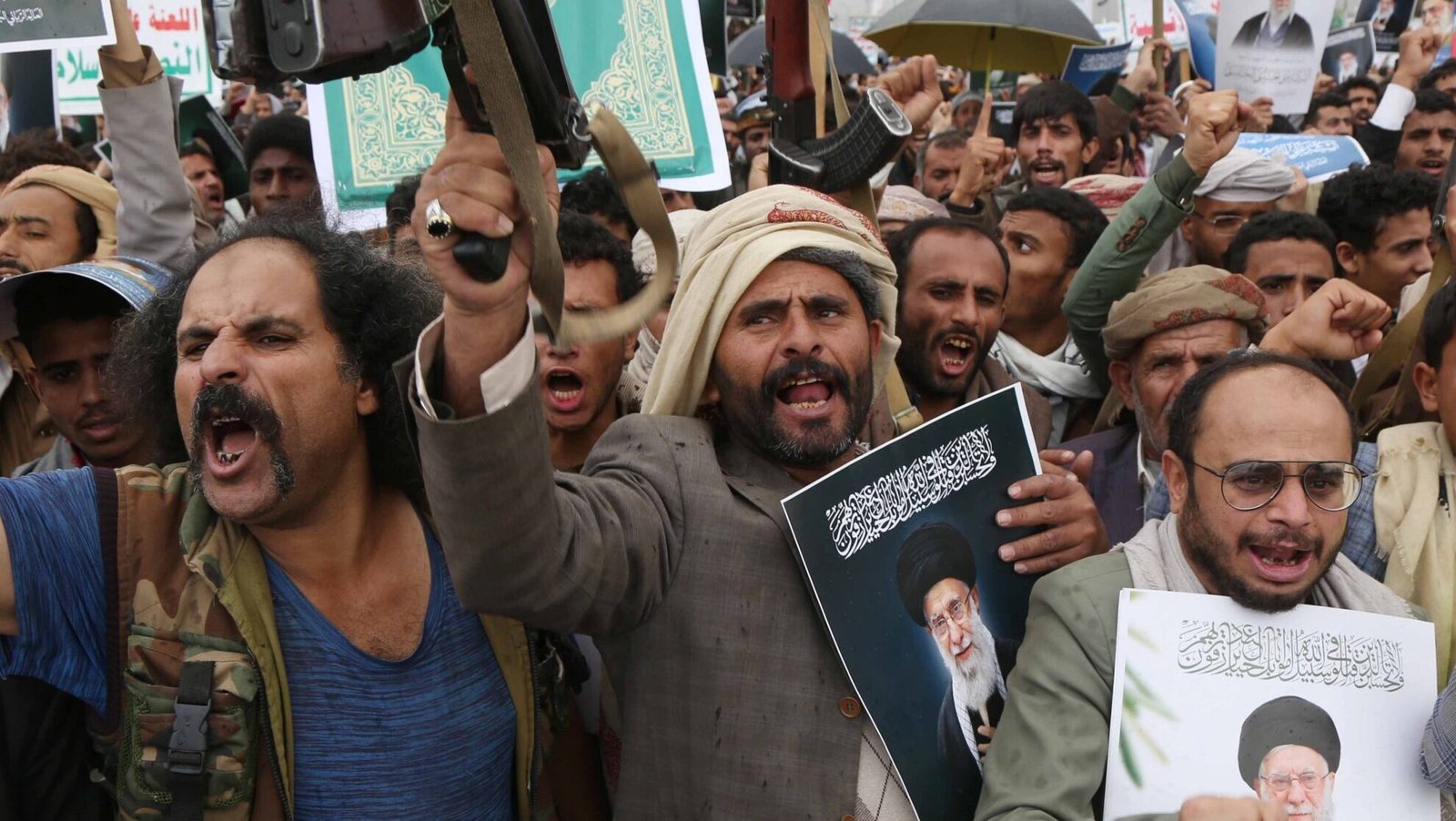
Saleh Hamdan*, a man in his forties employed by the General Corporation for Roads and Bridges, stands in Al-Sabeen Square in Sanaa, Yemen’s capital, waving his personal AK- 47 during a large demonstration organized by Ansar Allah, also known as the Houthis.
Exhausted after years of not receiving his salary and deteriorating living conditions, he shouts: “We are starving while our salaries are with Saudi Arabia. We have starved because Saudi Arabia is besieging us, blocking food, travel, and salaries.” Around him, relatives and people from his community insist that the Houthis should wage a direct war against Saudi Arabia to break what they describe as the “blockade.”
The demonstrations coincided with the Houthis’ announcement that they had carried out an attack using ballistic missiles and drones targeting Abha International Airport in southern Saudi Arabia. The Houthis also announced a ban on maritime navigation for Saudi vessels, a move that observers viewed as the beginning of a new round of military escalation.
Behind these developments lies the complex issue of Sanaa International Airport. While Yemen’s internationally recognized government says it does not oppose resuming Yemenia Airways flights under previously agreed arrangements, the Houthis insist on operating direct flights between Sanaa and Tehran via Iranian airlines, which analysts describe as an effort to use the airport issue to advance broader regional objectives.
Political analyst Abdul Salam Mohammed told The Media Line that decisions on war and major military operations—such as strikes deep inside Saudi Arabia or disrupting maritime navigation—remain tied to the operations room of Iran’s Islamic Revolutionary Guard Corps (IRGC).
He said the Houthis have connected their survival to Iran’s regional strategy, operating as Tehran’s most loyal proxy in the region, while the leadership in Sanaa is largely tasked with mobilization and carrying out operations on the ground.
Mohammed added that insisting on opening a direct Sanaa–Tehran air route and using the airport as leverage serves the broader agenda of Iran’s regional alliance by complicating international calculations and increasing the costs of the conflict.
Even if progress is made on reopening the airport or advancing negotiations over the UN-backed roadmap, Mohammed believes the Houthis’ leadership will find new justifications for continued escalation.
Indeed, the Houthis have found a reason for escalation.
In the early hours of Thursday, the Houthis announced they had targeted two Saudi oil tankers with missiles and drones in the Red Sea as part of what they described as a maritime “blockade” imposed on Saudi Arabia.
Meanwhile, the IRGC said the Strait of Hormuz was “completely closed,” and transit would require coordination with Tehran.
According to Windward, the maritime intelligence platform: “Five tankers heading toward Bab al-Mandeb reversed course as blockade threats rose. Four were carrying Saudi-origin cargo: crude, gas, oil, and naphtha, totaling an estimated 3.84 million barrels.”
Regarding the logistical and human resources needed to sustain a multi-front conflict for months, sources speaking to The Media Line said the Houthis estimate they have a registered force of more than 200,000 fighters, in addition to over 250,000 personnel affiliated with popular mobilization formations in areas under their control. These figures are estimates provided by a Houthi source and could not be independently verified.
The Houthis also depend on trained personnel within government institutions and universities, as well as tribal support estimated in the hundreds of thousands, although the extent to which tribal members would participate in a full-scale conflict remains uncertain.
A source working with the Houthis’ General Mobilization Forces told The Media Line that the Houthis are fully prepared for confrontation.
“The Ansar Allah are fully ready for this war, whether on the domestic front, against Saudi Arabia, or against any enemy by land, sea, or air. “The source added: “There will be no retreat this time unless all the rights of the Yemeni people are secured from Saudi Arabia,” describing the kingdom as “a house of glass that fears stones.”
In addition, the same source said the Houthis’ battlefield capabilities have become more cohesive, citing a unified command structure, an advanced missile arsenal, military aircraft, drones, one-way attack drone boats, and autonomous underwater vehicles operated under the supervision of specialists. He said these capabilities would enable the Houthis to withstand and manage a prolonged war of attrition.
He concluded: “We are the most experienced in this kind of warfare. Saudi Arabia, its allies, and even Israel understand the danger posed by this force. Bab al-Mandab, Saudi airports, and every other target are awaiting zero hour.”
In contrast, Abdul Wali Al-Kazmi, a member of the Moral Guidance Directorate at Yemen’s Ministry of Defense, told The Media Line that government forces are now at their highest level of military readiness after completing efforts to reorganize and unify the armed forces under a single command.
He said the internationally recognized government’s forces currently number about 400,000 fighters—a figure that also requires independent verification—and benefit from substantial air support and international backing.
The source said the government’s decision not to launch a comprehensive military operation to retake Houthi-controlled territory reflects the leadership’s commitment to peace, its desire to protect civilians and infrastructure, and Saudi Arabia’s continued efforts to advance the roadmap process while maintaining flexibility with Yemen’s political actors.
Nevertheless, Abdul Salam Mohammed believes the Houthis’ calculations could be undermined by a significant shift in Saudi policy.
He said Riyadh, whose strategy has focused on protecting its southern border and securing shipping lanes while keeping direct confrontation at a relatively low level, has begun reassessing its options in response to direct threats against its airports and critical infrastructure, as well as mounting pressure on maritime navigation through the Bab al-Mandab Strait.
According to Mohammed, continued Houthi pressure could ultimately compel Saudi Arabia to provide full political, military, and logistical backing to Yemeni government forces for a decisive ground offensive toward Sanaa, with direct US support, in an effort to reduce the Houthis’ military capabilities after it has come to be viewed as a threat to the global economy and energy security.
Alongside military mobilization, the Houthis have accelerated measures aimed at strengthening their domestic front. These include requiring medical personnel in government hospitals to sign pledges placing them at the disposal of the “Supreme Emergency Committee” for deployment to field support units, while instructing them to keep their mobile phones on and remain at their assigned locations.
The plan also includes training, through the Civil Defense Authority, employees of government institutions and private companies in evacuation procedures and firefighting, as well as converting warehouses and basements of strategic facilities and schools into undisclosed shelters and alternative accommodation centers in preparation for the possibility of intensive airstrikes.
A source in the Supreme Emergency Committee in Sanaa told The Media Line that these measures are precautionary steps intended to enhance preparedness and ensure the continuity of essential services and the resilience of the domestic front in the event of any escalation by what the source described as the “Forces of Aggression.”
As military and political tensions continue to intensify, Yemen appears to be approaching a critical phase, with the convergence of humanitarian challenges and regional strategic calculations, raising the risk of a broader conflict extending beyond the country’s traditional front lines.
*a pseudonym