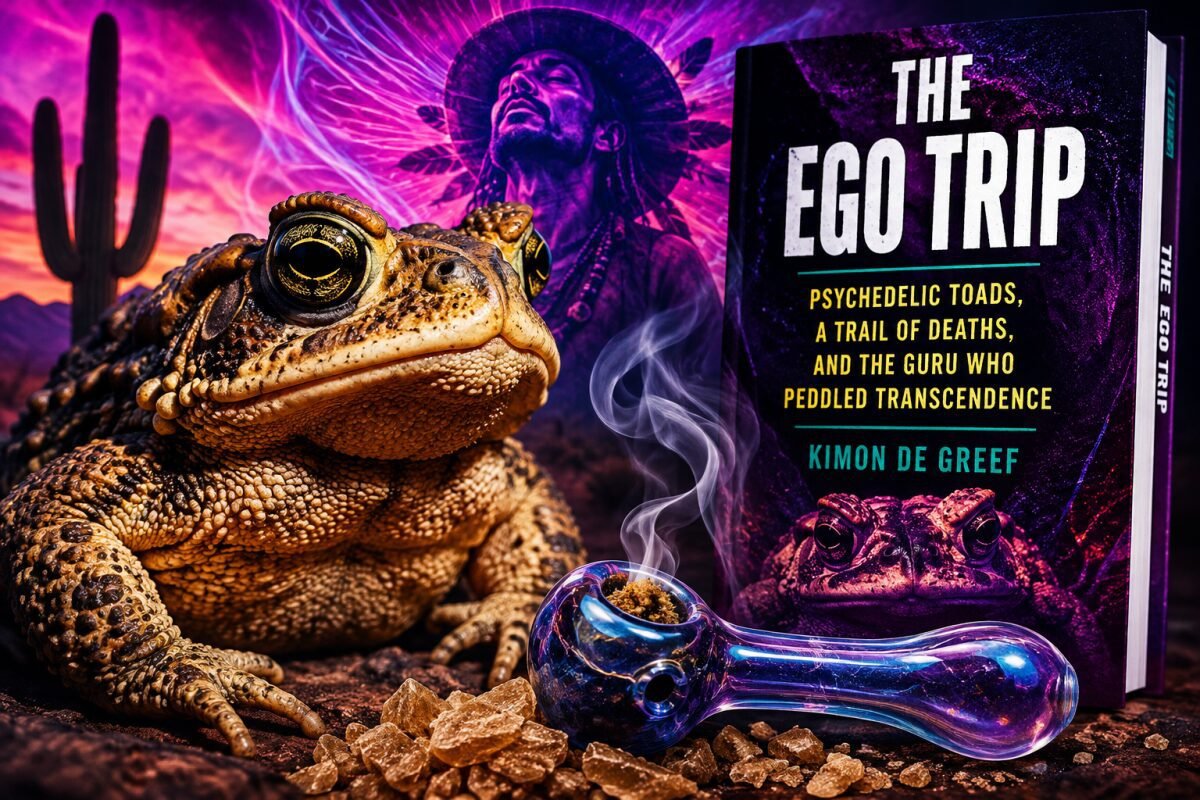
Forget LSD, magic mushrooms and ayahuasca.
For a growing circle of celebrities, thrill-seekers and psychedelic devotees, the ultimate mind-bending experience comes from something far stranger — smoking the dried venom of a desert toad.
The powerful substance, known as 5-MeO-DMT, is found in the secretions of the Sonoran Desert toad, a large amphibian native to parts of Mexico and the American Southwest.
Its venom is collected from glands on the animal, dried into brittle flakes and then vaporized in a glass pipe before being inhaled.
Users call the ritual “smoking the toad.”
And some devotees have given the potent psychedelic an even more dramatic nickname: the “God Molecule.”
Now, a new book is pulling back the curtain on the bizarre movement — and the controversial Mexican doctor who helped turn an obscure desert drug into an international psychedelic phenomenon embraced by celebrities, Silicon Valley figures and people desperate to overcome addiction or trauma.
In “The Ego Trip: Psychedelic Toads, a Trail of Deaths, and the Guru Who Peddled Transcendence,” author Kimon de Greef traces the rise of Dr. Octavio Rettig Hinojosa, a former drug addict who reinvented himself as a modern-day shaman and became one of the world’s most aggressive promoters of toad venom.
Known simply as Octavio to many followers, Rettig presented himself as a spiritual healer capable of guiding people through one of the most overwhelming psychedelic experiences imaginable.
The drug can reportedly produce an almost immediate collapse of a person’s sense of reality and identity — an experience users often describe as “ego death.”
Some claim it changed their lives.
Hunter Biden wrote in his memoir that using 5-MeO-DMT helped him stay away from cocaine for roughly a year.
Former Navy SEAL Robert O’Neill, who has publicly claimed he fired the shots that killed Osama bin Laden, told Tucker Carlson that he tried the substance while seeking relief from post-traumatic stress.
Former heavyweight champion Mike Tyson has also spoken openly about smoking toad venom.
“I’ve never been the same,” Tyson said during an appearance on “The Joe Rogan Experience,” describing the experience as something like “dying and being reborn.”
Bill Atkinson, an early member of Apple’s original Macintosh team, told de Greef that he first tried it in 2017.
He compared the experience to a “psychedelic bungee jump” and said it felt like “training wheels” for reaching a divine state of consciousness.
But behind the celebrity endorsements and promises of instant transcendence is a far darker story.
The Sonoran Desert toad — also known as the Colorado River toad — produces a cocktail of chemicals in large glands along its body.
While the secretions can be dangerous if swallowed, users vaporize the dried material and inhale the resulting smoke.
The practice remained relatively obscure until people like Octavio began aggressively promoting it around the world.
According to de Greef, Octavio’s own journey into the psychedelic world began after years of serious cocaine addiction.
While studying at the University of Guadalajara, he reportedly met fellow student Gerardo Sandoval, who exposed him to a wide range of psychedelics and eventually introduced him to 5-MeO-DMT.
Octavio later claimed the experience eliminated his desire for cocaine.
Soon, the former addict became an evangelist.
He eventually brought the drug to an Indigenous community in northern Mexico that was struggling with a methamphetamine crisis in the early 2010s.
His work reportedly impressed some locals enough that he earned the nickname “el doctor sapo” — the toad doctor.
Then came Burning Man.
TEDx organizer Klaudia Oliver reportedly saw potential in the charismatic doctor, helping coach him as a speaker and polish his public image.
The pair traveled to Burning Man in 2013, where Octavio promoted toad venom as an ancient healing medicine and described it as “the ultimate experience.”
His reputation exploded.
Soon, followers were lining up to smoke the substance under his supervision.
The doctor began traveling internationally and presenting himself as a bridge between Indigenous spirituality and the modern psychedelic movement.
During ceremonies, de Greef writes, Octavio dressed in traditional-looking red Seri clothing, shook rattles and sang while participants prepared for the intensely powerful drug.
Money followed.
Group ceremonies could reportedly bring in thousands of dollars, and Octavio eventually raised his prices as his fame grew.
His business card reportedly described him as a “practitioner of indigenous knowledge for the whole world.”
For years, his star continued rising.
But disturbing allegations eventually began following the self-styled shaman.
According to the book, Octavio sometimes showed little patience with nervous newcomers.
When one group asked what they should expect during their first psychedelic experience, he allegedly snapped, “Put on a f—ing diaper and go outside!”
Critics also accused him of failing to properly prepare participants or provide a safe environment during sessions.
De Greef reports that Octavio became romantically involved with several women who had participated in his ceremonies.
More troubling footage surfaced later.
In 2016, Octavio was allegedly captured on video kicking and slapping a frightened man during a session on a beach in Venezuela.
Another video reportedly showed him pouring water down the throat of an unconscious participant, while other accounts accused him of using a Taser-like device on unwilling or resistant clients.
Octavio defended his aggressive methods as part of breaking through psychological resistance.
“That’s what I’m trying to do,” he once told a psychedelic conference. “A real mindf— for people.”
But the controversy became far more serious as reports of deaths surfaced.
According to de Greef’s book, rumors and allegations linked at least four deaths to sessions associated with Octavio.
He was eventually arrested by Mexican authorities in connection with one death, although he was never convicted and has denied wrongdoing.
“My work has been misunderstood, misinterpreted, and misused,” he previously said.
The Seri people also distanced themselves from him.
Members of the Indigenous community reportedly demanded that Octavio stop using their name while promoting claims that smoking toad venom was rooted in their ancestral traditions.
One Yaqui activist interviewed by de Greef dismissed Octavio’s spiritual image entirely.
He “was looking for validation as a shaman,” the activist said, “but he’s nothing more than an actor — a fake.”
Yet whatever people think of Octavio, his influence is difficult to ignore.
The former addict helped take a little-known psychedelic chemical from Mexico’s desert fringe and push it into celebrity culture, underground wellness retreats and eventually serious scientific research.
Researchers have since begun investigating 5-MeO-DMT and related compounds for possible applications involving depression, trauma and addiction.
That means the strange psychedelic movement Octavio helped unleash could ultimately become far bigger than the man himself.
De Greef describes him as the substance’s “divisive early prophet.”
Now, after years of shamans, desert ceremonies, celebrity testimonials, frightening allegations and deaths, a dramatically different chapter may be beginning.
The psychedelic toad is moving out of the desert and toward the laboratory.
As de Greef puts it, “The pharmaceutical era of toad medicine had begun.”