Cambodia and China recently agreed to fast-track four priority infrastructure projects under the Diamond Hexagon cooperation framework, deepening a partnership that already accounts for roughly 75% of Cambodia’s foreign direct investment.
The acceleration comes as Cambodia pursues its own ambitious development targets under the Pentagonal Strategy, which aims for upper-middle-income status by 2030 and high-income by 2050.
Reaching those milestones will require a broader economic base than any single partner can supply, and that is where the tension lies.
The high-income threshold currently sits at US$14,375, roughly six times Cambodia’s present per capita income of $2,520. That is a steep climb, but others in the region have managed comparable transitions, and Cambodia’s record offers reasons for confidence.
Between 2000 and 2019, Cambodia grew at an average of 8.2% annually, the fifth-fastest rate in the world. Investment approvals reached $10 billion in 2025, with growing diversification into electronics, renewable energy and agro-processing alongside the traditional garment and tourism base. The economy is among the world’s most trade-integrated, with total trade exceeding 140% of GDP.
The challenge is less about ambition than about whether the strategies meant to deliver on it are working together or at cross-purposes. Two transitions are arriving at roughly the same time, and they are pulling the economy in different directions.
The first is the approaching loss of preferential trade access. In December 2029, Cambodia is scheduled to graduate from least developed country status, a milestone that reflects real development progress but also removes the trade preferences that have underwritten the garment sector’s competitiveness.
The EU’s Everything But Arms scheme, partially withdrawn in 2020 over human rights concerns, grants duty-free access under rules of origin for least developed countries that require only a single transformation, a considerably lower bar than the double-transformation requirement Vietnam faces under the EU-Vietnam Free Trade Agreement.
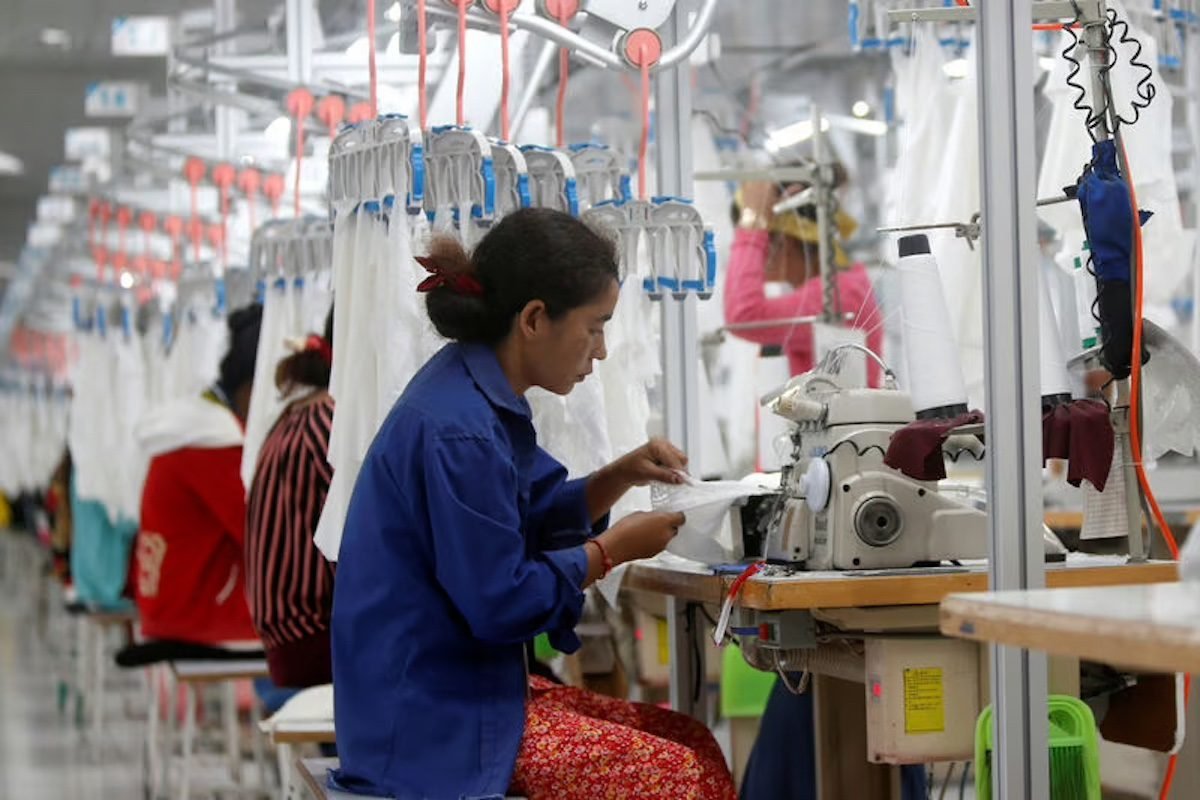
After graduation, that edge disappears. The UNDP has estimated that GDP growth could slow by 0.5 to 1.5 percentage points, with 165,000 jobs at risk, concentrated among women in the garment sector.
Phnom Penh is clearly aware of this. Cambodia applied for CPTPP accession in December 2025, and senior officials have framed membership as essential to replacing the preferential access the country will lose upon graduation.
A regulatory gap analysis commissioned by the UK Foreign, Commonwealth and Development Office found significant compliance gaps in cross-border data governance and environmental standards, areas where closing the gap before LDC graduation in 2029 will be difficult.
The second transition is the deepening of Cambodia’s relations with China. The Diamond Hexagon framework, established in February 2023, covers politics, manufacturing, agriculture, energy, security and cultural exchanges.
Chinese investment has delivered tangible results: expressways, airports, special economic zones and power infrastructure that Cambodia could not have financed independently.
But the concentration of Chinese investment carries its own risks. A NUS East Asian Institute analysis has noted that growing dependence on Chinese investment and financing is narrowing Cambodia’s policy flexibility in an increasingly contested region.
And the more concentrated the investment base, the harder it is to credibly pursue the kind of open-market commitments the CPTPP requires.
The World Bank has assessed Cambodia’s productivity growth at around 0.8%, less than half the 2% it estimates would be needed annually for 25 years to reach high-income status, a pace previously sustained only by South Korea.
GDP growth forecasts for 2026 sit between 3.9% (World Bank) and 4.5% (Asian Development Bank). Headline growth is respectable, but the gap between current productivity trends and what the 2050 target requires is wide.
Vietnam’s path offers a useful, if imperfect, comparison. The two economies are at different scales: Vietnam’s GDP exceeds $500 billion, more than ten times Cambodia’s roughly $50 billion, and its population of 102 million is six times larger. Vietnam’s industrial base extends into electronics and machinery in ways Cambodia’s does not yet match.
What makes the comparison relevant is sequencing. Vietnam joined the CPTPP and signed its EU free trade agreement before reaching upper-middle-income status, spreading its trade relationships early.
Its investment base is spread across Japan, South Korea, the EU, the United States and China. Even with those advantages, the World Bank estimates Vietnam needs sustained average annual growth of 6% for two decades to reach high-income by its own 2045 target.
Cambodia is not Vietnam, and the differences in scale, structure and development stage matter more than superficial parallels. But the sequencing question is relevant: it is easier to diversify trade and investment partnerships before the pressures arrive rather than after.
Of the three pressures Cambodia faces, LDC graduation is on a fixed timeline Phnom Penh cannot change. The China relationship deepens through deals that deliver visible results now.
The CPTPP bid is the only one that requires Cambodia to actively reform rather than passively receive, and it is the one with the weakest institutional momentum. That is where the gap between aspiration and delivery may show first.
Lam Duc Vu is a risk analyst writing on Indo-Pacific security and regional affairs.