Subsea cable projects owned by US companies such as Google and Meta face some of the greatest risks from the threat of deep-sea sabotage in the Pacific Ocean, according to a new report. That coincides with Chinese research ships spending an extraordinary amount of time apparently surveying undersea cables—not to mention Chinese commercial ships being investigated for cutting cables in both European and Asian waters.
Most damage to the undersea cables that form the Internet’s backbone is the result of accidents involving bottom-trawling fishing nets and ship anchors dragging on the seabed, with storms and undersea landslides also factoring in. But the recent rise in international tensions and open conflicts have placed new scrutiny on more suspicious instances of cable-cutting damage, with analysts warning about Russia and China in particular engaging in cable sabotage or tampering as “gray zone” tactics that fall short of direct military confrontation.
One of the newest risk assessments of China’s gray zone tactics targeting the Internet’s undersea infrastructure comes from a research report published by the US-China Economic and Security Review Commission, an independent government commission that advises Congress. The report was contracted to the London-based think tank China Strategic Risks Institute and published in September 2026.
Mapping the risks
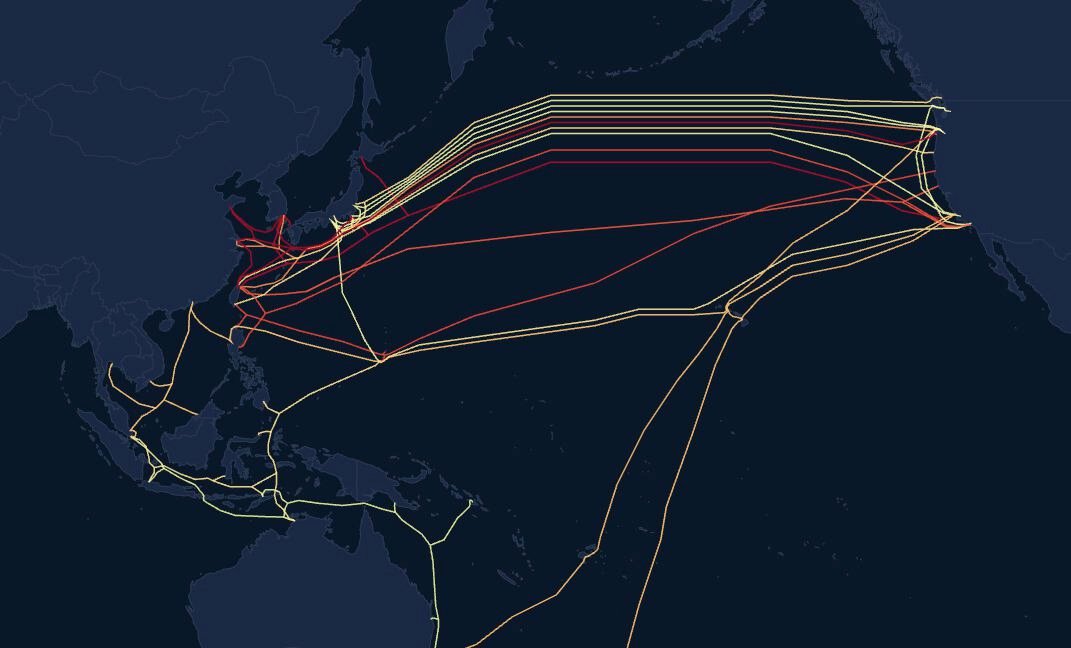
The report authors created an interactive Trans-Pacific Cable Gray Zone Vulnerability Index that ranks the undersea cables considered most at risk and displays a map of their routes spanning the Pacific Ocean. Such an index could help identify which cables should get highest priority in terms of placing underwater sensors or setting up patrols to monitor for threats.
Risk factors used in the vulnerability index include the undersea depth of the cable routes, nearby shipping traffic, cable ownership, China’s exclusive economic zone and broader territorial claims, and whether each cable connects to Taiwan. Taiwan is considered a geopolitical hotspot as a self-governing island democracy that is also claimed by China, with the latter ramping up military maneuvers involving warships and aircraft around Taiwan in recent years.
The index suggests that the risk to cables is highest around Taiwan, Japan and the Philippines, partly because of China’s claim of sovereignty over Taiwan but also because subsea cables linking the region to the United States must pass through shallow water with busy shipping lanes.
Among the 10 trans-Pacific cables identified as being most at risk, several are still under development with significant ownership stakes from US companies. These include the TPU project owned by Google, the ORCA cable owned by Meta, and the E2A cable co-owned by Verizon along with firms in Japan, South Korea and Taiwan. All three of these projects had risk scores in the top five.
The report authors warn that any serious disruption to a single trans-Pacific cable could “risk overwhelming current available capacity on direct routings between the United States, Taiwan, Japan and the Philippines, forcing data onto slower, less direct routes.”
An even greater disruption involving multiple cables, potentially during a geopolitical crisis involving Taiwan, could “significantly reduce headroom and even overwhelm trans-Pacific capacity as a whole,” with communications between the United States and Indo-Pacific region having to reroute through other cables across the globe. That could have major economic consequences for Internet communications, cloud services and financial trading.
Dual-use technologies and survey tracks
This comes as the world’s major powers continue to build up their fleets of military submarines and undersea drones, along with further developing and deploying dual-use technologies such as undersea cable cutters that could either be used for repair or sabotage.
China has also deployed a fleet of research vessels equipped with seabed-mapping technologies that have deployed near trans-Pacific undersea cables, according to a separate report by the Center for Strategic and International Studies (CSIS), a think tank based in Washington, DC, published in October 2026.
The CSIS analysts found that China-flagged research ships stood out as outliers in the amount of time spent near subsea infrastructure. They analyzed the movements of more than 200 research ships from multiple nations between 2020 and 2025.
This pattern involving Chinese vessels stood out even when compared with the generally high activity of US and Russian research ships on the high seas. Several Chinese ships spent much of their time performing survey-style tracks near undersea cables rather than checking out regions known for undersea mineral deposits.
Chinese-owned fishing boats and cargo vessels have been involved in several notable cable-cutting incidents in recent years, especially near Taiwan. One incident in 2025 led to the first case of Taiwan’s government convicting and sentencing a Chinese captain to three years in prison, after his ship dropped anchor and performed a zigzag pattern that damaged the Tai-Peng 3 cable linking Taiwan to the offshore islands of Penghu.
The broader threat
The Pacific is not the only region where undersea cables face growing danger. In recent years, both Russian- and Chinese-linked ships have been investigated for causing damage to subsea communications cables, power cables and pipelines in the Baltic Sea. These incidents typically involved the ships dragging their anchors over unusually long periods of time
On October 21, The Telegraph published an analysis showing more than 500 incidents involving Russia’s fleet of fishing boats loitering near crucial undersea cables connecting the UK to the rest of the world, with some vessels following the routes of the undersea cables. Reuters reporting also recently revealed that NATO countries had confronted Russian submarines that were practicing how to disable undersea cables using a new type of technology in Arctic waters near Norway earlier this year.
Meanwhile, Iran has repeatedly threatened to charge fees to US tech companies for the undersea Internet cables running beneath the contested Strait of Hormuz and has prepared plans to attack them—another consequence of the wider war that began when the United States and Israel attacked Iran in February 2026.
For a big-picture perspective on why the world has become more dangerous for the Internet’s undersea backbone, Ars recently interviewed Elisabeth Braw, author of the book Undersea War.