Beijing may believe that Donald Trump’s 2016 election and his return to office eight years later are not accidents but part of a deeper American current. Beyond Trump himself, the America that has emerged since 2016 increasingly seems unwilling to worry about the world.
For a century, beginning with America’s intervention in the First World War in 1917, the United States concerned itself with the global order through three great conflicts: World War I, World War II, and the Cold War.
Trump’s 2016 election, however, gave voice to an America tired of international affairs, once again “selfish” and feeling cheated by the world for its generosity. This America is undermining the very international institutions it created, including the United Nations and the World Trade Organization.
China has never truly felt that these institutions fully represented it, its values, or its way of thinking. The American world order does not belong to China. If America wants to destroy that order, why should China support it?
China does not believe it is in a position to replace the American order with a ready-made alternative, as the Soviet Union once did. If America dismantles the existing system and creates chaos, China’s response is to protect itself from that chaos, avoid being swept up in external confusion and perhaps take advantage of any opportunities it creates.
In the medium- to long-term, the aim is to survive the destruction of the American-made world and emerge stronger.
Iran’s turmoil
In that sense, the turmoil in Iran may appear to Beijing as the latest manifestation of this broader trend. If the Strait of Hormuz was destabilized by American intervention, why should China help Washington fix it now? What would America offer in return? Could China help shape a different global order, beginning with a reordering of the Strait of Hormuz?
For China this may resemble the fourth century BC – the Warring States period when the old political order, centered on the Zhou dynasty’s Son of Heaven, collapsed.
The prime minister of Wei, Hui Shi, concluded that a new order had to be established, one in which each state recognized itself as fully sovereign, without deferring moral or political authority to the Son of Heaven.
Today, for China, the old order and effective American centrality may no longer exist.
In 2004, four Chinese strategists, Wang Jian, Wang Xiangsui, Qiao Liang, and Li Xiaoning, published a book titled The New Warring States Period (Xin ZhanGuo Shidai). It forecast a time of increasing state-to-state friction, due to the collapse of the US order, and growing confusion that could last for decades.
The book, presented to the foreign press at the Institute of Italian Culture in Beijing, drew its first lessons from the then-faltering US intervention in Iraq.
Among the authors, sketching the root problem was Wang Jian – who’d been praised in the 1980s as the best economist of his generation by Party Secretary Zhao Ziyang (who himself was later demoted for supporting the 1989 Tiananmen demonstrations).
It was about the US’s unmanageable debt and the hijacking of political and economic agendas by private companies as long-term problems that would cripple America. The 2008 financial crisis, which didn’t fully punish all companies involved and didn’t change the faulty market’s rules, seemed to confirm the analysis.
It is a factual question: are the Chinese right? Presently, even many of America’s own allies suspect they may be. So, what is to be done? China is inclined to close in on itself and wait for others to make the first move.
Perhaps changing that Chinese attitude would require a different international framework – a different message from America, its allies, and the states around China.
Could Iran become a place to begin experimenting with a new order? Perhaps, but only through proactive effort. Yet it is likely that none of the players on the ground has any easy, concrete proposals.
… and its black hole
Iran is a country of nearly 100 million people, roughly half the size of Europe, full of mountains, and strategically positioned between the Caspian Sea and the Persian Gulf, Central Asia and the Mediterranean. Today, it does not appear politically very unified. The old Supreme Leader, Ali Khamenei, is gone, and it is unclear whether his son and heir, Mojtaba Khamenei, is active or to what extent. The Revolutionary Guards appear to have the final say, but they have not rebuilt political unity even within the country. They seemingly trust no one.
Iran’s regime has survived not because it has prevailed militarily but because US domestic political constraints have limited Washington’s willingness to pursue the conflict to its logical conclusion. Survival, however, has come at enormous cost.…
The Iranian regime confronts deepening political, economic and security challenges that will constrain its ability to recover and shape its strategic environment for years to come.
Iran is a failing state that could bring chaos to China’s doorsteps.
It is unclear what China could do, even if it wanted to. Yet, thinking through ways to talk with China about Iran may not be a waste of time. They may be small threads thrown into a chaotic situation.
Yesterday’s American order might not be reversed. A new order will have to be established. The question is how quickly that will happen and how peacefully, rather than through war. Iran could be a path to find some peaceful solutions.
Is the US losing?
There is, however, one more point. Despite MAGA’s isolationist rhetoric, US influence has grown in Venezuela and Syria. Is there a risk that, out of excessive caution and a determination to defend at all costs its political-energy axis with Iran and Russia, Beijing may inadvertently help expand America’s disruptive role in the world and shoot itself in the foot?
That may be the real crux of the matter. Is China’s analysis right or wrong? Perhaps American power is not disintegrating but reorganizing — and, if so, China’s wait-and-see approach could backfire.
American power may be less in decline than in a state of reconfiguration, as has so often happened in the past with the United States. That reordering can appear dramatic from the outside. America lives through chaos, just as much as China abhors chaos and sees it as the apocalypse.
Plus, there’s the US feeling wronged by China. The US opened to China in the 1980s and again with China’s accession to the WTO. It offered China opportunities that were not extended to any other country.
China used these opportunities but didn’t join the US order as a “responsible stakeholder,” opening its market and currency, although Premier Zhu Rongji wanted to in the late 1990s. Its growth and size unsettled the old order.
So, the US, unable or unwilling to spend more time trying to rein in China, decided to scuttle the old order that was favoring Beijing at Washington’s expense.
This was not pursued through a detailed plan drawn up in a secret boardroom, but most likely it grew in Washington’s fuzzy atmosphere of government agencies, think tanks, financial leaders and foreign diplomats, where ideas are sown and may gain traction or fail.
If the US has a long-term plan and a deep feeling, no matter how fuzzy, Beijing’s calculations could turn out wrong.
In the very short term, China can afford to wait for the American midterm elections in the fall and for its own party congress in Beijing next year.
But perhaps it should also prepare to re-engage America and the wider world, so as not to be caught by surprise. Iran is in serious difficulty, and so is Russia, whatever America may intend to do. If Russia and Iran — two important pieces of Chinese foreign policy — falter, Beijing could have more trouble than it anticipated.
Besides Iran
Moreover, in the coming months, China could face even greater geopolitical challenges. The new defense pact among Turkey, the Saudis and Pakistan is certainly a setback for Israel, which is now trying to rope in India, which has historically had good ties with Iran.
It’s not good for America because it has shown some regional players that America cannot manage Iran. It also shows that America’s withdrawal won’t create a situation of confusion that would allow China to insert itself. Countries that doubt the US will be building alliances that could be deployed against Beijing. The same is happening in Asia. America’s perceived retreat is coalescing anti-Chinese sentiments that were previously held in check by US presence.
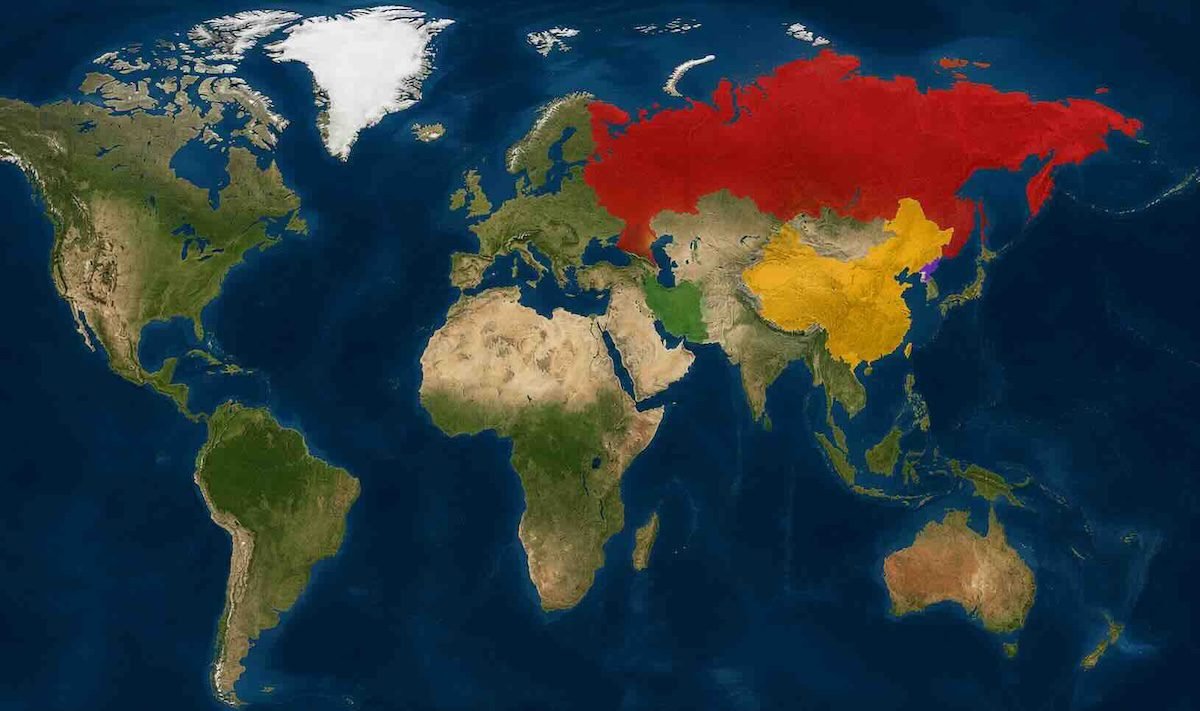
Here, the fuse could be North Korea.
Zheng Jiyong wrote, “Tensions between North Korea and South Korea are mounting, which raises the possibility of conflict that could spill beyond the Korean Peninsula. Security coordination among Japan, South Korea, and the United States is also becoming stronger, putting pressure on China, and North Korea’s entrenched nuclear status has made Japan and South Korea anxious about their own security and could even motivate them to eventually pursue nuclear weapons themselves.”
Therefore, Zheng points out,“China is increasingly worried about North Korea’s role in creating and intensifying these risks – and about the need to adjust its North Korea strategy to manage them without inflaming tensions and further destabilizing the region. Pyongyang has grown more unpredictable as it has become emboldened by its nuclear program.”
But here is a catch. North Korea, on a loose but real leash with China, could be used by Beijing as a wild card in the complex dynamics of East Asia. But if Pyongyang is put on Beijing’s tight leash, whatever it does will be blamed on Beijing.
Russia’s new ties with North Korea upset the old Beijing-Pyongyang game, creating a situation where Beijing has to keep a tight leash. But this is impossible given the freewheeling nuclear rearmament in North Korea. The rearmament is spurring similar rearmament drives in South Korea, Japan, and the rest of Asia, all of which are contrary to China’s interests.
Plus, the new Russian ties with North Korea project Moscow’s unresolved historical issues with Japan onto East Asia and are complicating Chinese diplomatic efforts.
On August 13, Putin visited Iturup (Etorofu in Japanese), an island claimed by Japan at the end of the Kuril chain near Hokkaido, a day after major naval drills and a missile launch by ally North Korea. It’s unclear why Putin wants to irritate Japan with his visit. There could be an element of trying to needle China, as Japan, already irked by Russia, would become even more confrontational with China, Russia’s friend. Moscow might do it because of differences with China over the war in Ukraine, or to show support for restive North Korea. With partners like this, who needs enemies?
For these reasons, Joseph DeTrani keeps insisting that the US should open a dialogue with North Korea without preconditions to probe Pyongyang’s intentions.
Moreover, greater cooperation between Israel and India could spell trouble for China, as both countries feel they have an axe to grind with China.
The economy
Trade disputes remain highly charged and may become even more severe, since China’s surplus is on track to reach a new record by year’s end, further straining relations with its trading partners and creating additional pressure on the world trading system.
The consensus range for China’s share of global industrial production is roughly 28 to 30%; the figure has been climbing steadily.

China’s share of global manufacturing output rose from 5% in 1980 to around 30% by 2023. The US share fell from 21% to 17% over the same period. Before the 1929 financial crisis, the US was commonly cited as accounting for ~40 to 45% of global industrial production.
In theory, China could still expand its manufacturing base before reaching the US 1929 inflection point. However, unlike America in 1929, China is surrounded by political controversies that exacerbate its commercial disputes.
US industrial capacity supported WWII efforts, but at the end of the war, America didn’t just leave the world in pieces. It left it in peace. It used its wealth to rebuild the economies of its allies and even of its former enemies, like Germany, Japan, and Italy. It did so with self-interest in mind, to stem the communist tide from the USSR reaching the western shores of the Atlantic, but it also did so with the interests of every country in mind.
Plus, the US 1929 overcapacity was brutally resolved through a wave of bankruptcies that wiped out huge personal fortunes and left almost half of the workforce jobless. After this slaughter, the US jump-started the economy with a series of public works projects.
China is suffering from similar overcapacity, but there is no wave of bankruptcies, even though 2-300 million are de facto underemployed in the gig economy in the cities (about 40% of the urban workforce).
Mountains of unrepayable debt are piling up, with no solution in sight for China or the rest of the world. This is because companies are not private but partly or fully state-owned. Debt can’t simply be wiped out, forcing private entrepreneurs to rethink their lives, while the state absorbs it and is left to cough up solutions. Moreover, public works have driven Chinese growth for over two decades, but returns are now declining.
It may be even worse than the 2008 financial crisis in the US. Then the administration decided to salvage the financial world, perhaps swayed by political interference from private investment. Now, in China, the state can’t simply let some companies go bust because it owns them, and their demise would follow. China needs a more complex approach.
How the US could get out
In any case, the domestic political confusion in Washington – a mixed bag of results that are positive in Venezuela, hesitant in Ukraine, failing on tariffs and Iran, and disruptive toward the allies – may prompt Beijing to avoid moving first.
In theory, the US path ahead should be clear: replicate and adapt Cold War policies. As with all its complicated differences, this with China is some kind of new Cold War. How was the Cold War won? The US and its allies reached bipartisan consensus and established domestic and international offices to implement long-term policies.
In the last chapter of his “The Hundred-Year Marathon,” Michael Pillsbury described the long-term policies to be implemented, and David Goldman, in his essays, has long drafted re-industrialization plans for America.
The sticking point is building a new domestic and inter-allies’ consensus. It is difficult because the US is in the middle of an identity crisis that spills into its relationships with its allies and the world. But identity crises are both very serious and very simple, especially for the US. America was badly split in the 1930s, but Japan’s attack on Pearl Harbor brought the country together.
A sudden sense of danger could turn the US around all of a sudden, even now; then things could be different for everyone, including China.
And there is an actual issue. The US is not just its physical borders. It is the only country with a really massive presence abroad, unparalleled since the fall of the Soviet Empire. To push away this presence could be difficult, and it’d be even harder for China to replace it.
Sending troops to be stationed abroad is a complex political and economic calculus. Who will pay for those troops? What will be the troops’ duties? With the US and the USSR, it was Washington and Moscow that paid for everything and also guaranteed the security of the host nation.
Without that security, the stationed troops would be in danger. In fact, the host country spends less on its defense because of the presence of foreign troops. The upside of political interference for the host nation came at an economically impossible cost to Russia during the Cold War. Now America has stretched its purview even further than it did during the Cold War, and the burden has become similarly impossible.
This is the gist of the issue with Trump. He would like to withdraw US forces, and Italy, for instance, doesn’t want to increase its defense expenditures. Also, US interference in Italy is de facto negligible. So, is this a US tribute system, similar to what China had with its vassals in imperial times?
The problem is what Imperial China knew all too well: tributary nations received more economically than they gave to the Son of Heaven, while the political projection they provided may not have been decisive. Eventually, the Son of Heaven capped the tributes brought to the capital to make the system economically viable. But the cap didn’t stop vassals’ requests and demands from straining ties.
Then China and the Belt and Road Initiative: Is Beijing willing to spend its money to defend foreign countries in order to station troops in Central Asia, for instance, with little control over volatile local politics? If Beijing did so, it’d follow the Soviet and US examples by taking responsibility in part for foreign/global security.
If it doesn’t, its ties would be based only on commercial blackmail: You comply, or I won’t sell you knots and bolts and will stop your economy. But this blackmail could be harder to manage than foreign military projection, which has the upside for host countries of limiting defense expenditures.
So far, there’s no sign that Beijing wants to do it — too expensive and too risky.
Then the US is still alone. Maybe it’s confused, feeling divided and overstretched, with its mind in too many places and tripping over contradictory pulls. But unless it hits a massive stone wall, there’s nothing to replace it.
On the other hand, there is a very large continental bloc controlling the global heartland, as Mackinder would see it. But the bloc is not economically self-sufficient, even though it’s politically adversarial toward the US. China needs to sell its stuff to the rest of the world to earn a trade surplus and access advanced dual-use technology; Russia and Iran depend on their oil exports to sustain the war. To replace exports, China should prioritize domestic consumption, and to do so, it needs a complete overhaul of its financial and political systems.
In theory, the rest of the world could replace both oil and Chinese goods without a massive systemic revamping. It’d require a new logistical reorganization and would incur high costs for some years. Most importantly, the US would need to put its head into it, which at the moment seems almost impossible.
It’s hard to say who has the most difficult task, but certainly it won’t be easy for either.
(Thanks to Marco Mayer for the conversation)
This article was originally published by Appia Institute, of which the auhor is the director.