<
article id=”post-952353″>
China’s sudden surge in amphibious warship construction has thrust a foundational military question to the forefront: can sheer industrial mass and converted civilian shipping overcome the lethal tactical choke points of a cross-strait invasion?
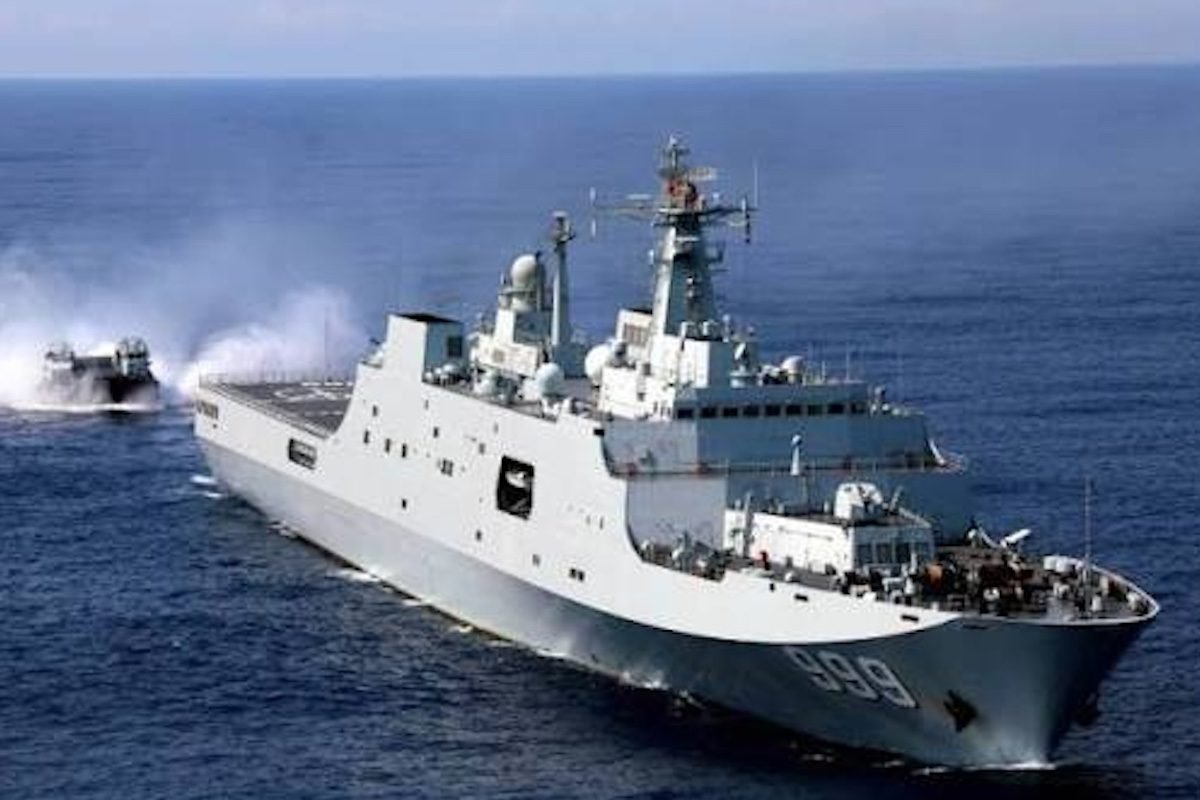
The South China Morning Post (SCMP) reported that China is significantly expanding production of its Type 071 amphibious transport dock warships across two shipyards to address critical maritime lift shortfalls ahead of a potential cross-strait invasion of Taiwan.
Commercial satellite imagery reveals six new Type 071 hulls currently under construction or fitting out—four at Hudong-Zhonghua on Changxing Island in Shanghai and two at CSSC Offshore & Marine Engineering Group’s Longxue shipyard in Guangzhou.
Once commissioned, these six vessels will expand the People’s Liberation Army Navy’s (PLAN) existing inventory of eight Type 071s by 75%, bringing the class total to 14 warships.
The Type 071 landing platform dock represents the PLAN’s foundational step toward blue-water power projection, enabling shipbuilders to master well-deck and flight-deck operations.
Each 25,000-tonne vessel is designed to carry a battalion of 500 to 800 Marines, four transport helicopters, and four Type 726 Landing Craft Air-Cushion (LCAC) or 10 vehicles such as the ZBD-2000 or the ZTD-05 amphibious assault tracked armored vehicles.
This procurement push directly targets longstanding US Department of Defense (DoD) assessments concluding that China lacks sufficient dedicated amphibious lift to execute and sustain a large-scale assault on Taiwan.
Yet, quantifying how much this fleet expansion actually moves the needle requires measuring the new hulls against the baseline capacity of China’s existing amphibious forces and the formidable shore defenses awaiting them across the Taiwan Strait.
A December 2024 China Maritime Studies Institute (CMSI) report estimated that the PLAN’s dedicated amphibious fleet, at the time of writing, could land only about one division — roughly 20,000 to 25,000 troops and approximately 1,000 vehicles — in a single initial lift.
Across the entire dedicated naval fleet—now fielding 14 Type 071s alongside existing tank and medium landing ships—China’s dedicated first-wave delivery capacity expands to roughly 23,000 to 29,800 troops.
In mechanized strength, adding the six new hulls raises China’s initial dedicated naval vehicle lift to approximately 1,060 armored fighting vehicles (or up to 1,090 to 1,120 under standard vehicle deck configurations).
Even with these reinforcements, Jay McVann argues in a July 2026 War on the Rocks article that such an assault echelon would remain dangerously understrength against Taiwan’s defenders.
McVann notes that Taiwan could field 85,000 to 110,000 soldiers to oppose an amphibious invasion, backed by roughly 1,000 tanks. McVann also points out that Taiwan’s few possible landing beaches — numbering fewer than 20 — mean defenders need not be deployed everywhere; instead, they could concentrate forces on viable landing sites to prevent attackers from establishing a beachhead.
Because naval hulls alone cannot bridge this divide, China’s true mass in an amphibious invasion of Taiwan may lie in its civilian ferry fleet. Thomas Shugart argues for War on the Rocks that civilian roll-on/roll-off shipping can deliver first-echelon assault forces at a scale that dwarfs China’s traditional amphibious fleet.
Shugart says that rather than waiting to support follow-on forces at seized ports, civilian ferries regularly practice launching amphibious assault craft directly into the water via modified stern ramps toward beaches.
He states that China’s large roll-on/roll-off ferries provide roughly 750,000 displacement tons, and vehicle carriers contribute 425,000 tons, totaling over 1.1 million tons; this civilian sealift delivers more than three times the transport capacity of the entire naval amphibious fleet.
Once preliminary tactical stability is established, Shugart says civilian shipping alone can deliver about 300,000 troops and their vehicles in 10 days.
Skeptics contend this civilian armada faces fatal operational hurdles. In a February 2024 China Maritime Studies Institute (CMSI) report, J. Michael Dahm assesses that China’s civilian roll-on/roll-off ferries cannot support an initial assault wave against Taiwan through at least 2030 because of significant tactical vulnerabilities.
Dahm points out that during amphibious drills, civilian ferries remain sitting ducks, anchoring for hours offshore in calm waters to deploy armor while lacking combat damage control, structural survivability, or escort protection.
He adds that routine exercises fail to simulate active enemy resistance, port sabotage, or adverse sea states that easily swamp open-vented southern vessels.
Furthermore, Dahm says that deep-draft ferries cannot execute over-the-shore landings independently, remaining critically tethered to undamaged quays or fragile, rarely tested floating causeways.
China has taken deliberate steps to address these deficiencies. According to The War Zone (TWZ), China’s massive jack-up barges act as vital ship-to-shore connectors, linking commercial roll-on/roll-off ferries directly to Taiwanese beachheads.
TWZ notes that seabed-anchored struts turn these barges into stationary piers that withstand heavy seas better than conventional floating causeways, enabling continuous offloading.
TWZ points out that when coupled into an 850-meter causeway reaching deep water—or when using integrated ramps to interface directly with ferry ramps—they create an independent, relocatable over-the-shore unloading facility.
The report says this enables the People’s Liberation Army (PLA) to bypass sabotaged ports, rapidly funneling mass follow-on mechanized forces and supplies ashore once preliminary tactical stability is established.
Yet, deploying such sprawling, stationary infrastructure inside a contested battlespace creates extreme survivability risks. A January 2023 report by the Center for Strategic and International Studies (CSIS) notes that China’s amphibious fleet—comprising specialized naval transports and civilian vessels alike—is acutely vulnerable because it has minimal organic defensive systems.
According to the report, these high-value ships, operating in the narrow, contested Taiwan Strait to disembark forces, become prime targets for standoff long-range anti-ship cruise missiles launched by US bombers, allied attack submarines penetrating defensive zones, and surviving Taiwanese coastal cruise missiles.
The report adds that because dedicated amphibious lift is limited and irreplaceable in combat, concentrated allied interdiction rapidly inflicts catastrophic attrition, crippling China’s amphibious fleet, severing critical beachhead sustainment lines, and leaving landed assault forces isolated and doomed.
Ultimately, whether China can actually pull off an amphibious invasion of Taiwan remains open to intense debate. In a June 2026 Proceedings article, Lyle Goldstein argues that China holds decisive offensive advantages akin to the Allies during the 1944 Normandy Landings – an overwhelming cross-strait force asymmetry, Taiwan’s unfortified coastline lacking Atlantic Wall–style defenses, precision missiles, and advanced staging ports.
Conversely, Dennis Blair contends in a June 2026 Foreign Affairs article that alarmism over Chinese dominance is a dangerous mirage, arguing a cross-strait stalemate endures.
Blair emphasizes Taiwan’s hardened underground bunkers, dispersed mobile defenses, and the PLA’s acute amphibious sealift deficits, concluding that cross-strait assault vulnerabilities render an invasion far too risky, costly, and operationally prohibitive for China to execute successfully.
Expanding dedicated warships, militarizing commercial roll-on/roll-off ferries and deploying innovative causeway barges may expand China’s options, but altering the operational balance ultimately hinges on an unforgiving arithmetic: the PLA must deliver overwhelming mass onto Taiwan’s fortified beaches faster than allied precision strikes and concentrated shore defenses can destroy its vulnerable transport fleet.