China’s makeshift platform at Scarborough Shoal may have disappeared, but it has exposed a far more enduring strategy to cement its control of the South China Sea.
This month, the Wall Street Journal (WSJ) reported that a temporary Chinese floating platform deployed at the disputed Scarborough Shoal in the South China Sea has renewed international concerns over China’s expanding campaign to dominate the strategic waterway.
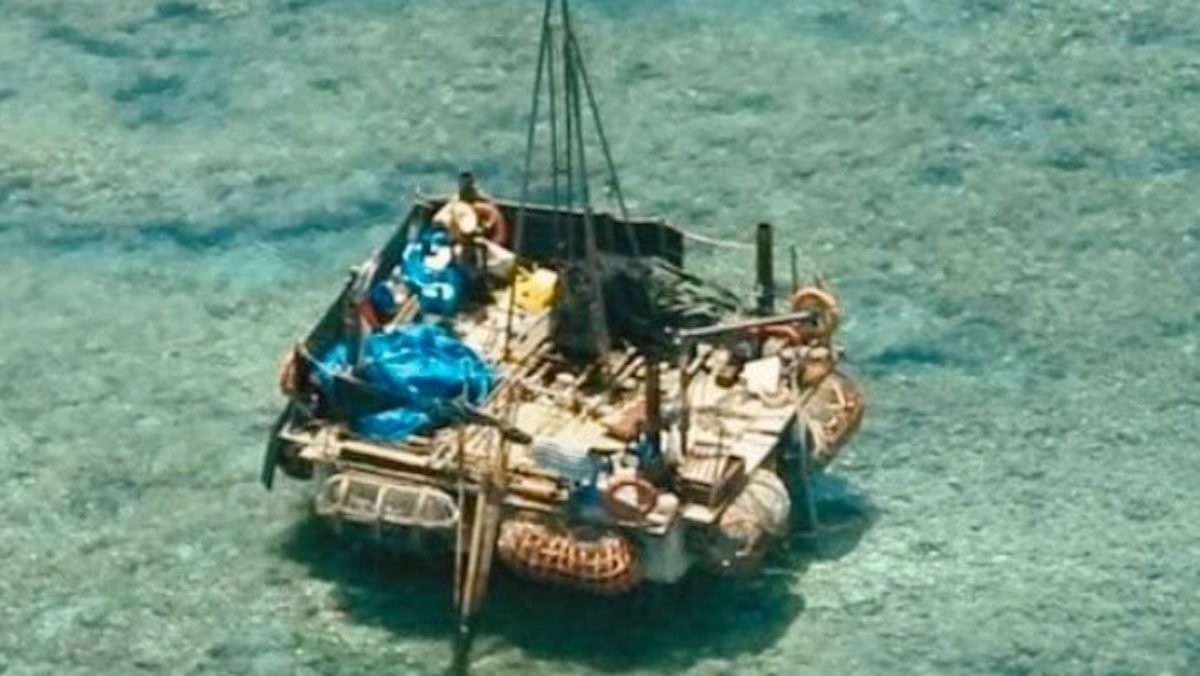
Discovered by Manila in late May and removed by Beijing this month, the rickety structure spanned over 27 square meters, featured an antenna and carried Chinese nationals.
While oceanographers from the state-controlled Chinese Academy of Sciences (CAS) maintained that the platform was a temporary facility for studying coral reefs, maritime analysts and Philippine defense officials warned that it was an incremental “salami-slicing” tactic toward permanent habitation.
Located just 233 kilometers from the Philippine island of Luzon, the highly contested atoll lies within a maritime thoroughfare that carries a quarter of global seaborne trade. China has restricted access to the shoal since a 2012 standoff with the Philippines, rejecting a 2016 ruling by the Permanent Court of Arbitration (PCA) that invalidated its sweeping historical claims.
The platform’s appearance signals an evolving phase of gray zone operations. This escalation threatens to complicate US-China diplomatic relations ahead of Chinese leader Xi Jinping’s planned US visit in September, a delicate period given that the US views any physical land reclamation at Scarborough Shoal as a diplomatic red line.
The salami-slicing strategy aims to advance China’s territorial claims without sparking escalation, using ambiguity between civilian, scientific and military spheres as cover.
China employed such tactics against the Philippines in the 1995 Mischief Reef incident, constructing supposed “fishermen shelters”, which have been long since upgraded into an artificial island hosting a runway, sustainment facilities and weapons systems.
If Scarborough Shoal is turned into a military facility comparable to China’s other major outposts in the South China Sea, it would extend China’s sensing range toward the Philippines and enhance the capacity and redundancy of its naval and air forces in the northern South China Sea.
Emplaced weapons on Scarborough Shoal, such as long-range missiles and drones, would enable China to strike Philippine and US military facilities on Luzon during any future conflict over Taiwan.
Moreover, Scarborough Shoal may also be the final missing piece in China’s plans to turn the South China Sea into a bastion for its underwater nuclear deterrent.
Should China put a permanent physical structure with corresponding defenses on the disputed feature, it would enable the complete triangulation of the South China Sea alongside China’s other outposts in the Paracels and Spratly Islands.
Those static defenses on disputed features, along with maneuver elements from the People’s Liberation Army Navy (PLAN), would serve to defend China’s nuclear ballistic missile submarines (SSBNs), which, when armed with the newer JL-3 submarine-launched ballistic missile (SLBM), could hit the US mainland from their bastion in the South China Sea.
But despite having de facto control of Scarborough Shoal since 2012, China has not yet built any permanent structure on the disputed feature. One possible reason is that the Philippines’ localized anti-access/area-denial (A2/AD) military capabilities may be deterring China from building a permanent structure on the feature.
The Philippines operates several BrahMos supersonic anti-ship missile batteries that could reach Scarborough Shoal from multiple launch points in Luzon. While the Philippines has arguably limited intelligence, surveillance and reconnaissance (ISR) capabilities to fully utilize its maximum range, let alone hit maneuvering PLAN warships with layered defenses, the location of Scarborough Shoal is fixed, making any permanent structure inherently vulnerable.
The Philippines’ internationalization of its South China Sea dispute with China may already be paying dividends for the country’s territorial claims. The Philippines has been diversifying its defense partnerships beyond the US, signing visiting forces agreements (VFAs) with Japan, Australia, New Zealand, Canada, and France.
One possible rationale is to sustain a high tempo of multilateral naval exercises near disputed features such as Scarborough Shoal, with the near-constant presence of more capable partners aside from the US acting as a deterrent against China’s attempts to solidify its control over the feature.
While the Philippines’ BrahMos missile batteries and the internationalization of the South China Sea dispute may keep China from building up its presence on Scarborough Shoal, the Philippines may face the challenge of navigating dual ambiguity from China and the US.
Deliberate strategic ambiguity on the part of China and the US may be one of the preferred ways these great powers use to maintain a tenuous peace between themselves, by avoiding pronouncements, policies or moves that either could deem escalatory.
Within the South China Sea, the US may have prioritized its broader interests by forgoing assistance to the Philippines on multiple instances of maritime standoffs with China.
Incidents illustrating this include its lack of visible assistance during the 2012 Scarborough Shoal standoff that led to China seizing de facto control of the disputed feature, its decision not to enforce the 2016 PCA ruling in favor of the Philippines and being absent during a June 2024 standoff at the Second Thomas Shoal, which resulted in multiple injuries among Philippine Navy personnel.
Additionally, the US could restrain the Philippines from taking actions that might draw it into confrontation with China in the South China Sea.
In a sense, strategic ambiguity preserves stability among great powers, at the expense of small and middle powers’ sovereignty. In the case of the Philippines, China’s gray zone activities and the risk of escalation, combined with inconsistent US commitment, could leave the Philippines with little room to push back against China’s moves at Scarborough Shoal.
While the Philippines may seek to reclaim strategic maneuvering room and hedge against US abandonment by engaging alternative defense partners, they also have to weigh their dependence on China, their capability limitations and immediate priorities against supporting the Philippines on principle under international law.
Japan’s reliance on China for rare earth metals, Australia and New Zealand’s dependence on China as export markets for minerals and agricultural produce, Canada’s strategic partnership with China, France’s lack of permanent basing in the Pacific and the Philippines’ dependence on China as a major trade partner could temper Manila’s expectations of its internationalization strategy in the contested sea.
For now, Philippine deterrence and diplomacy may delay China’s next move at Scarborough Shoal, but strategic ambiguity keeps the Philippines reacting rather than shaping events.