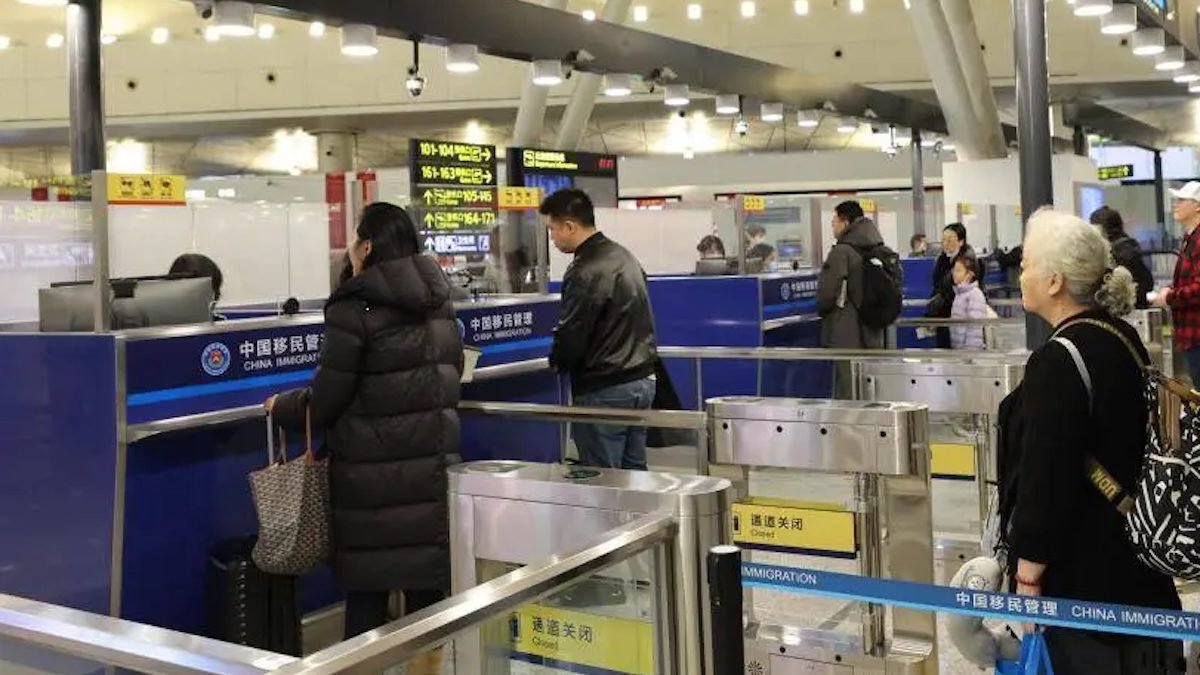
China will tighten its exit-entry rules from September 15 to stop experienced engineers from leaking knowhow in industries subject to export controls and deter tourists from visiting “high-risk” nations such as Japan.
The State Council’s new regulation, which spans 19 articles and was announced on July 31, sets up a coordinated system to warn citizens of overseas risks, verify the purpose of each exit-entry application and tighten restrictions on both citizens and foreigners.
The regulation states that:
- immigration and visa authorities can question applicants and demand documents or data to verify identity and travel purpose, and invitation letter issuers are liable for their authenticity;
- citizens violating export control or technology trade rules or those who may endanger national industrial or technological security will be barred from leaving by commerce departments;
- when processing travel documents and border checks, authorities must remind citizens headed to high-risk countries to travel cautiously, and may discourage travel to destinations under the highest-level warning;
- those committing crimes abroad that harm national security face bans of six months to three years after returning (uthorities barring someone from leaving must notify immigration agencies and inform the person in writing of the facts, reasons and appeal channels, except where it could affect national security or a criminal probe);
- agencies providing exit-entry intermediary services must register with local immigration authorities within 15 days of setup, with staff registered by their employers, and existing agencies must register within 90 days.
The export control clause does not name specific sectors, but Chinese commentators said it targets fields where Beijing has already imposed its own restrictions, including electric vehicle (EV) batteries, solar panels and rare earths.
“There are many situations that could endanger national security and interests, and it is hard to spell out every one of them in legislation,” said Cheng Xiezhong, a legal scholar and professor at the China University of Political Science and Law. “The new regulation names one such situation, which is the violation of export control or technology trade management.”
He says unauthorized exports of dual-use items or transferring key industrial technology abroad will fall under the provision of “causing harm to national security and interests” in Article 12 of the new exit-entry law.
“‘May endanger’ is one of the key phrasings in the regulation,” says a Shandong-based columnist writing under the pen name “Xinghe Duke.”
“It means the authorities won’t wait until harm is done, but they will take precautionary measures. The wording of ‘Decided by the commerce authority and other departments’ means there is a lawful process. ‘Barred from leaving’ does not mean arrest; it just means the targeted person cannot leave the country.”
He says that the State Council’s Regulations on Overseas Investment, which took effect July 1, bars investors from moving export control goods, technology, services or data abroad by sending staff, arranging overseas work, giving technical guidance or running cross-border training. He adds that engineers who have the know-how in core technologies such as electrolyte formulas, N-type solar cell technology and rare earth separation are the main targets.
“In the past, foreign companies dodged China’s export controls by poaching Chinese engineers, offering them higher pay, green cards and equity to help build identical factories in Vietnam, India or Mexico,” he says. “That path is now closed under the new regulation.”
He adds that the United States and Japanese rare earth separation projects in Australia and Texas have relied on Chinese talent to break purity bottlenecks.
When the Trump administration launched the trade war against China and the rest of the world in April 2025, China restricted exports of critical minerals, separation equipment and purification technology against the US. It also did the same to Japan after the country’s Prime Minister Sanae Takaichi made her pro-Taiwan remarks last November.
As the United States, Japan and the European Union build alternative rare earth supply chains in Australia, Brazil and parts of Africa they have leaned on experienced Chinese engineers to get the projects going, in recent months pushing Beijing to crack down harder on talent and data outflows.
Chinese state media reported in June 2025 that many senior executives at state-owned rare earth producers had recently resigned, noting that industry veterans had become prime recruitment targets for foreign forces. Since then, authorities have piloted a set of measures in parts of the country:
- barring such personnel from working at similar overseas companies for three years after they leave their jobs;
- embedding digital watermarks in documents sent from internal company networks, which trigger a red alert if found overseas;
- requiring employees in key posts to report their children’s plans to study abroad to the Communist Party organization in advance;
- requiring family members of core personnel to submit applications well in advance before traveling abroad.
On April 23 this year, the Ministry of State Security disclosed the details of a 2023 case in which a Chinese rare earth company manager surnamed Cheng was jailed for 11.5 years for leaking state secrets to a foreign nonferrous metals firm employee surnamed Ye. The two traveled abroad often, and Cheng pocketed about US$510,000 to cover overseas living costs for his wife and daughter.
Yet according to observers, all these measures fall short. Authorities can only stop someone leaving the country if a criminal investigation is underway, and retirees or people who have resigned face no obligation to explain their travel plans, as long as they are not employed by foreign firms. They say those gaps may be what pushed Beijing to tighten its exit-entry rules.
High-risk countries
Some Chinese legal experts said the new exit-entry regulation is meant to help Chinese travelers avoid either falling into traps set by foreign scam networks or entering war zones in high-risk countries.
“The regulation requires China’s foreign affairs and culture and tourism authorities to promptly issue security alerts and travel risk warnings based on conditions such as war, armed conflict, public safety, natural disasters and disease outbreaks,” said Guo Yongliang, deputy dean and a professor at the School of Foreign-Related Security at the China People’s Police University. “It also requires immigration authorities to warn citizens headed to high-risk countries to travel cautiously and stay alert when they apply for travel documents or go through border checks.”
However, the warning mechanism has sometimes been used by Beijing to apply diplomatic pressure. After Prime Minister Sanae Takaichi delivered her pro-Taiwan remarks in early November last year, China’s Ministry of Foreign Affairs and Ministry of Culture and Tourism advised citizens to avoid traveling to Japan.
In mid-2026, some Chinese travel agencies reportedly planned to resume selling Japan tour packages, but the government quickly stopped them.
According to the Japan National Tourism Organization (JNTO), about 2.06 million mainland Chinese tourists visited Japan in the first half of 2026, down 56.4% from a year earlier. Even so, that works out to an average of 340,000 Chinese visitors a month, most of them independent travelers rather than tour group members.
Some pundits say the new exit-entry regulation will give Beijing more administrative power to discourage Chinese travel to Japan as a way to increase political pressure on Tokyo.
Read: China’s DUV lithography still lags ASML by four generations
Follow Jeff Pao on X at @jeffpao3