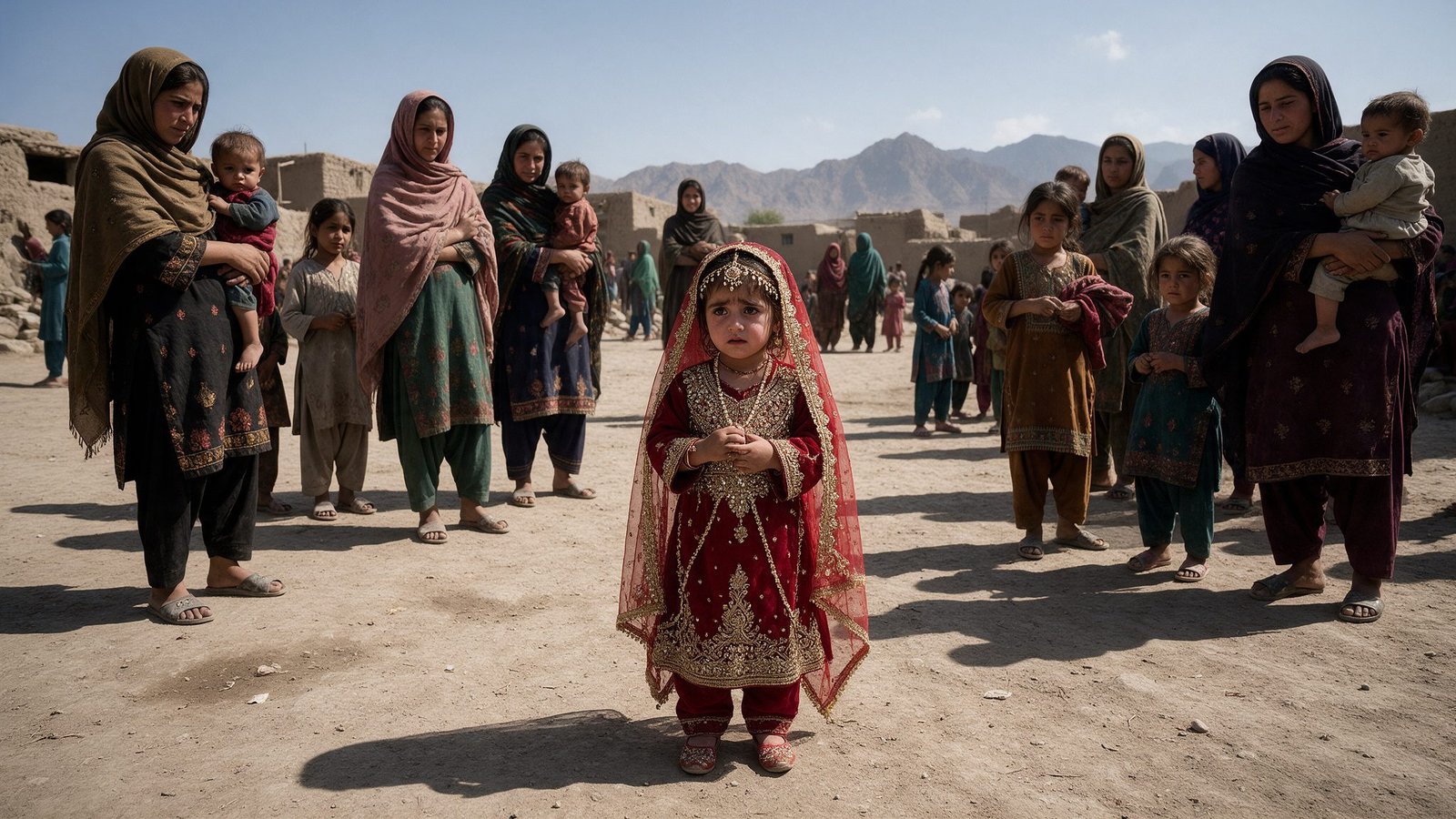
Police arrested the girl’s father and are searching for the 60-year-old man identified as her alleged husband as investigators examine links to the killing of her older sister
[ISLAMABAD] The alleged marriage of a 3-year-old girl to a 60-year-old man for 2.5 million Pakistani rupees, around $9,000, has drawn attention to child marriage and the traditional practice of walwar in Pakistan’s southwestern province of Balochistan.
Police in the border city of Chaman arrested the girl’s father, Abdul Baqi, after the case surfaced on social media. The 60-year-old man, identified as Salah Uddin, remains at large.
Walwar is a Pashto term for money paid by a groom or his family to the family of a bride.
At the time police intervened, the alleged marriage existed only on paper because the full walwar payment had not been made. According to The Media Line’s reporting, once the agreed amount was paid, the arrangement would have taken effect, and the 3-year-old would have been regarded as Salah Uddin’s wife.
That did not necessarily mean she would immediately have begun living with him. But she could have remained bound to the arrangement for years if payment was delayed. If her family later attempted to arrange a different marriage after she reached adulthood, the unresolved agreement could have triggered a serious dispute between the families, potentially including violence.
The case drew widespread attention online, prompting Balochistan Chief Minister Mir Sarfraz Bugti to direct authorities to investigate. Police acted after the allegations became public rather than waiting for a formal complaint from a relative.
Israr Ahmed Umrani, assistant inspector general of Balochistan Police for gender issues, told The Media Line that police arrested the girl’s father after receiving information about the case and were pursuing the man identified as her alleged husband.
Umrani said the investigation was continuing and that authorities firmly opposed child marriage.
Chaman Police Subdivisional Police Officer Abdul Jabbar Khan told The Media Line that “a case had been registered on behalf of the State in connection with the incident. Police are looking for the 60-year-old suspect who absconded.”
Khan said the 3-year-old girl, Babbo, and her mother had been placed under police protection.
Asked how many walwar-related cases were currently registered with his police unit, Khan said this was the only one.
The investigation has also become linked to the killing of the girl’s older sister, Shukria Bibi, about two weeks earlier in Kuchlak, on the outskirts of Quetta.
According to Khan, police allege that Baqi had previously arranged Shukria’s marriage, when she was 13, to Kamran, Salah Uddin’s son, in exchange for a walwar payment of 1.5 million rupees.
Months later, Khan said, Baqi allegedly arranged for his 3-year-old daughter to marry Salah Uddin for 2.5 million rupees. Police say Salah Uddin subsequently demanded that Baqi send his 8-year-old daughter instead.
Khan said a dispute between the families followed, and police were investigating whether it was connected to Shukria’s killing.
Quetta police arrested Shukria’s husband, Kamran, on suspicion of killing her. Police say Kamran told investigators that he became enraged after his wife looked outside through a doorway, then struck her with an iron rod, killing her.
In a Pashto-language interview with a local vlogger before his arrest, Baqi said he had arranged Shukria’s marriage for 1.5 million Pakistani rupees in walwar.
He alleged that she was subjected to violence after the marriage and that her father-in-law, Salah Uddin, repeatedly pressured him to arrange the marriage of another minor daughter.
Baqi said he eventually agreed to marry his 3-year-old daughter to Salah Uddin for 2.5 million rupees, saying poverty and his desire to obtain a home had influenced his decision.
Balochistan law prohibits child marriage. The Balochistan Child Marriages Restraint Act, 2025, sets the minimum marriage age at 18 and makes it a criminal offense for an adult man to enter into a child marriage.
An adult man convicted under the law can face two to three years of rigorous imprisonment and a fine of 100,000 to 200,000 Pakistani rupees. Similar penalties can apply to those who perform, conduct, direct, promote or assist such a marriage.
Police can investigate cases and make arrests without a warrant, and such cases cannot be ended through a private settlement between the parties.
Child marriage remains a substantial problem across Pakistan despite a long-term decline. The Pakistan Demographic and Health Survey for 2017-18, the most recent national survey used for the country’s child-marriage prevalence estimate, found that 18.3% of women ages 20 to 24 had been married by age 18 and 3.6% by age 15. UNICEF’s Child Marriage Data Portal estimates that about 20.5 million girls and women living in Pakistan were married before age 18, including about 5 million who were married before 15.
The figures also show wide differences by geography, wealth and education. UNICEF’s latest available subnational data, from 2018, put the prevalence of marriage before 18 among young women in Balochistan at 21.6%, compared with 18.3% nationally. Across Pakistan, the rate was 21.6% in rural areas and 12.5% in urban areas. It reached 34.1% among the poorest households, compared with 7.3% among the richest, and 33.7% among women with no schooling, compared with 7.5% among those with secondary education or higher.
Yet the existence of laws against child marriage does not mean authorities learn about every case.
There are no reliable province-wide figures showing how widespread walwar remains across Balochistan or how often it involves minors. Interviews conducted for this report indicate that the practice persists mainly in remote, predominantly tribal communities, particularly along or near the Pakistan-Afghanistan border, while becoming less common in cities.
Families may never report such arrangements to police or other state institutions, making the practice difficult to measure.
Enforcement can also run up against a social order in which tribal norms and customary authority strongly influence family decisions. In some remote communities, those traditions can carry greater practical weight in daily life than formal law or religious principles, allowing illegal marriages to be arranged beyond the immediate reach of the state.
Authorities have not publicly specified which provisions of the 2025 law, or any other statutes, have been invoked against Baqi or Salah Uddin.
Critics say walwar becomes especially problematic when the payment is treated primarily as income for the bride’s family, leaving girls with little or no say in marriages arranged on their behalf. They say it can contribute to forced marriages and large age disparities between brides and grooms.
Allauddin Khilji, resident director of the Aurat Foundation in Balochistan, a civil society organization focused on women’s rights and violence against women and girls, said the case appeared to be closely connected to walwar.
Khilji described the practice as a serious problem in tribal society and said disputes surrounding it could contribute to domestic violence and, in some cases, killings.
Balochistan has not enacted legislation specifically prohibiting walwar itself, Khilji said, though child marriages resulting from such arrangements can be prosecuted under the province’s 2025 child marriage law.
He said one obstacle to legislation targeting walwar was the difficulty of challenging deeply rooted tribal traditions and winning support in the provincial assembly, where many members come from influential tribal families.
Khilji cautioned against treating walwar as representative of Pashtun or Baloch culture as a whole, saying the focus should instead be on practices that contribute to coercion, exploitation and child marriage.
Imran Takkar, a child rights activist based in Peshawar, told The Media Line that “such insane marriages” deprive children of fundamental rights to education, protection, recreation and a safe childhood.
Takkar said such cases were not simply social issues but serious child-rights concerns that could violate child-protection laws and Pakistan’s obligations under the UN Convention on the Rights of the Child, which Pakistan ratified in 1990.
He called for nationwide awareness campaigns drawing on religious teachings, Pakistan’s Constitution, existing laws and the country’s international human-rights commitments, as well as better training and coordination among officials and organizations responsible for child protection, justice and accountability.
The practice persists because of widespread poverty, limited income opportunities and unemployment, which can leave families financially dependent on receiving walwar
Hazar Khan Baluch, a Quetta-based political observer, told The Media Line that “the practice persists because of widespread poverty, limited income opportunities and unemployment, which can leave families financially dependent on receiving walwar.”
But Baluch said money was not the only factor.
Social pressure can encourage families to seek such payments, he said, with some fearing criticism or loss of status if they marry their daughters without receiving walwar. In some communities, large payments can also become a source of prestige.
Family authority and customary expectations can reinforce the practice even when financial need is not the sole consideration.
Opposition to walwar exists, Baluch said, and some families that have moved to urban areas have abandoned it. He called for greater access to education and sustained public awareness campaigns to reduce practices that can leave girls vulnerable to coercion and abuse.
The Media Line also spoke with Islamic cleric Hafiz Iqbal Muhammed about whether walwar and the marriage of young girls have a religious basis.
Islamic teachings do not prescribe walwar or any similar bride-price customs, as these practices hold no basis in the core principles governing Islamic marriage
He said that “Islamic teachings do not prescribe walwar or any similar bride-price customs, as these practices hold no basis in the core principles governing Islamic marriage.”
Muhammed said marriage in Islam is based on mutual consent and that cultural customs cannot override rights granted under Islamic teachings.
“Islamic law fundamentally recognizes a woman’s right to consent to marriage and strictly forbids forcing her into a union against her will,” he said.
Muhammed said customs followed in the name of tradition should not be confused with religious requirements.